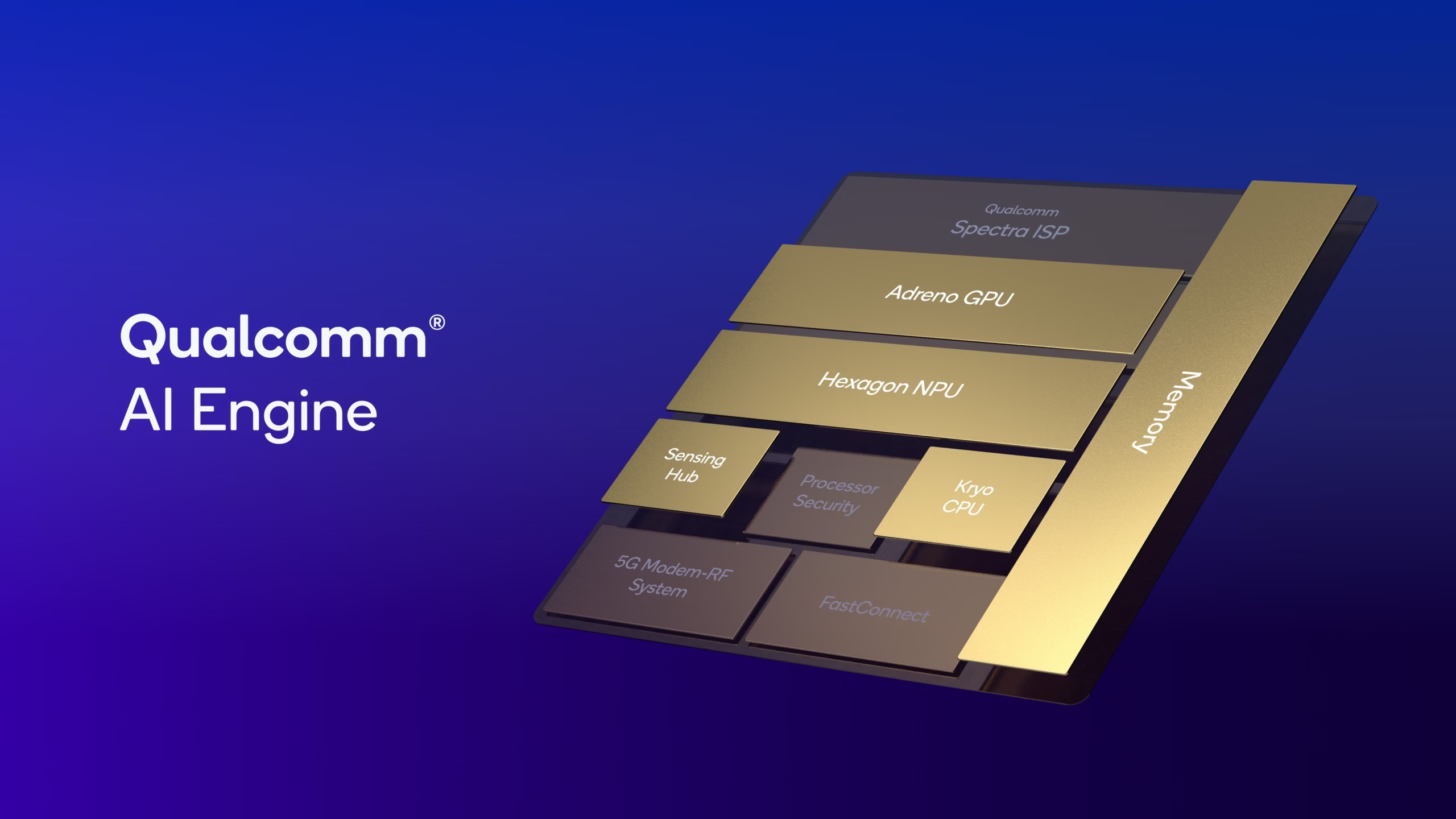
How Smartphone And Tablet GPU Works — In One Simple Flow ( 2025 )
Explore 2025 mobile GPU trends: unified shader architecture, GPU‑centric edge AI, and the impact on AR/VR SDKs. Discover how smartphone‑tablet GPUs shape power efficiency and developer workflows.
How Smartphone‑Tablet GPUs Are Redefining Edge AI and AR in 2025 { "@context": "https://schema.org", "@type": ["Article","NewsArticle"], "headline":"How Smartphone‑Tablet GPUs Are Redefining Edge AI and AR in 2025", "datePublished":"2025-12-07", "author":{"@type":"Person","name":"Riley Chen"}, "publisher":{"@type":"Organization","name":"AI2Work"} } How Smartphone‑Tablet GPUs Are Redefining Edge AI and AR in 2025 By Riley Chen, AI Technology Analyst at AI2Work December 7, 2025 – Executive Insight for Embedded Engineers, Mobile GPU Developers, Product Managers, and Technical Decision‑Makers. Executive Summary The 2025 mobile GPU landscape has moved beyond mere rendering. Smartphone‑tablet GPUs now serve as the central nervous system of every on‑device AI workflow, AR/VR experience, and power‑efficient compute stack . Key shifts include: GPU–SoC integration unites graphics, general compute, and AI inference within a single die, delivering up to 1.8 TFLOPs peak while staying under a 500 mW envelope. The unified shader architecture (UVA) collapses pixel, vertex, and compute pipelines, cutting context‑switch latency by ~30 % and boosting AR frame rates by 18–20 % over 2024. Memory bandwidth now drives performance: Apple’s HBM2e (1.2 TB/s) and Qualcomm’s LPDDR5X power high‑resolution textures and real‑time ray tracing for the first time on mobile. Security and privacy are baked into the driver stack—on‑device AI toggles, confidential compute enclaves, and mandatory use of Vulkan 1.3 / Metal 3 ensure that data never leaves the chip unless explicitly allowed. Business implications: vendors with higher GPU specs (Apple A17, Snapdragon 8 Gen 4) become de‑facto prerequisites for next‑gen AR/VR SDKs; developers must adopt new APIs and profiling tools; enterprises can now justify premium pricing on devices that deliver AI + graphics workloads in a single silicon package. For product managers and embedded engineers, the takeaway is simple: design around GPU‑centric power budgets,
Related Articles
December 2025 Regulatory Roundup - Mac Murray & Shuster LLP
Federal Preemption, State Backlash: How the 2026 Executive Order is Reshaping Enterprise AI Strategy By Jordan Lee – Tech Insight Media, January 12, 2026 The new federal executive order on...

Apollo Backs $5.4 Billion Valor and xAI Data Center Compute Infrastructure Transaction with $3.5 Billion Capital Solution
Explore Apollo’s 2026 AI compute lease‑back deal and its impact on institutional capital allocation, GPU density, renewable power, and ESG compliance.

Dear Abby: ChatGPT has helped me more than my therapist
Discover how secure aggregation, differential privacy, and next‑gen enclave tech are reshaping federated learning in 2026. Get practical guidance on deploying GPT‑4o‑based models with Intel SGX‑R, AMD