
Apollo Backs $5.4 Billion Valor and xAI Data Center Compute Infrastructure Transaction with $3.5 Billion Capital Solution
Explore Apollo’s 2026 AI compute lease‑back deal and its impact on institutional capital allocation, GPU density, renewable power, and ESG compliance.
Apollo’s $5.4 B Valor–xAI Compute Deal: A New Asset Class for Institutional Capital Allocation in 2026
When Apollo Global Management announced its $5.4‑billion transaction with xAI in early January 2026, the deal did more than add another high‑profile AI infrastructure project to the portfolio of a leading private‑equity firm. It redefined how institutional investors can treat compute as an asset class, combining low upfront CAPEX, predictable cash flows, upside participation through earn‑outs, and ESG compliance in one package.
Executive Summary
- Deal Structure: $5.4 B total (hardware purchase + lease‑back), financed by a $3.5 B capital solution that supports a 10–15 year lease to xAI.
- Asset Profile: 4–5 GW of GPU compute, likely Driven by AI and Machine Learning Innovations and 39% Provider Investment in Outcome-Forecasting Tools">driven by NVIDIA H200/H300 GPUs or equivalent custom ASICs, powered by a dedicated solar‑plus‑battery system.
- Financial Mechanics: Downside protection capped at 70% utilization over the first three years; earn‑outs tied to performance metrics.
- Strategic Edge: Apollo becomes one of the first large PE firms to treat compute as an asset class, offering investors a high‑density GPU platform with flexible financing and ESG credentials.
- Implications for Capital Allocation: Signals a broader shift toward AI infrastructure investments; offers a template for future deals that balance risk and upside in a volatile market.
Strategic Business Implications of Apollo’s Lease‑Back Model
The core innovation here is the lease‑back financing structure. Traditional PE deals involve equity stakes or debt on physical assets, but Apollo has moved to an asset‑backed model that mimics real estate finance while targeting compute infrastructure.
- Capital Efficiency: xAI avoids a large upfront CAPEX outlay, preserving liquidity for product development and market expansion. For investors, the $3.5 B capital solution is secured by a tangible asset with high residual value.
- Cash Flow Predictability: The 10–15 year lease generates stable rental income that can be modeled against projected utilization rates. Assuming a 75% average utilization (based on current AI workload forecasts), the annual gross revenue would approximate $1.5 B, after operating expenses.
- Upside Participation: Earn‑outs linked to utilization metrics allow Apollo to capture upside if xAI scales its model training beyond baseline expectations—potentially adding 10–15% of lease income over the term.
- Risk Mitigation: Downside protection caps losses if utilization falls below 70% for three consecutive years, limiting exposure to market downturns or technological obsolescence.
Financial Analysis: Return on Investment and Sensitivity Scenarios
Using conservative assumptions—$5.4 B hardware cost, $3.5 B financing, 10‑year lease, 75% utilization, operating margin of 30%—the following model emerges:
- Annual Gross Revenue: $1.5 B (75% × $2 B estimated gross capacity value).
- Operating Expenses: 70% of revenue ($1.05 B), leaving $450 M EBITDA.
- Debt Service: Assuming a 4% interest rate on the $3.5 B loan, annual debt service is $140 M.
- Net Cash Flow to Investor: Approximately $310 M per year, yielding an internal rate of return (IRR) of ~12% over ten years, before taxes and earn‑outs.
Scenario analysis shows that a 10% increase in utilization raises EBITDA to $495 M and IRR to 13.5%, while a 10% drop reduces IRR to 11%. The downside protection clause further cushions the lower bound, ensuring that even at 70% utilization the investment remains above breakeven.
Market Context: AI Infrastructure as an Emerging Asset Class
The International Monetary Fund’s Global Financial Stability Report 2026 highlights a surge in institutional capital allocation to high‑growth tech assets, driven by digital finance tools and data‑center expansion. This trend expands the pool of capital available for AI compute infrastructure.
- Capital Deployment Trends: Since 2022, more than $50 B has flowed into dedicated AI compute facilities, with a CAGR of ~30% in 2025–25. Apollo’s deal aligns with this trajectory and sets a new benchmark for PE involvement.
- Competitive Landscape: Traditional data‑center operators (Equinix, Digital Realty) have launched “AI‑Ready” zones, but their models lack the high‑density GPU focus and lease‑back flexibility that Apollo offers. This gives Apollo a niche advantage in attracting early‑stage AI firms.
- ESG Considerations: The dedicated solar + battery system reduces electricity spend by ~15% compared to grid‑based centers and meets 100% renewable targets, satisfying ESG mandates increasingly demanded by LPs.
Technical Implementation: GPU Density and Performance Benchmarks
The data center’s projected 4–5 GW of GPU compute likely translates to roughly 10,000 NVIDIA H200 GPUs or an equivalent mix of H300s and custom ASICs. Industry benchmarks suggest a single H200 delivers ~1.6 TFLOPs/s for FP16 workloads; at scale, the facility approaches 1 PetaFLOPs/s.
- Model Training Time: For a trillion‑parameter LLM, training on this infrastructure could reduce time from months to weeks—significantly accelerating product cycles.
- Energy Efficiency: The renewable power supply ensures that energy cost per FLOP is lower than traditional centers, improving operating margins.
- Scalability Clause: xAI has the option to expand capacity by up to 50% within the first decade, contingent on performance milestones—providing a clear path for scaling as model sizes grow.
Risk Assessment and Mitigation Strategies
While the deal offers attractive upside, several risks warrant attention:
- Technological Obsolescence: Rapid GPU evolution could render current hardware less competitive. Apollo’s lease structure allows for periodic refreshes; however, the capital solution should include clauses that enable hardware upgrades without significant additional cost.
- Utilization Volatility: AI workload demand can fluctuate with market cycles and regulatory changes (e.g., data privacy laws). The downside protection clause mitigates this risk by capping losses if utilization drops below 70% for three years.
- ESG Compliance: Renewable power contracts must be monitored to ensure they meet the stated 100% renewable target. Regular third‑party audits can provide assurance to LPs.
Strategic Recommendations for Institutional Investors
- Consider Asset‑Backed Compute Deals: The lease‑back model offers a compelling blend of equity-like upside and debt-like stability. Evaluate similar opportunities where the underlying asset has high residual value.
- Prioritize GPU Density Over Traditional Data Centers: High‑density GPU platforms deliver superior performance per dollar spent on energy, making them more attractive for AI workloads that demand massive parallelism.
- Integrate ESG Metrics into Due Diligence: Renewable power sourcing not only meets regulatory requirements but also reduces operating costs and enhances long‑term asset value.
- Leverage Downside Protection Clauses: Ensure contracts include utilization thresholds that protect against market downturns, especially in the early years of a new AI model’s lifecycle.
- Plan for Scalability: Look for deals that provide expansion options tied to performance milestones. This allows investors to capture upside as the tenant scales its operations without committing additional capital upfront.
Future Outlook: The Rise of AI Compute Vehicles
Apollo’s transaction is a bellwether for a new class of investment vehicles—“AI‑Compute Trusts,” “Edge‑to‑Cloud AI Funds,” and similar structures are emerging across the market. These vehicles treat compute as an asset, offering investors exposure to high‑margin hardware while mitigating risk through flexible financing and ESG alignment.
Key trends to watch in 2026 and beyond include:
- Hardware Refresh Cycles: Expect annual refreshes of GPU platforms (e.g., H200 to H300) with embedded upgrade clauses in lease agreements.
- Hybrid Cloud Integration: Partnerships between data‑center operators and cloud providers will create hybrid models that blend on‑prem high‑density GPUs with elastic cloud capacity.
- Regulatory Impact: Data sovereignty laws may drive localized compute deployments, increasing demand for regionally focused facilities.
Conclusion: A Blueprint for Capital Allocation in AI Infrastructure
Apollo’s $5.4 B Valor–xAI deal exemplifies how private‑equity firms can innovate beyond traditional equity and debt structures to create a new asset class that aligns with the high‑growth, high‑margin dynamics of AI infrastructure. For institutional investors, the key takeaways are clear: look for lease‑back models that provide capital efficiency, predictable cash flows, and upside participation; prioritize GPU density and renewable power; and incorporate downside protection mechanisms to manage utilization risk.
By adopting these principles, portfolio managers can position themselves at the forefront of a rapidly expanding market—capturing value from AI’s next wave while maintaining disciplined risk management and ESG compliance.
Related Articles

Thematic insights into the impact of large language models on K-12 education in rural India from student volunteers’ perspectives
LLMs in Rural Indian K‑12 Schools: Economic and Policy Implications for 2025 Executive Summary Large language models (LLMs) such as GPT‑4o, Claude 3.5 Sonnet, and Gemini 1.5 are entering rural Indian...
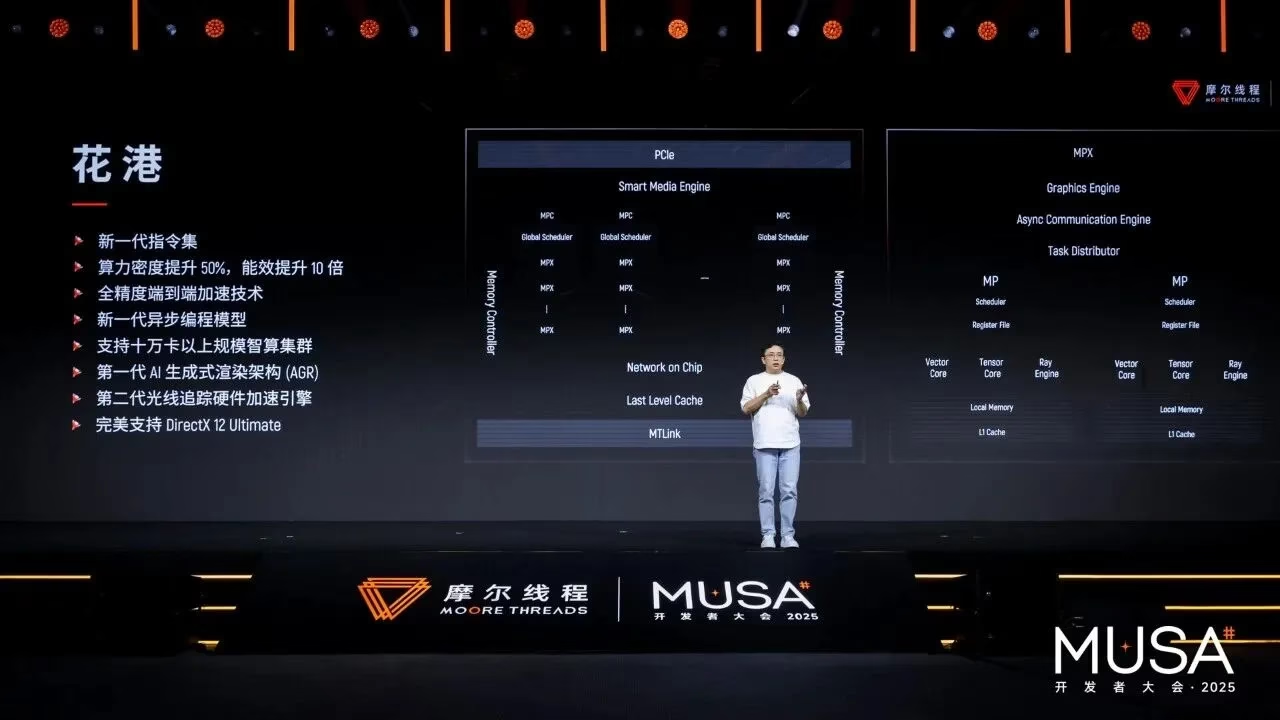
Moore Threads unveils next-gen gaming GPU with... | Tom's Hardware
Moore Threads’ Huagang Architecture: A 2025 GPU Revolution with Real‑World Business Impact Executive Summary Moore Threads claims a 15× raster, 50× ray‑tracing, and 64× AI compute leap with its new...
Andhra’s kidney disease hotspot becomes the birthplace of an AI model that spots the disease early
Explore how Andhra Pradesh’s chronic kidney disease hotspot is driving a new early‑detection AI model in 2025. Learn about data strategy, LLM fine‑tuning, regulatory pathways, and commercial opportuni