Moore Threads unveils next-gen gaming GPU with... | Tom's Hardware
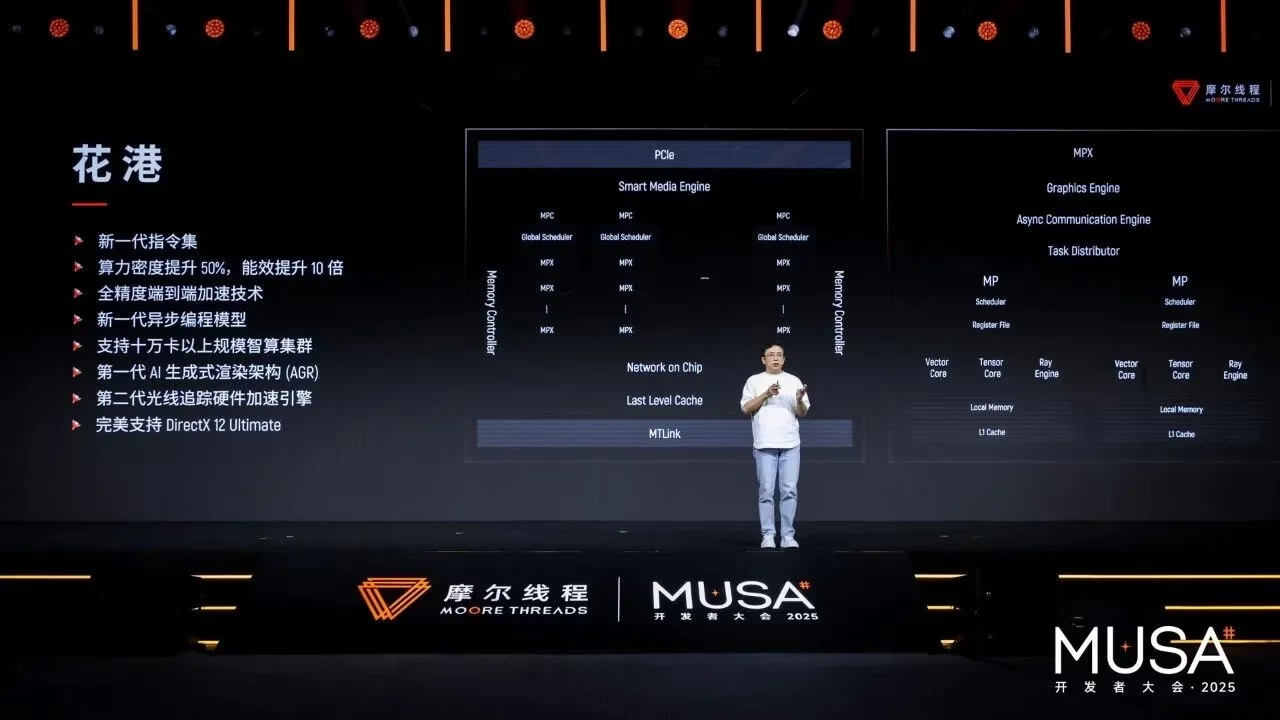
Moore Threads’ Huagang Architecture: A 2025 GPU Revolution with Real‑World Business Impact Executive Summary Moore Threads claims a 15× raster, 50× ray‑tracing, and 64× AI compute leap with its new...
Moore Threads’ Huagang Architecture: A 2025 GPU Revolution with Real‑World Business Impact
Executive Summary
- Moore Threads claims a 15× raster, 50× ray‑tracing, and 64× AI compute leap with its new Huagang line.
- The architecture combines gaming and data‑center workloads on a single silicon family, potentially displacing Nvidia’s mid‑range GPUs and entering the high‑performance AI market.
- Key business takeaways: evaluate performance claims through independent benchmarks, assess supply chain resilience, and consider early adoption for cost‑effective GPU clusters in 2026.
Strategic Business Implications of a Dual‑Purpose GPU
The core promise of Huagang is its ability to serve two distinct markets: consumer gaming and enterprise AI. For business leaders, this means:
- Cost Efficiency : If the 10× energy efficiency materializes, data centers could reduce cooling and power budgets by up to 70% for comparable compute.
- Supply Chain Diversification : MTLink interconnect and dual‑chiplet design lessen reliance on Nvidia’s NVLink or AMD’s Infinity Fabric, aligning with China’s sovereign chip strategy.
- Rapid Time‑to‑Market : A single silicon family can shorten R&D cycles for game studios that also run AI workloads (e.g., procedural content generation).
Technical Implementation Guide: From Specs to Deployment
Below is a step‑by‑step roadmap for organizations looking to evaluate or pilot Huagang GPUs.
- Acquire sample Lushan (gaming) and Huashan (AI) boards once available.
- Run Unreal Engine 6 , Unity 2025 , and DLPerf AI suites to compare against RTX 4060/4070 and A100/Hopper.
- Document performance per watt, memory bandwidth (GDDR6 vs HBM), and driver latency.
- Verify DirectX 12 Ultimate compliance for gaming workloads.
- Check CUDA/ROCm compatibility for AI frameworks; note that UniTE may require vendor‑specific SDKs.
- Ensure driver updates support the new MTLink interconnect for cluster scaling.
- Design a 100,000‑GPU testbed using MTLink to validate scalability and latency.
- Model power draw with the claimed 10× efficiency; calculate projected TCO over a five‑year horizon.
- Assess geopolitical constraints: export controls may limit sales outside China.
- Evaluate component sourcing—SMIC for silicon, in‑house HBM manufacturing—to gauge lead times.
- Evaluate component sourcing—SMIC for silicon, in‑house HBM manufacturing—to gauge lead times.
Market Analysis: Where Huagang Fits in 2025’s GPU Landscape
Moore Threads is positioning itself directly against Nvidia’s Hopper/Blackwell tier. Key comparative points:
Metric
RTX 4060/4070
Lushan (Huagang)
A100/Hopper
Raster Performance
Baseline
15×
Baseline
Ray‑Tracing Throughput
Low
50×
High (Tensor cores)
AI Compute
Moderate (Tensor cores)
64×
Baseline
Memory Capacity
16 GB GDDR6
Up to 64 GB GDDR6
40–80 GB HBM2e
Energy Efficiency
Baseline
10× better
High
Interconnect
NVIDIA NVLink
MTLink
NVIDIA NVLink/InfiniBand
These numbers, if verified, suggest Lushan could replace RTX 4060/4070 in mid‑range PCs, while Huashan may compete with A100/Hopper for training large language models or generative AI workloads.
ROI Projections for Enterprise Adoption
Assuming the claimed efficiencies hold:
- Power Cost Savings : A 10× efficiency improvement translates to a 70% reduction in power usage per FLOP. For a data center running 1,000 GPUs at 300 W each, annual electricity savings could reach $4–5 M.
- TCO Reduction : Lower cooling requirements and reduced hardware density (50% compute density gain) cut rack space by half, lowering real estate costs by up to 30%.
- Accelerated Deployment : Dual‑purpose GPUs mean a single procurement cycle for both gaming and AI needs, saving an estimated $1–2 M in engineering time over three years.
Implementation Challenges & Practical Solutions
While the upside is compelling, several hurdles must be addressed:
- Driver Maturity : Early drivers may lack full support for complex AI pipelines. Solution: Engage with Moore Threads’ SDK team early and contribute feedback.
- Supply Chain Uncertainty : SMIC’s production capacity is still ramping up. Mitigation: Secure multi‑source agreements or consider leasing GPUs from cloud providers that partner with Moore Threads.
- Export Controls : U.S. sanctions could restrict sales to certain regions. Strategy: Focus on domestic or allied markets first, while monitoring policy changes.
Future Outlook and Trend Predictions
The Huagang architecture signals a broader industry shift toward
multi‑purpose GPUs
. Anticipated trends include:
- Unified AI & Gaming Platforms : Game studios will increasingly leverage GPU compute for real‑time AI (e.g., dynamic NPC behavior), blurring the line between entertainment and machine learning.
- Edge AI Acceleration : With 64 GB memory, Huagang GPUs could power edge inference clusters in telecom or autonomous vehicles, reducing latency compared to cloud‑only solutions.
- Energy‑First Design Philosophy : As data centers face rising cooling costs, the industry will prioritize silicon with built‑in energy efficiency—Huagang’s 10× improvement sets a new benchmark.
Actionable Recommendations for Decision Makers
- Select a small subset of workloads (e.g., AI training for NLP models, high‑end gaming demos) to validate performance claims before full deployment.
- Request early access to driver SDKs and participate in beta testing programs to influence feature roadmaps.
- Create a unified GPU acquisition plan that serves both gaming studios and AI research teams, maximizing ROI on each silicon purchase.
- Stay informed about export control changes; consider partnering with local OEMs to mitigate supply chain risks.
- Design cluster architectures that can scale from a few GPUs to 100,000+ using MTLink, ensuring future growth without redesigning infrastructure.
- Design cluster architectures that can scale from a few GPUs to 100,000+ using MTLink, ensuring future growth without redesigning infrastructure.
In summary, Moore Threads’ Huagang architecture offers an ambitious leap in both gaming and AI performance. For business leaders, the key is to balance optimism about its transformative potential with rigorous validation of its unverified claims. By adopting a structured evaluation framework—benchmarking, driver readiness, cluster design, and risk mitigation—organizations can decide whether Huagang represents the next strategic GPU investment for 2026 and beyond.
Related Articles

China just 'months' behind U.S. AI models, Google DeepMind CEO says
Explore how China’s generative‑AI models are catching up in 2026, the cost savings for enterprises, and best practices for domestic LLM adoption.

How the power of AI can revolutionize the financial markets
Explore AI‑driven automation and risk analytics in finance for 2026. Learn how GPT‑4o, Claude 4, and federated learning boost efficiency, cut costs, and drive new revenue streams.

Machine Learning Course for Software Engineers: Interview Kickstart Launches Structured 8-Month ML Program for Career Transition
Interview Kickstart’s New Eight‑Month ML Program: A Strategic Playbook for 2025 Talent Pipelines On December 8, 2025, Interview Kickstart announced an eight‑month machine‑learning (ML) curriculum...