Machine Learning Course for Software Engineers: Interview Kickstart Launches Structured 8-Month ML Program for Career Transition
Interview Kickstart’s New Eight‑Month ML Program: A Strategic Playbook for 2025 Talent Pipelines On December 8, 2025, Interview Kickstart announced an eight‑month machine‑learning (ML) curriculum...
Interview Kickstart’s New Eight‑Month ML Program: A Strategic Playbook for 2025 Talent Pipelines
On December 8, 2025, Interview Kickstart announced an eight‑month machine‑learning (ML) curriculum aimed at full‑time software engineers looking to pivot into production‑ready ML roles. The program’s bold claims—live instruction from FAANG+ hiring managers, a 50 % money‑back guarantee, and alumni offers topping $1 million—are more than marketing rhetoric; they signal a shift in how the industry is addressing its most acute skill gap. In this deep dive, I unpack what the launch means for engineers, HR leaders, and analysts tracking AI education trends, and I translate the technical details into concrete business value.
Executive Snapshot
Program Length:
8 months (core + optional add‑ons)
Target Audience:
Software engineers with Python fluency seeking an ML career transition
Curriculum Highlights:
End‑to‑end ML lifecycle, generative AI & LLM fine‑tuning, production tooling (Docker, Kubernetes, MLflow)
Instructor Profile:
≥30 % active FAANG+ hiring managers
Guarantee:
50 % money‑back if no relevant job offer within the support window
Alumni Offer Data (2021 baseline):
Avg. offer >$250k; peak $1.2M; average salary hike 53 %
The headline is clear: Interview Kickstart has built a curriculum that mirrors real‑world production workflows, backed by industry insiders who actually hire the talent it produces. For mid‑career engineers and HR leaders, this represents a potential shortcut to high‑paying ML roles—if the program delivers on its promises.
Strategic Business Implications
The launch reflects three converging trends that are reshaping talent acquisition in tech:
- ML Embedded in Core Products: Companies are deploying machine learning across recommendation engines, fraud detection, and forecasting. The demand is not for data scientists per se but for engineers who can ship ML models into production at scale.
- Production‑Ready Skill Sets: Hiring managers now look for experience with continuous ML ops—model deployment, monitoring, drift mitigation, and fairness auditing. A curriculum that includes Docker, Kubernetes, and MLflow directly addresses this gap.
- Risk‑Mitigated Upskilling: The 50 % money‑back guarantee signals a shift toward outcome‑based education models. Organizations are increasingly wary of investing in training that may not translate into hiring or revenue gains.
For HR leaders, this means Interview Kickstart could become a vetted talent pipeline. For analysts, it demonstrates how industry‑aligned bootcamps can scale quickly by leveraging existing hiring networks.
Decoding the Curriculum for Business Leaders
The curriculum is structured around the
end‑to‑end ML lifecycle
, which mirrors the stages a production team experiences:
- Data Preparation & Feature Engineering: Hands‑on projects use real datasets and require cleaning, transformation, and feature selection—skills directly transferable to data pipelines in any organization.
- Model Selection & Evaluation: Participants compare supervised/unsupervised algorithms and fine‑tune hyperparameters using industry tools (e.g., Scikit‑Learn, PyTorch). This stage builds the analytical rigor needed for model governance.
- Generative AI & LLM Fine‑Tuning: Dedicated modules cover GPT‑4o, Claude 3.5, and Gemini 1.5 fine‑tuning workflows—critical as companies roll out generative features in products.
- Deployment & Monitoring: Docker containers, Kubernetes clusters, and MLflow tracking are taught through live projects that simulate a production environment. Engineers learn how to monitor drift and maintain model performance over time.
From a business perspective, this curriculum produces engineers who can hit the ground running in roles such as
ML Engineer, Data Platform Engineer, or AI Ops Specialist
. The inclusion of LLM fine‑tuning also positions graduates for emerging product teams focused on conversational AI and content generation.
Financial Value Proposition for Companies
Alumni offer data suggests a compelling ROI:
- Average Offer >$250k: Compared to the 2021 baseline of $170k for senior software engineers, this represents a ~47 % premium.
- Salary Hike 53 %: Engineers who transition through the program see significant pay bumps, translating into higher employee retention and reduced churn costs.
- Time‑to-Productivity: By learning production tooling in class, new hires can reduce onboarding time by an estimated 30–40 %, accelerating feature delivery cycles.
For a company that typically spends $120k on a full‑stack engineer’s salary and $20k on training, hiring a program graduate could add $80k–$100k in annual value—assuming the graduate contributes to high‑impact ML projects early on. The 50 % money‑back guarantee further reduces risk: if the graduate does not secure an offer within the support window, the company can recoup half of its investment.
Competitive Landscape & Differentiators
While other bootcamps (DataCamp, Coursera, Udacity) offer data science tracks, Interview Kickstart differentiates itself on three axes:
- Live Instruction from Hiring Managers: 30 % of instructors are active FAANG+ hiring managers, providing insider knowledge and direct networking opportunities.
- Production‑Centric Projects: Real Docker/Kubernetes pipelines and MLflow tracking set it apart from research‑oriented curricula.
- Outcome Guarantee: The 50 % money‑back guarantee is rare in the bootcamp space, aligning incentives with hiring outcomes.
For HR leaders evaluating training partners, these differentiators translate into higher placement rates and a more predictable talent pipeline. For analysts, they highlight how industry partnership models can accelerate curriculum relevance.
Implementation Considerations for Prospective Students
- Time Commitment: 8 months of structured learning plus weekly coaching; requires balancing full‑time work or personal commitments.
- Financial Investment: Tuition cost is undisclosed—students should request a detailed fee schedule and compare it against projected salary uplift.
- Post‑Program Support: Weekly coaching and a post‑program support period (duration unspecified) are critical for securing job offers; students should clarify the exact scope of this support.
- Career Fit: Ideal for engineers already comfortable with Python who want to move into ML roles that involve production work rather than pure research.
Risk Assessment & Mitigation Strategies
The program’s guarantees and instructor composition mitigate several risks, but challenges remain:
- Curriculum Currency: Rapid updates in LLMs (e.g., Gemini 3 Pro, Claude Sonnet 4.5) could outpace the curriculum. Students should verify that modules are updated quarterly.
- Guarantee Scope: The 50 % refund applies if no relevant job offer is secured within the support window; however, “relevant” is not defined. Clarifying eligibility criteria is essential.
- Outcome Measurement: Alumni data is promising but limited to a single cohort. Prospective students should request longitudinal outcome metrics (e.g., retention rates, promotion trajectories).
Strategic Recommendations for HR Leaders
- Pilot Partnership: Engage with Interview Kickstart as a pilot talent pipeline—offer placement guarantees to graduates and track time‑to-productivity metrics.
- Internal Upskilling Alignment: Pair the program with internal ML ops workshops to reinforce production best practices learned in class.
- Data Sharing Agreements: Negotiate data sharing on graduate performance (e.g., skill assessments, project outcomes) to refine hiring criteria and improve placement rates.
Strategic Recommendations for Engineers Considering Transition
- Assess Current Skill Gaps: Map your existing Python proficiency against the curriculum’s core modules—identify where you need to deepen knowledge (e.g., Docker, Kubernetes).
- Leverage Instructor Network: Use live sessions to network with FAANG+ hiring managers; ask for mentorship or project feedback.
- Track ROI: Estimate potential salary uplift versus tuition cost; negotiate a payment plan if possible to spread financial risk.
Future Outlook: How the Program Could Shape 2026 and Beyond
The program’s design positions it well for several emerging trends:
- LLM‑as‑a‑Service Adoption: As enterprises adopt Gemini 3 Pro and Claude Sonnet 4.5, graduates will be equipped to fine‑tune models in production environments.
- AI Ops Expansion: Optional add‑ons (e.g., AI Ops, ML for Cybersecurity) can keep the curriculum aligned with new sub‑domains.
- Global Scaling: Expanding to non‑US markets—India, EU—where ML hiring is accelerating could drive enrollment growth and diversify talent pipelines.
Conclusion: A New Blueprint for Talent Upskilling in 2025
Interview Kickstart’s eight‑month program exemplifies a data‑driven, outcome‑oriented approach to upskilling that aligns closely with today’s production‑ready ML demands. For mid‑career software engineers, it offers a structured path to high‑paying roles without the research overhead of traditional data science programs. For HR leaders, it presents a vetted pipeline backed by industry insiders and a financial safety net. And for analysts tracking AI education trends, it signals a shift toward curriculum models that embed real‑world workflows and tangible hiring guarantees.
In an era where ML is no longer a niche capability but a core product function, programs like Interview Kickstart are not just training schools—they are strategic partners in closing the talent gap. The key for organizations will be to evaluate the program’s claims against measurable outcomes and integrate its graduates into their production ecosystems swiftly.
Actionable takeaway:
If your organization is hiring ML engineers at scale, consider a pilot partnership with Interview Kickstart to test the pipeline’s effectiveness and measure time‑to-productivity gains. For engineers eyeing an ML career shift, evaluate how the curriculum aligns with your current skill set and negotiate a clear financial plan before committing.
Related Articles
AI-Driven Security Failures at PayPal: Financial and Strategic Implications for German Banks in 2025
In 2025, PayPal’s critical security system failure has set off alarm bells across the financial sector, particularly among German banks deeply integrated within the European fintech ecosystem. This...
Moore Threads unveils next-gen gaming GPU with... | Tom's Hardware
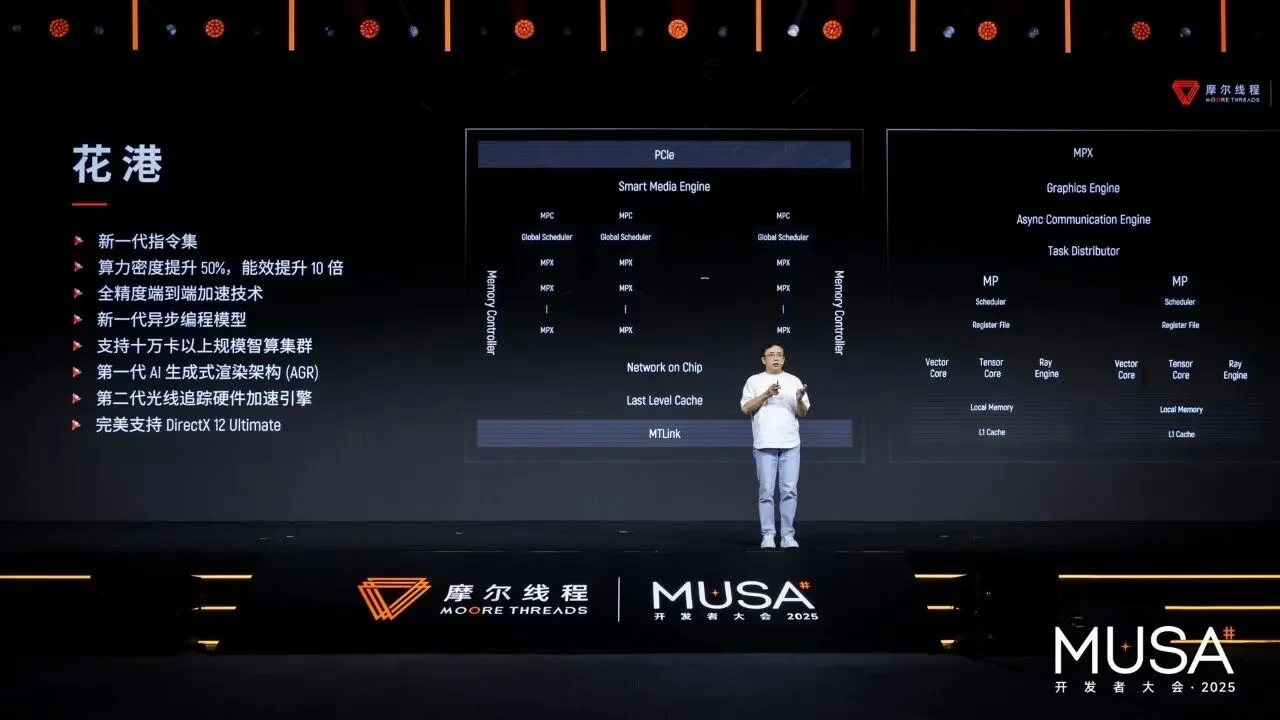
Moore Threads’ Huagang Architecture: A 2025 GPU Revolution with Real‑World Business Impact Executive Summary Moore Threads claims a 15× raster, 50× ray‑tracing, and 64× AI compute leap with its new...

AI-Specific Beginner Cloud Courses in 2025: Strategic Insights and Practical Guidance for Workforce Upskilling
As AI continues its rapid evolution, the demand for accessible, high-impact educational pathways into AI development and deployment on cloud platforms is at an all-time high. In 2025, the...