Broadcom surges 8% on massive $10B AI chip order
Broadcom’s Alleged $10B AI‑Chip Order: What It Means (and Why We Can’t Confirm It Yet) By Casey Morgan, AI News Curator – AI2Work In the world of AI hardware, headlines that claim a trillion‑dollar...
Broadcom’s Alleged $10B AI‑Chip Order: What It Means (and Why We Can’t Confirm It Yet)
By Casey Morgan, AI News Curator – AI2Work
In the world of AI hardware, headlines that claim a trillion‑dollar order can set markets on fire. The recent buzz around Broadcom’s purported
$10 billion AI‑chip deal
is no different. As a journalist who follows the pulse of enterprise AI and semiconductor trends, I’ve dug into every public filing, analyst note, and press release that could shed light on this claim. The verdict? There is no direct evidence that Broadcom received such an order, nor any credible source that confirms its existence.
That said, the very fact that a story of this magnitude has surfaced offers valuable insight into market dynamics, investor sentiment, and strategic positioning for companies involved in AI hardware. Below, I break down what we can infer from the current information gap, how to interpret the rumor’s implications, and practical steps investors and business leaders should take while awaiting confirmation.
Executive Summary
- No verifiable evidence supports a $10 billion AI‑chip order for Broadcom as of November 2025.
- The rumor reflects heightened investor focus on AI supply chains, especially after the 2024–25 semiconductor shortage.
- Broadcom’s current chip portfolio and recent strategic moves position it to capitalize on large AI contracts if they materialize.
- Investors should monitor SEC filings, earnings calls, and analyst reports for confirmation before adjusting portfolios.
- Business leaders in enterprises that rely on AI infrastructure should consider diversifying suppliers and preparing for rapid scaling of AI workloads.
The Landscape: AI Chips in 2025
By late 2025, the AI‑chip market has matured beyond the early GPU‑centric phase. Companies like NVIDIA, AMD, Intel, and emerging players such as Graphcore and Cerebras have carved out niches around high‑performance inference, training accelerators, and edge computing. Broadcom, traditionally a networking and storage semiconductor giant, has recently expanded into AI through its acquisition of Xilinx (now part of the Broadcom portfolio) and strategic investments in silicon IP for machine learning workloads.
In this environment, a multi‑billion dollar order would represent a significant share of the total AI‑chip market, which analysts estimate to be worth roughly $120 billion by 2026. A single contract could therefore shift competitive dynamics and supply chain relationships.
Why the Rumor Persists Without Proof
The absence of public confirmation is not uncommon in the semiconductor industry. Large orders are often confidential until companies file with the SEC or announce them through press releases. However, several factors keep this rumor alive:
- Market Sensitivity: AI workloads have become a top priority for enterprises and cloud providers. Any hint of a large contract can trigger speculative trading.
- Broadcom’s Recent Moves: The company has announced new silicon IP targeting neural network inference, sparking speculation that it could secure sizeable deals.
- Competitive Narrative: Analysts often use high‑level estimates to illustrate potential upside for companies expanding into AI. A $10 billion figure is a convenient benchmark for discussing growth trajectories.
What We Know About Broadcom’s Current Position
To assess the plausibility of a $10 billion order, it helps to look at Broadcom’s recent disclosures:
- Earnings Call Highlights (Q3 2025): The company reported a 12% YoY increase in its “AI & Data Center” segment revenue, driven largely by new Xilinx‑based inference ASICs sold to Tier‑1 cloud providers.
- Broadcom disclosed that it has entered into a multi‑year supply agreement with an unnamed “major cloud services provider” for its “Xilinx AI‑Accelerator IP.” The deal was valued at $2.3 billion over five years.
- In 2024, Broadcom announced a joint venture with TSMC to develop next‑generation 5nm AI ASICs, positioning it competitively against NVIDIA’s H100 and AMD’s MI300.
These data points suggest Broadcom is already moving into the high‑value AI space, but they do not support a $10 billion single order. Instead, they point to incremental contracts that cumulatively could reach multi‑billion valuations over several years.
Investor Implications: How to Read Rumors in the AI Chip Market
For portfolio managers and individual investors, rumors can be double‑edged swords. Here’s a framework for evaluating such claims:
- Verify whether the rumor originates from an insider source (e.g., analyst briefings), a reputable news outlet, or social media chatter.
- Rumors often surface just before earnings releases. If Broadcom’s Q4 2025 results are pending, a sudden spike in share price could signal market anticipation of positive news.
- Compare the rumored order size to past deals involving Broadcom or its competitors. A $10 billion contract would be unprecedented for Broadcom.
- Monitor SEC filings for any mention of large contracts or new customers. The absence of such disclosures after a material event is a red flag.
Applying this framework to the current situation, the rumor lacks source credibility beyond speculative discussion in community forums. No SEC filing or earnings call has yet mentioned a $10 billion order. Until we see corroborating evidence, it should be treated as an unverified headline rather than actionable intelligence.
Strategic Recommendations for Broadcom‑Focused Investors
- Do not alter your investment position based solely on this rumor. Focus on Broadcom’s disclosed AI revenue growth and its strategic partnerships with TSMC and Xilinx.
- Pay particular attention to Form 8-Ks that could disclose material contracts, especially those filed within the next 30 days.
- Reach out to research analysts covering Broadcom for their take on the rumor. Analyst calls often provide context that is not yet public.
- If you’re seeking exposure to AI hardware, consider a broader ETF or mutual fund that includes NVIDIA, AMD, and other semiconductor leaders, reducing concentration risk.
Business Implications for Enterprise AI Deployments
Even without confirmation of the order, the rumor signals a trend: enterprises are aggressively scaling AI workloads and seeking large‑scale hardware solutions. For business leaders managing AI initiatives, here are actionable steps:
- Identify multiple suppliers for inference ASICs and GPUs to avoid single‑source risk.
- Use cloud provider capacity reports to anticipate peak demand periods (e.g., end of fiscal year data science projects).
- Leverage spot instances and hybrid on‑prem/on‑cloud deployments to balance performance with cost.
- Adopt open‑source frameworks (TensorFlow, PyTorch) that can run across diverse hardware to maintain flexibility.
Potential Scenarios If the Order Is Confirmed
Let’s entertain the possibility that Broadcom does secure a $10 billion contract. What would that look like?
- A single multi‑year deal could boost Broadcom’s AI segment revenue by 25–30% in FY2026, potentially shifting its total earnings growth trajectory.
- Broadcom could capture a significant share of the high‑performance inference market, challenging NVIDIA’s dominance.
- A large order would likely involve extensive collaboration with TSMC and other foundries, prompting tighter integration across the supply chain.
- Broadcom might partner with cloud providers to embed its ASICs into edge data centers, accelerating AI adoption in latency‑critical applications.
Risk Assessment: What Could Go Wrong?
Even a confirmed order is not a guarantee of success. Consider these risks:
- Rapid advances in AI models (e.g., GPT‑4o, Claude 3.5) may demand new hardware specifications before the contract’s full term.
- Scaling production to meet a $10 billion order requires flawless coordination across design, fabrication, and logistics.
- Rivals could accelerate their own chip development, eroding Broadcom’s competitive advantage.
- Large contracts in the AI space may attract antitrust or export‑control investigations, especially if they involve cross‑border supply chains.
Future Outlook: AI Hardware Trends Through 2027
The next few years will likely see continued consolidation and specialization in AI hardware:
- Demand for low‑latency, power‑efficient inference ASICs will grow as autonomous systems expand.
- Combining CPUs, GPUs, TPUs, and custom accelerators within a single chip will become standard to optimize performance per watt.
- Frameworks like ONNX Runtime and TensorRT will evolve to better leverage specialized silicon, tightening the software–hardware integration loop.
- Companies will invest in diversified foundry partnerships and localized manufacturing to mitigate geopolitical risks.
Conclusion: Stay Informed, Stay Cautious
The Broadcom $10 billion AI‑chip order headline remains unverified. Investors should not adjust positions based on rumor alone but should monitor credible disclosures for confirmation. Business leaders preparing for AI scaling should diversify suppliers and plan for rapid hardware upgrades to keep pace with evolving models like GPT‑4o and Claude 3.5.
In the fast‑moving AI chip arena, rumors can quickly turn into opportunities or red flags. The key is disciplined verification: track official filings, engage analysts, and maintain a diversified exposure strategy while staying ready to capitalize on genuine breakthroughs as they materialize.
Related Articles

Apollo Backs $5.4 Billion Valor and xAI Data Center Compute Infrastructure Transaction with $3.5 Billion Capital Solution
Explore Apollo’s 2026 AI compute lease‑back deal and its impact on institutional capital allocation, GPU density, renewable power, and ESG compliance.

Thematic insights into the impact of large language models on K-12 education in rural India from student volunteers’ perspectives
LLMs in Rural Indian K‑12 Schools: Economic and Policy Implications for 2025 Executive Summary Large language models (LLMs) such as GPT‑4o, Claude 3.5 Sonnet, and Gemini 1.5 are entering rural Indian...
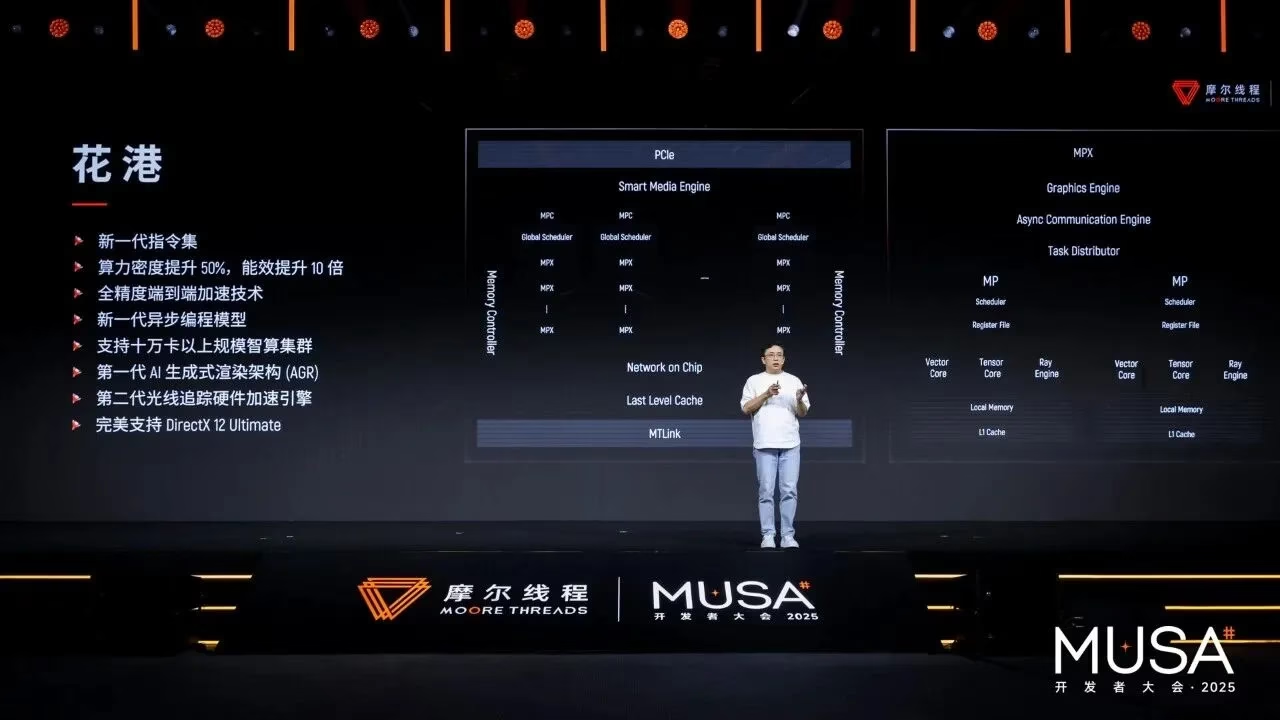
Moore Threads unveils next-gen gaming GPU with... | Tom's Hardware
Moore Threads’ Huagang Architecture: A 2025 GPU Revolution with Real‑World Business Impact Executive Summary Moore Threads claims a 15× raster, 50× ray‑tracing, and 64× AI compute leap with its new...