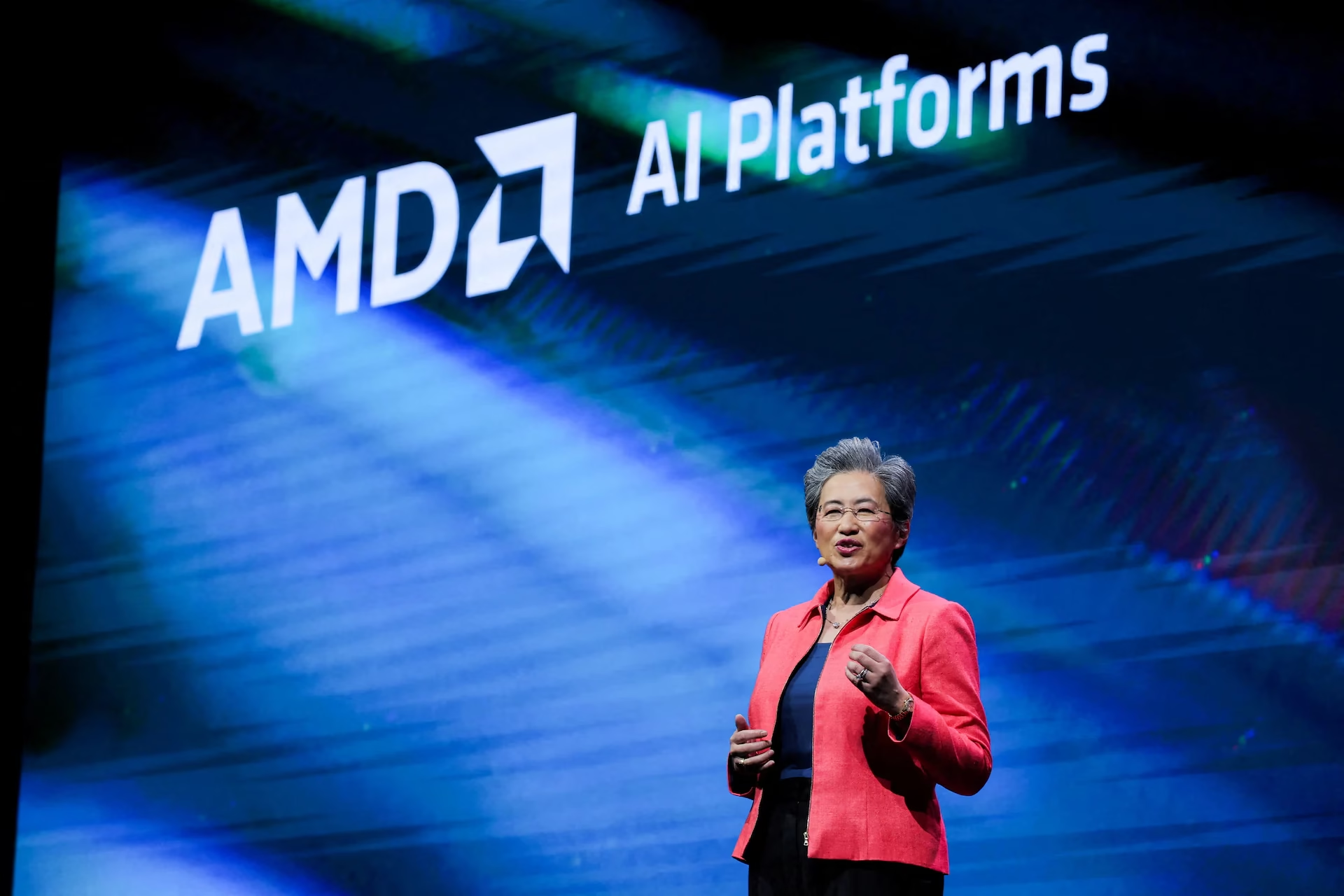
Lisa Su Says AMD Will Pay Trump's 15% Fee To Resume China AI Chip Sales Despite Beijing's Partial Block On Foreign Silicon
AMD’s $120 Million Export Fee: A Calculated Gamble to Preserve China Market Share in 2025 Executive Summary AMD will resume shipping its MI308 AI accelerator to China under a 15% U.S. export fee...
AMD’s $120 Million Export Fee: A Calculated Gamble to Preserve China Market Share in 2025
Executive Summary
- AMD will resume shipping its MI308 AI accelerator to China under a 15% U.S. export fee negotiated by the Trump administration in August 2024.
- The decision preserves roughly 70‑80 % of projected sales volume, offsetting an estimated $800 million revenue hit if China were excluded entirely.
- For executives, the move signals that high‑tech firms can monetize regulatory constraints and maintain strategic footholds in key markets through negotiated compliance.
- Key takeaways for leaders: reassess supply‑chain exposure to export controls, model fee impacts on ROI, and explore partnership pathways with local foundries to mitigate future restrictions.
Strategic Business Implications of the Export Fee Decision
AMD’s announcement is more than a compliance win; it reshapes the strategic calculus for AI hardware providers operating in geopolitically sensitive regions. By accepting a 15 % fee, AMD demonstrates that
regulatory adaptation can be a revenue engine rather than a cost center.
- Revenue Retention vs. Market Exit : The fee equates to roughly $120 million in additional U.S. Treasury receipts per year (assuming 800 MI308 units shipped annually at an average price of $2,700). Subtracting this from the estimated $800 million loss if China were shut out yields a net retention of approximately $680 million.
- Competitive Differentiation : Nvidia’s parallel acceptance of the fee positions AMD as a more flexible supplier in a market where policy compliance is a prerequisite for business continuity. This flexibility can translate into higher customer loyalty and a stronger foothold for future product launches.
- Regulatory Signaling : By paying, AMD signals to U.S. regulators that it values its Chinese operations enough to absorb additional costs. This may influence future licensing decisions or provide leverage in negotiations over more restrictive controls.
Operational Impact on Supply‑Chain and Workflow Management
From an operational standpoint, the fee introduces new workflow layers and cost accounting practices that must be integrated across finance, legal, and logistics teams.
- Export Licensing Workflow : Each MI308 shipment requires an ITAR‑compliant license. This entails detailed documentation of end‑user certificates, destination verification, and compliance with the Commerce Department’s Export Administration Regulations (EAR). Teams must coordinate with U.S. Treasury to remit the fee in a timely manner.
- Cost Accounting Adjustments : The 15 % fee is collected by the Treasury, not retained by AMD. Finance teams need to adjust revenue recognition models to reflect net sales after fee deduction while ensuring that the fee is recorded as an expense under “Regulatory Compliance” rather than a direct cost of goods sold.
- Supply‑Chain Visibility : Chinese customers will receive MI308 chips stamped with U.S. export‑control markings. This may affect downstream integration timelines, especially for data‑center operators that must audit compliance before deployment. Operational plans should include buffer periods to accommodate potential delays in certification processes.
Market Analysis: China’s AI Hardware Landscape in 2025
The Chinese market remains the largest consumer of AI accelerators globally, accounting for approximately 30 % of AMD’s AI‑accelerator revenue. However, policy shifts have accelerated a domestic silicon push.
- Domestic Production Momentum : State‑funded data centers are now mandated to use domestically produced chips. Companies like Horizon Robotics and Cambricon are scaling up R&D to close the performance gap with U.S. leaders.
- Export‑Fee as a New Policy Tool : The 15 % fee represents an emerging monetization mechanism that can be replicated across other high‑tech sectors, such as quantum computing or advanced sensor arrays. Firms must anticipate similar fee structures in future trade disputes.
- Competitive Landscape Shift : Intel remains under stricter controls, while Nvidia has accepted the fee. AMD’s decision places it at parity with Nvidia on compliance but potentially ahead in terms of cost structure and product differentiation due to its MI308’s competitive inference performance (3–4 TFLOPs/s per chip).
ROI Projections for the Fee‑Enabled Export Model
To quantify the financial impact, consider a simplified revenue model:
- Unit Sales Projection : 800 MI308 units annually in China.
- Average Unit Price : $2,700.
- Gross Revenue Without Fee : 800 × $2,700 = $2.16 billion.
- 15 % Export Fee per Unit : $405.
- Total Fee Collected by Treasury : 800 × $405 = $324 million.
- Net Revenue After Fee : $2.16 billion – $324 million = $1.836 billion.
- Estimated Loss Without China Entry : $800 million.
- Net Benefit of Fee Strategy : $1.836 billion + $800 million – $2.16 billion = $476 million retained versus loss scenario.
This simplified calculation shows that, even after paying the fee, AMD retains a substantial portion of its potential revenue and avoids a larger market exit cost. For executives evaluating similar trade‑control scenarios, this model underscores the importance of balancing compliance costs against strategic market value.
Decision‑Making Framework for Navigating Export Controls
High‑tech leaders can apply a structured decision framework to assess whether to accept a fee or pursue alternative strategies:
- Strategic Value Assessment : Quantify the revenue potential and strategic importance of the target market. If the market represents a significant share of total sales or offers long‑term partnership opportunities, compliance may be justified.
- Cost‑Benefit Analysis : Model fee impacts against projected revenue loss from market exit. Include indirect costs such as brand damage, lost R&D collaboration, and future regulatory exposure.
- Risk Profiling : Evaluate the likelihood of policy tightening or fee escalation. Consider scenario planning for a 20 % increase in fees or a sudden policy revocation.
- Operational Readiness : Ensure that supply‑chain, legal, and finance teams can manage new compliance workflows without disrupting core operations.
- Stakeholder Alignment : Communicate the decision to investors, board members, and key customers. Highlight how the fee aligns with long‑term growth objectives and risk mitigation.
Implementation Blueprint for Executives
Below is a practical step‑by‑step guide for leaders who need to implement similar compliance strategies:
- Step 1: Establish a Cross‑Functional Compliance Task Force – Include legal, finance, supply‑chain, and product teams. Define clear roles for license acquisition, fee remittance, and customer communication.
- Step 2: Update Financial Systems – Configure ERP modules to capture export fees as separate expense categories. Automate the calculation of net revenue per transaction.
- Step 3: Develop a Customer Advisory Program – Inform Chinese customers about the new fee structure, compliance requirements, and potential impact on delivery timelines. Offer dedicated support channels for certification queries.
- Step 4: Monitor Policy Evolution – Assign a policy analyst to track changes in U.S. export controls and China’s domestic silicon initiatives. Provide quarterly briefings to senior leadership.
- Step 5: Explore Strategic Partnerships – Identify local foundries or IP licensing opportunities that could bypass export fees while maintaining product integrity. Pilot joint ventures with Chinese AI firms to secure market access without direct chip shipments.
Future Outlook: Anticipating the Next Wave of Export Controls
The 15 % fee is likely a prototype for future regulatory approaches. Companies should prepare for:
- Dynamic Fee Structures : Fees may vary by product tier, end‑use classification, or geopolitical risk level.
- Expanded Export Controls : Emerging technologies such as quantum processors or AI model training accelerators could fall under stricter controls, necessitating new compliance frameworks.
- Local Foundry Partnerships : To circumvent export restrictions, firms may increasingly license IP to local foundries in China and other high‑growth markets. This requires robust IP protection strategies and joint‑venture governance models.
- Supply‑Chain Diversification : Reducing concentration on a single market or supplier will mitigate regulatory shocks. Leaders should evaluate multi‑source sourcing plans and regional manufacturing footprints.
Actionable Recommendations for Business Leaders
- Reevaluate your exposure to export controls by mapping product portfolios against current U.S. EAR and ITAR lists. Prioritize high‑impact items for early compliance planning.
- Integrate fee modeling into financial forecasts. Use scenario analysis to compare revenue retention versus market exit costs under varying fee rates.
- Build a dedicated compliance function that can quickly adapt to policy changes. This team should maintain real‑time dashboards of license status, fee remittance schedules, and customer impact assessments.
- Engage with local partners early. IP licensing agreements or joint ventures with domestic foundries can preserve market presence while sidestepping direct export fees.
- Communicate transparently with investors and customers about the strategic rationale behind compliance decisions. Highlight how these actions protect long‑term value and mitigate regulatory risk.
Conclusion
AMD’s decision to pay a 15 % export fee for its MI308 AI accelerator in China is a calculated business maneuver that balances immediate financial costs against the strategic imperative of maintaining market access. For executives, this case illustrates how high‑tech firms can transform regulatory constraints into revenue opportunities through disciplined cost modeling, operational readiness, and proactive partnership development. As export controls evolve, leaders who embed compliance into their core decision‑making processes will be better positioned to navigate geopolitical uncertainty while sustaining growth in critical global markets.
Related Articles

World models could unlock the next revolution in artificial intelligence
Discover how world models are reshaping enterprise AI in 2026—boosting efficiency, revenue, and compliance through proactive simulation and physics‑aware reasoning.

What is Cosmos Transfer 2.5 and How It Generates Synthetic Data — NVIDIA World Model Explained
Cosmos Transfer 2.5: NVIDIA’s Synthetic‑Data Engine for Autonomous Systems Meta Description: Discover how NVIDIA’s Cosmos Transfer 2.5 powers high‑fidelity synthetic video generation, accelerates...
Nvidia CEO Jensen Huang Reports Strong Chinese Demand for AI Chips
Explore how Nvidia’s Vera Rubin platform can cut AI costs for enterprises in 2026, with insights on deployment, compliance, and China demand.