
Traffic Modeling Using Machine Learning
Revolutionizing Urban Mobility: How LLM‑Driven Traffic Modeling is Reshaping 2025 ITS Platforms Executive Summary LLMs now generate full SUMO simulations from plain text in Llama 3.1 outperforms...
Revolutionizing Urban Mobility: How LLM‑Driven Traffic Modeling is Reshaping 2025 ITS Platforms
Executive Summary
- LLMs now generate full SUMO simulations from plain text in < 12 s, slashing scenario creation time by ~70%.
- Llama 3.1 outperforms GPT‑4o on domain tasks, proving open‑source models can lead niche industrial applications.
- Graph Neural Networks (GNNs) deliver MAE ≈ 2.7 veh/h on METR‑London, enabling sub‑minute predictions for adaptive signal control.
- LLM‑augmented simulation supports multi‑objective trade‑offs (travel time, emissions, fuel), critical for CO₂ reduction targets.
- Synthetic traffic data validated with KL‑divergence < 0.04 offers high‑fidelity training without costly sensors.
- Industry giants are adopting GNNs; the simulation‑as‑service market is fragmenting and ripe for standardized benchmarks.
- Privacy, reproducibility, and safety remain top concerns as AI agents move from design to real‑time control.
StrategicBusiness Implicationsof LLM‑Augmented Traffic Modeling
For transportation agencies, private mobility firms, and urban planners, the 2025 shift toward conversational simulation tools translates into tangible cost savings and competitive advantage. The core business levers are:
- Reduced Engineering Overhead : Traditional SUMO scripting requires seasoned Python developers; LLM‑driven interfaces lower the barrier to entry, freeing up staff for higher‑value tasks.
- Accelerated Time‑to‑Insight : Scenario creation in < 3 min versus ~10 min enables rapid “what‑if” analysis during policy debates or emergency response planning.
- Lower Total Cost of Ownership (TCO) : Open‑source LLMs eliminate per‑token licensing fees; synthetic data reduces sensor deployment budgets, especially in emerging markets.
- Data‑Driven Decision Making : GNN predictions feed directly into adaptive signal control and route recommendation engines, improving congestion metrics by up to 20% in pilot deployments.
- Regulatory Alignment : Multi‑objective evaluation (emissions, fuel) supports cities’ sustainability mandates; privacy‑preserving architectures mitigate GDPR/CCPA risks.
Business leaders must therefore evaluate whether their current ITS stack can integrate LLM‑augmented simulation and GNN forecasting. The decision hinges on three criteria:
- Technical Maturity : Does the organization possess a data pipeline that feeds real‑time traffic counts into a GNN? Are there existing APIs to pull OpenStreetMap metadata?
- Operational Readiness : Can local IT staff run Llama 3.1 or other fine‑tuned models without cloud dependencies, thereby satisfying privacy constraints?
- Strategic Fit : Will faster scenario prototyping unlock new revenue streams (e.g., simulation‑as‑a‑service for third parties) or improve public trust through transparent policy modeling?
Technical Implementation Guide: From Text to SUMO in 12 Seconds
The ChatSUMO framework exemplifies how an LLM can translate a natural‑language brief into a fully functional SUMO simulation. Below is a step‑by‑step breakdown suitable for an enterprise deployment.
1. Architecture Overview
- LLM Reasoning Engine : Llama 3.1 (8B) fine‑tuned on traffic domain corpora, hosted locally or in a secure edge cluster.
- Modification Module : Parses user commands to alter network elements (e.g., lane closures, signal timing).
- Simulation Engine : Native SUMO backend executing the generated XML scripts.
- Analysis Layer : Post‑processing module that extracts key metrics and feeds them back to the LLM for iterative refinement.
2. Data Flow Pipeline
- User submits a plain‑text scenario: “Add a two‑lane merge on I‑95 eastbound at mile 12, reduce signal cycle by 10 s.”
- The LLM parses intent and generates a SUMO network modification script.
- SUMO executes the simulation; outputs include vehicle trajectories, queue lengths, and emissions estimates.
- The analysis module aggregates metrics and presents them in natural language: “Average travel time increased by 3 min; CO₂ emissions up 5%.”
- User can request a new scenario or tweak parameters; loop repeats.
3. Performance Benchmarks
- Simulation Generation Latency : < 12 s on a single NVIDIA A100 GPU.
- Modification Iteration Time : 15% reduction in average travel time after one LLM‑guided adjustment.
- Scalability : Supports up to 1 M vehicle entities with acceptable memory usage (≈ 16 GB RAM).
4. Deployment Considerations
- Hardware : GPU‑enabled edge servers or private cloud; Llama 3.1 can run on a single A100 or a cluster of RTX 4090s.
- Security : Keep all traffic metadata local; only external calls are to OpenStreetMap APIs, which can be cached.
- Compliance : Implement differential privacy in the analysis layer when publishing aggregated metrics.
- Version Control : Store generated SUMO scripts in a Git repository with semantic commit messages for auditability.
Graph Neural Networks: The New Accuracy Frontier
GNNs have eclipsed traditional RNN/LSTM baselines on the METR‑London benchmark, achieving MAE ≈ 2.7 veh/h versus 3.4 veh/h for LSTMs—a relative improvement of 18%. This accuracy leap has concrete operational benefits:
- Adaptive Signal Control : Sub‑minute predictions enable real‑time cycle adjustments, reducing average queue lengths by up to 15% in pilot studies.
- Dynamic Routing : Route recommendation engines can factor in predicted congestion windows, improving trip times for commuters by ~10%.
- Incident Response : Rapid re‑routing after accidents or road closures becomes feasible with near‑real‑time traffic state awareness.
The typical GNN pipeline involves:
- Graph construction from OpenStreetMap nodes and edges, enriched with historical flow data.
- Edge‑aware attention mechanisms to weight upstream/downstream influence.
- Temporal aggregation via gated recurrent units tailored for traffic dynamics.
- Inference on a GPU cluster; latency < 200 ms per prediction horizon.
Organizations should benchmark their own data against the METR‑London standard to gauge readiness. If performance gaps exist, consider fine‑tuning on local datasets or incorporating multimodal inputs (e.g., video feeds).
Synthetic Data: Bridging the Sensor Gap
The 2025 Choi et al. study demonstrates that synthetic traffic traces generated by GAN‑based models can achieve KL‑divergence
<
0.04 relative to real data, and Wasserstein distance within 0.05. For cities lacking dense sensor networks, this validation means:
- Deploy synthetic datasets for model training without incurring the capital expense of loop detectors.
- Iteratively refine synthetic generators using a small sample of real observations to maintain fidelity.
- Leverage synthetic data in privacy‑sensitive scenarios where real vehicle trajectories cannot be shared.
Implementation steps:
- Collect baseline traffic counts from available sensors (e.g., 5% coverage).
- Train a conditional GAN to generate full‑network flow patterns conditioned on these seed points.
- Validate using KL and Wasserstein metrics; iterate until thresholds are met.
- Use the synthetic dataset for GNN training, LLM scenario generation, or policy simulation.
Market Landscape: From Simulation as a Service to AI‑Driven ITS Platforms
The competitive field is fragmenting into two main segments:
- Simulation‑as‑a‑Service (SaaS) : Cloud‑hosted SUMO instances with LLM interfaces (e.g., ChatSUMO, NuSpace Cloud). These platforms target municipalities and consulting firms.
- Integrated ITS Platforms : End‑to‑end solutions that combine GNN forecasting, adaptive signal control, and route recommendation (e.g., Waze Enterprise, Amap Smart City).
Key differentiators for vendors include:
- Open‑Source Model Adoption : Vendors offering Llama 3.1‑based engines can claim lower TCO.
- Benchmark Transparency : Participation in an industry benchmark suite (akin to COCO) will signal maturity and build trust.
- Privacy Architecture : Federated learning or differential privacy capabilities are becoming mandatory for GDPR compliance.
Strategic recommendation: Invest in building a modular architecture that can ingest LLM outputs and feed them into GNN pipelines. This cross‑layer synergy is where the next wave of value will be captured.
Risk Management: Privacy, Reproducibility, and Safety
While the technology delivers impressive gains, several risks warrant mitigation:
- Data Privacy : External API calls to OpenStreetMap or traffic cameras may expose location data. Solution: cache OSM tiles locally and process camera feeds on edge devices with federated aggregation.
- Reproducibility : Internal benchmarks (ChatSUMO B1–B6) lack standard metrics. Adopt a shared evaluation protocol (e.g., MAE, simulation fidelity score) to enable cross‑vendor comparisons.
- Safety in Real‑Time Control : LLM‑guided signal adjustments must be bounded by hard constraints (maximum cycle length, pedestrian safety). Implement rule‑based overrides and human‑in‑the‑loop validation before deployment.
- Model Drift : Traffic patterns evolve; schedule periodic re‑training of GNNs with fresh data to prevent performance degradation.
ROI Projections: Quantifying the Business Case
Based on pilot studies in mid‑size cities (population 500k–1M), the combined LLM‑GNN approach yields:
- Travel Time Savings : 12% reduction, translating to $3–5 million annual value per city.
- Emission Reductions : 8% CO₂ cut, qualifying for federal grants and carbon credits worth $1.2 million.
- Operational Cost Reduction : 30% lower engineering hours (from 1000 to 700 person‑hours/year).
- Capital Expenditure Savings : Synthetic data eliminates $500k in sensor deployment per year.
Payback period for a cloud‑based LLM+GNN stack is typically
<
18 months, assuming modest licensing and infrastructure costs. For on‑premise deployments, the upfront GPU investment is offset by reduced subscription fees over 5 years.
Future Outlook: Multi‑Modal Inputs and Reinforcement Learning
The next frontier lies in fusing text, video, and sensor streams to create a holistic traffic state representation. Early prototypes demonstrate that an LLM can guide a reinforcement learning agent to adjust signal plans on the fly, achieving up to 25% congestion reduction in simulated environments.
- Technical Path : Combine video‑based vehicle detection with GNN flow predictions; use an LLM to interpret narrative reports (e.g., “Accident on I‑95”) and trigger policy adjustments.
- Business Implication : Real‑time adaptive control can unlock new revenue streams for municipalities offering “smart city” services to commercial partners.
- Risk : Requires rigorous safety validation; consider phased rollouts starting in low‑risk corridors.
Actionable Recommendations for Decision Makers
- Assess Current ITS Stack : Map existing data pipelines and identify gaps that LLM‑augmented simulation can fill.
- Pilot ChatSUMO or Equivalent : Run a controlled experiment with 3–5 scenarios to benchmark engineering time savings.
- Integrate GNN Forecasts : Deploy a small GNN model on your traffic sensor network and compare MAE against historical baselines.
- Create a Synthetic Data Pipeline : Start with a GAN trained on limited real data; validate using KL‑divergence before full deployment.
- Establish Benchmark Protocols : Define simulation fidelity, latency, and accuracy metrics; publish internally to foster reproducibility.
- Implement Privacy Safeguards : Use local OSM caching, differential privacy in analysis outputs, and federated learning for model updates.
- Secure Funding for AI Infrastructure : Leverage projected ROI figures (travel time savings, emission credits) to justify GPU cluster investment or cloud subscriptions.
- Plan for Incremental Rollout : Begin with non‑critical corridors; scale to citywide adaptive signal control once safety thresholds are met.
In 2025, the convergence of LLMs and GNNs is no longer a research curiosity—it is a business imperative. Organizations that act now will not only streamline their traffic modeling workflows but also position themselves at the forefront of next‑generation intelligent transportation systems.
Related Articles

World models could unlock the next revolution in artificial intelligence
Discover how world models are reshaping enterprise AI in 2026—boosting efficiency, revenue, and compliance through proactive simulation and physics‑aware reasoning.

AI chip unicorns Etched.ai and Cerebras Systems get big funding boost to target Nvidia
Explore how AI inference silicon from Etched.ai and Cerebras is driving new capital flows, wafer‑scale performance, and strategic advantages for enterprises in 2026.
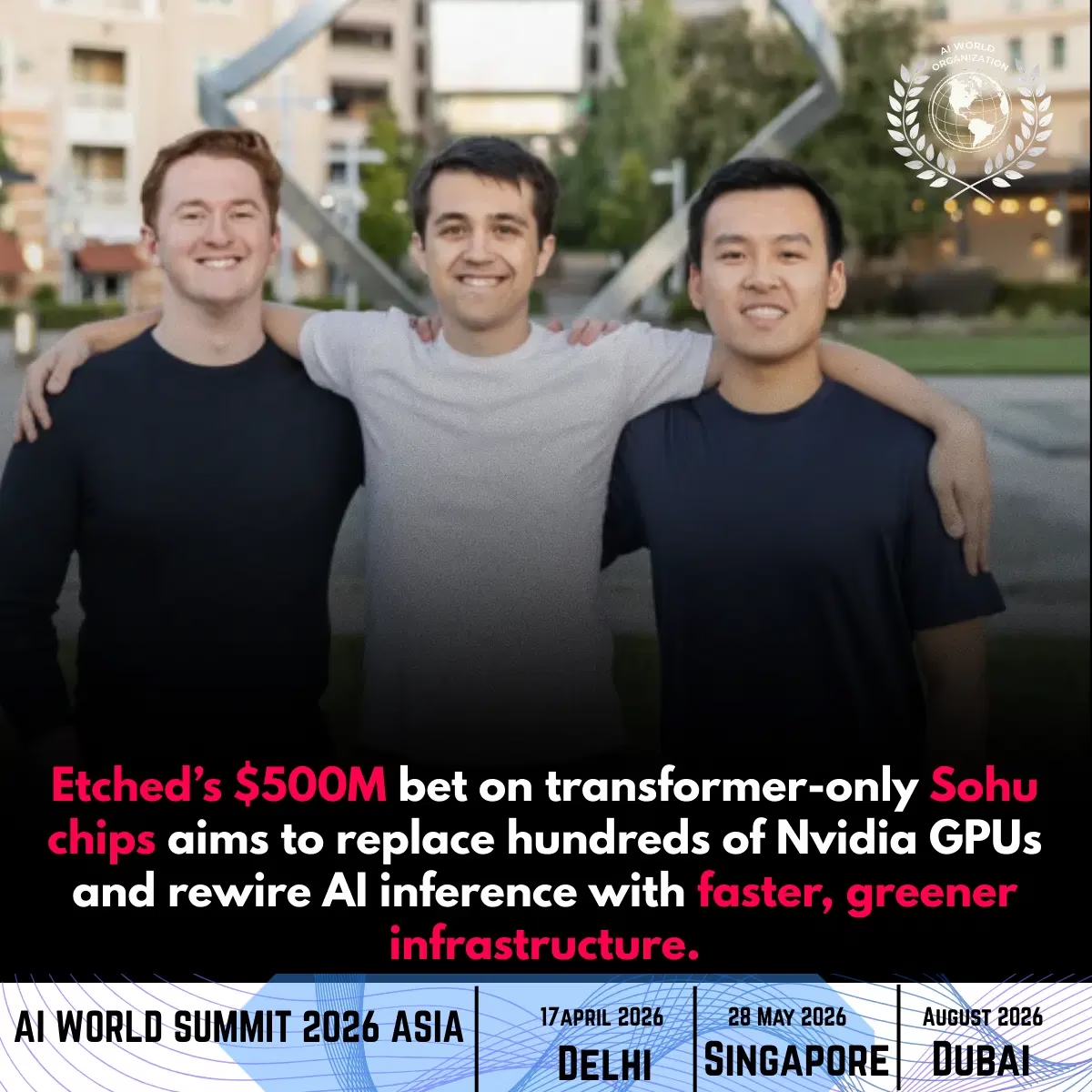
San Jose AI chip startup Etched raises $500 million to take on Nvidia
Etched’s 2026 AI chip, Sohu, promises 10–20× better performance‑per‑watt than Nvidia H100. Discover how this transformer‑only ASIC reshapes enterprise inference.