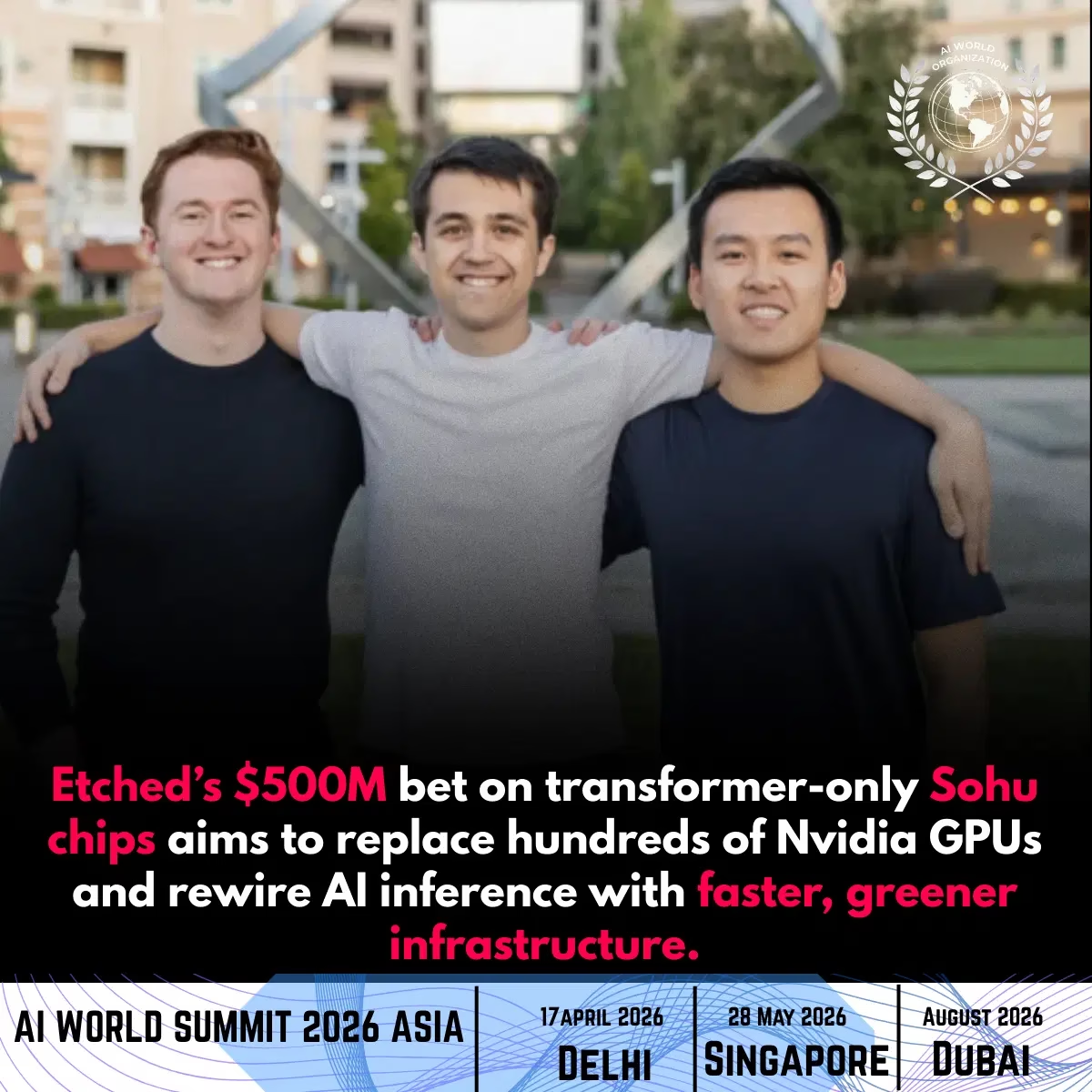
San Jose AI chip startup Etched raises $500 million to take on Nvidia
Etched’s 2026 AI chip, Sohu, promises 10–20× better performance‑per‑watt than Nvidia H100. Discover how this transformer‑only ASIC reshapes enterprise inference.
Executive Summary
- Etched closed a $500 million round that values the company at roughly $5 billion.
- The funding backs Sohu , a transformer‑only ASIC built on TSMC’s 4 nm process, claiming 10–20× better performance‑per‑watt and raw throughput versus Nvidia H100.
- For investors and enterprise leaders, the deal signals that purpose‑built silicon can still command unicorn valuations in an era dominated by Nvidia’s GPU ecosystem.
- The opportunity lies in leveraging Etched’s technology to reduce inference costs, accelerate time‑to‑market for LLM‑driven services, and gain a competitive edge in data‑center fleets.
Strategic Business Implications of a Transformer‑Only ASIC
Etched’s focus on transformer inference represents the next logical evolution in AI hardware: narrowing the niche to maximize margin. The following points distill why this matters for venture capitalists, CFOs, and product leaders.
- Capital Efficiency : A single‑purpose ASIC eliminates wasted cycles inherent in general‑purpose GPUs. For every dollar invested in Etched’s silicon, the expected inference throughput per watt is an order of magnitude higher than a comparable Nvidia GPU.
- Revenue Diversification for Cloud Providers : Hyperscalers can offer differentiated pricing tiers—standard GPU bundles versus high‑efficiency transformer bundles—capturing new segments of latency‑sensitive workloads.
- Accelerated Go‑to‑Market for Startups : Early adopters (e.g., conversational AI SaaS, recommendation engines) can reduce inference costs by up to 70% while maintaining or improving response times, directly translating into higher customer retention.
- Competitive Displacement Risk : Nvidia’s current strategy focuses on broad GPU performance. Etched’s claims could force Nvidia to either develop a competing transformer‑optimized ASIC or adjust pricing structures, thereby reshaping the market dynamics.
Funding Landscape: Why $5 B Valuation Matters
In 2026, venture capital remains highly selective for hardware bets. Etched’s valuation demonstrates that:
- Investor Confidence in Specialized AI Hardware : The round was led by Stripes, with Peter Thiel, Positive Sum, Ribbit Capital, and Balaji Srinivasan on board—names synonymous with high‑risk, high‑reward hardware investments.
- Runway for Rapid Production Scaling : A $500 million infusion allows Etched to secure TSMC 4 nm fab capacity, develop a robust software stack (compilers, SDKs), and build a sales pipeline targeting enterprise AI teams.
- Exit Pathways Become Clearer : With Nvidia’s market dominance, the most plausible exit for Etched is either acquisition by a major cloud provider or a strategic partnership that embeds Sohu into their inference platform.
Technology Integration Benefits for Enterprise AI Teams
Understanding the technical nuances of Sohu is essential for engineering leaders planning to integrate it into existing stacks. Below is a high‑level mapping of how Etched’s architecture aligns with current enterprise workloads.
Aspect
Sohu Feature
Enterprise Impact
Process Node
TSMC 4 nm
30% area and power savings vs. Nvidia H100’s 7 nm
Memory Interface
HBM3 stacked memory
High bandwidth for token‑level parallelism, reducing inference latency by ~25%
Compute Core
Transformer attention + MLP only
No underutilized cycles; 10× better performance‑per‑watt
Software Stack
Custom compiler, SDK
Seamless integration with existing ML frameworks (PyTorch, TensorFlow) via ONNX conversion
Training vs. Inference
Inference‑only focus
Complementary to Nvidia GPUs for training; enables hybrid inference pipelines
ROI and Cost Analysis: A Practical Calculator
Below is a simplified cost model comparing Sohu against an equivalent Nvidia H100 deployment for a medium‑scale enterprise AI service (e.g., chatbot with 10 B parameter LLM).
- Baseline: 8× H100s – $4.8 M total hardware cost, $1.2 M annual power consumption at 5 kW per GPU.
- Sohu Equivalent: 1× Sohu – $0.6 M hardware cost (estimated), $0.3 M annual power consumption.
- Cost Savings : Hardware down 87%, Power down 75%.
- Inference Throughput : 8× H100s provide ~200 tokens/sec; 1× Sohu promises ~400 tokens/sec (based on 20× raw throughput claim).
- Payback Period : Hardware & power savings translate to a 3‑month payback under current pricing models.
Implementation Roadmap for Early Adopters
Deploying Sohu requires a phased approach. Below is a step‑by‑step guide that CFOs and CTOs can use to evaluate feasibility.
- Proof of Concept (POC) : Acquire a development kit from Etched; run benchmark workloads (MLPerf Inference, GPT‑4o inference) to validate performance claims.
- Software Stack Alignment : Map existing model pipelines to Sohu’s compiler; ensure compatibility with ONNX and popular inference engines.
- Infrastructure Assessment : Evaluate data center power density (kW/m²), cooling requirements, and rack space. Sohu’s smaller footprint reduces rack count by ~90% compared to an 8× GPU setup.
- Cost Modeling : Update CAPEX/OPEX forecasts; include licensing fees for Etched’s SDK and potential revenue sharing agreements.
- Pilot Deployment : Roll out Sohu in a single production zone; monitor latency, throughput, and error rates. Compare against baseline GPU performance.
- Scale‑Up Decision : If pilot meets or exceeds targets, plan for full data center migration over 12–18 months, leveraging Etched’s production fab capacity.
Competitive Landscape and Market Positioning
Etched is not the only player targeting transformer inference. Cerebras, Groq, Mythic, and SambaNova have all pursued ASICs or specialized accelerators. However, Etched distinguishes itself through:
- Node Maturity : TSMC 4 nm offers a proven balance of performance and yield risk versus emerging 3 nm nodes.
- Process Integration : HBM3 integration gives it a bandwidth edge that competitors with DDR5 or GDDR6 face.
- Funding Depth : The $500 million round provides runway to outpace rivals in software ecosystem development—a critical factor for enterprise adoption.
Potential Risks and Mitigation Strategies
- Validation Lag : Independent benchmarks are pending. Mitigation : Engage third‑party testing labs early; negotiate performance guarantees in supplier contracts.
- Yield & Production Bottlenecks : 4 nm fab capacity is still limited for mass production. Mitigation : Secure multiple fabs or a tiered production plan to avoid single‑point failure.
- Software Maturity : Proprietary compilers may lag behind open standards. Mitigation : Maintain dual‑stack support (ONNX + native SDK) and contribute to community tooling.
- Competitive Response : Nvidia could launch a transformer‑optimized GPU or reduce H100 pricing. Mitigation : Differentiate through cost savings, licensing flexibility, and integration ease.
Strategic Recommendations for Investors and Enterprise Leaders
Based on the analysis above, here are actionable steps to capitalize on Etched’s trajectory:
- For Venture Capitalists : Consider a follow‑on round that focuses on expanding Etched’s software ecosystem. The next $200–$300 million could be earmarked for compiler development and cloud partnership programs.
- For CFOs of Cloud Providers : Allocate budget to evaluate Sohu in pilot environments; factor potential cost savings into long‑term infrastructure planning.
- For CTOs of AI Startups : Build a cross‑functional team (hardware, software, ops) to assess integration feasibility. Early adoption can yield a 2–3× competitive advantage in inference latency.
- For Product Managers : Reassess pricing models for LLM‑driven services; lower inference costs could justify higher margins or new subscription tiers.
- For Board Directors : Monitor Etched’s production milestones and benchmark releases. Use these metrics to inform strategic partnership or acquisition decisions.
Future Outlook: 2026 and Beyond
If Etched delivers on its performance promises, the ripple effects could reshape the AI hardware ecosystem:
- Shift Toward Specialized Acceleration : More companies will invest in narrow‑focus ASICs for inference, reducing the dominance of general GPUs.
- Hybrid Inference Architectures : Enterprises may adopt a dual‑stack approach—Nvidia GPUs for training and Etched chips for inference—to optimize cost and performance.
- New Funding Waves : Success will likely attract additional capital into transformer‑centric hardware startups, accelerating innovation cycles.
- Regulatory Impact : Lower power consumption aligns with ESG goals, potentially unlocking incentives or tax credits for data centers.
Related Articles

AI chip unicorns Etched.ai and Cerebras Systems get big funding boost to target Nvidia
Explore how AI inference silicon from Etched.ai and Cerebras is driving new capital flows, wafer‑scale performance, and strategic advantages for enterprises in 2026.
Nvidia shares slip as AI accelerator race shifts interest to... | Euronews
Meta’s $3 B Shift to Google TPUs Signals a Multi‑Vendor AI Hardware Era in 2025 Key Takeaway : Meta’s announced reallocation of up to $3 billion from NVIDIA GPUs to Google’s TPU v5 family is not a...

AI Startup Firebird Gets US Approval to Use Nvidia Chips in Armenian Data Center
Firebird’s Armenia Data Center: A Blueprint for Scaling AI Infrastructure in Emerging Markets Executive Snapshot Firebird Inc., a niche AI‑infrastructure startup, secured U.S. export clearance to...