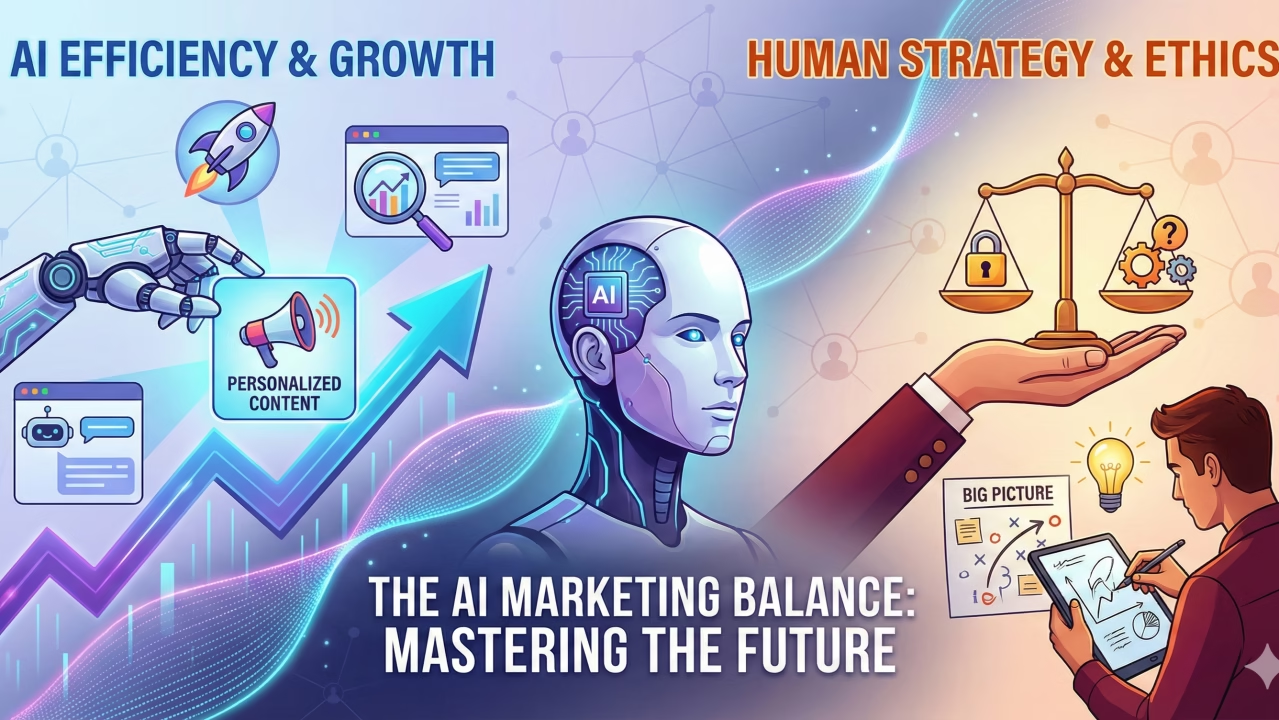
The Impact of ChatGPT and Artificial Intelligence on Marketing | EMEA Entrepreneur
Generative AI Is Now a Revenue Engine: What 2025 Marketers Must Do Executive Summary AI‑driven holiday sales hit $263 billion , accounting for 21 % of all orders. Shoppers referred by generative...
Generative AI Is Now a Revenue Engine: What 2025 Marketers Must Do
Executive Summary
- AI‑driven holiday sales hit $263 billion , accounting for 21 % of all orders.
- Shoppers referred by generative chatbots convert 30 % faster and spend 14 % more time on site.
- ChatGPT Atlas’s “Agent Mode” turns conversational search into instant checkout, eliminating cart abandonment.
- Brands that rank high in AI conversations capture up to 8 % more market share during peak seasons.
- Creative output is now >70 % generated by tools like Adobe Firefly and Canva Studio, cutting cost per asset by 40‑60 %.
For senior marketing leaders, the takeaway is simple:
AI is no longer an efficiency add‑on; it’s a strategic differentiator that directly drives revenue and reshapes consumer expectations.
Strategic Business Implications of AI‑First Marketing in 2025
In 2024, many brands treated generative AI as a productivity tool—automating copy, generating social posts, or drafting email blasts. By the end of 2025, the data tells a different story: AI has moved into the sales funnel, becoming a revenue‑generating partner.
- Revenue Attribution : 21 % of holiday orders originate from AI chatbots, and each transaction sees an average conversion lift of +30 %. With an estimated $263 billion in online holiday sales, this translates to roughly $55 billion attributable to generative assistants.
- Cost‑to‑Serve Reduction : AI reduces friction in the checkout funnel by up to 15 %, lowering customer acquisition cost (CAC) and increasing average order value (AOV).
- Budget Reallocation : Brands are moving 2–3 % of their e‑commerce spend into transaction‑fee models with OpenAI’s instant checkout, while cutting traditional search ad spend by up to 18 % in favor of chatbot partnership fees.
- Competitive Advantage : Walmart and Target have already invested heavily in AI visibility. Early adopters that secure top spots in conversational search capture an estimated 8 % more market share during peak periods.
Technology Integration Benefits: From Prompt Engineering to Low‑Latency APIs
The operational shift required to unlock these benefits is non‑trivial. A senior marketer must understand the technical levers that translate into business value.
- Low‑Latency API Coupling : Real‑time AI assistants demand inventory, pricing, and payment data feeds with ≤200 ms latency. This is a prerequisite for seamless instant checkout experiences.
- Prompt Continuity Management : Generative models can hallucinate product specs or pricing. Continuous prompt refinement—supported by human oversight—ensures factual accuracy, preserving brand credibility.
- Privacy‑First Design : Claude 3.5 Sonnet’s built‑in privacy controls align with GDPR and CCPA requirements, reducing compliance risk in data‑heavy interactions.
- Cross‑Model Flexibility : While GPT‑4o leads in conversational fidelity, Gemini 1.5 excels in multilingual contexts—essential for global brands. An architecture that supports multiple LLMs mitigates vendor lock‑in and optimizes performance per market segment.
Operational Impact: Redefining Creative Workflows
The creative arm of marketing is undergoing a paradigm shift. With >70 % of branding initiatives now generated by AI, the cost structure and talent needs are evolving.
- Asset Velocity : Content production time drops from weeks to days. This speed allows brands to test hypotheses faster and iterate on messaging in near real‑time.
- Cost Reduction : Per‑asset costs fall by 40‑60 %, freeing budget for high‑impact channels such as experiential marketing or influencer partnerships.
- Upskilling Imperative : Prompt engineering becomes a core competency. Teams must invest in training to craft effective prompts that align with brand voice and regulatory constraints.
- Quality Assurance Loop : Human review remains essential. A hybrid model—AI generates drafts, humans refine—delivers both speed and quality.
Consumer Trust and Experience: Balancing Novelty with Reliability
Mixed sentiment toward AI shopping is a real challenge. While some consumers find the experience fun, others view it as unreliable or uncanny. The business risk lies in eroding trust.
Privacy Assurance
: Transparent data handling policies, coupled with privacy‑preserving LLMs, build consumer confidence.
- Hallucination Mitigation : Implementing audit trails and explainability dashboards helps detect and correct misinformation before it reaches customers.
- Hallucination Mitigation : Implementing audit trails and explainability dashboards helps detect and correct misinformation before it reaches customers.
- UX Design Principles : Conversational UI must balance human‑like warmth with clear fallback options—e.g., “Let me connect you to a live agent if that’s preferable.”
- Feedback Loops : Real‑time sentiment analysis can trigger immediate adjustments, ensuring the AI adapts to consumer expectations.
ROI Projections and Financial Modeling for AI‑First Marketing
Senior leaders need concrete numbers to justify investment. Below is a simplified financial model based on 2025 data.
Payback Period
: 6–8 months for the initial AI integration investment, assuming a modest upfront cost of $200 million for API infrastructure, data governance, and talent development.
- Baseline Scenario : Traditional search ad spend of $500 million drives $1.2 billion in sales (24 % conversion).
- AI‑First Scenario : Allocate 30 % of the budget to chatbot partnership fees ($150 million) and reduce search spend by 18 % ($81 million). Assume a +30 % conversion lift on AI traffic.
- Projected Incremental Revenue : $55 billion attributable to AI referrals, plus a 14 % increase in time‑on‑site leading to higher upsell rates. Net incremental revenue: ~$60 billion.
- Cost Savings : Lower CAC (15 % reduction) and reduced creative spend (40 % per asset). Estimated savings: $12 billion annually.
- Cost Savings : Lower CAC (15 % reduction) and reduced creative spend (40 % per asset). Estimated savings: $12 billion annually.
Implementation Roadmap: From Pilot to Enterprise Scale
The path to full adoption can be broken into four phases:
- Discovery & Feasibility : Map existing customer journeys, identify high‑value touchpoints for AI integration, and conduct a pilot with GPT‑4o or Gemini 1.5.
- Infrastructure Buildout : Deploy low‑latency API gateways, secure inventory and payment feeds, and establish data governance frameworks.
- Talent & Process Alignment : Upskill creative teams in prompt engineering, set up a hybrid AI–human review process, and embed AI metrics into performance dashboards.
- Scale & Optimize : Expand to additional markets, integrate Claude 3.5 Sonnet for privacy‑critical segments, and iterate on conversational UX based on real‑time analytics.
Future Outlook: Conversational Commerce as the New Standard
The momentum is clear: by 2026, conversational commerce will represent a majority of online retail transactions in mature markets. Brands that fail to embed AI assistants into their checkout funnel risk being relegated to legacy search channels.
AI Governance
: Mature organizations will institutionalize AI ethics boards and audit committees to oversee model behavior and consumer impact.
- Emerging Monetization Models : OpenAI’s instant checkout fee structure foreshadows a shift from ad‑based revenue to transaction‑fee models for platform providers.
- Regulatory Evolution : As data privacy laws tighten, brands that adopt LLMs with built‑in compliance features will gain a competitive edge.
- Regulatory Evolution : As data privacy laws tighten, brands that adopt LLMs with built‑in compliance features will gain a competitive edge.
Actionable Recommendations for CMO & Marketing Leaders
1.
Reallocate Budget
: Shift 2–3 % of e‑commerce spend into instant checkout transaction fees and reduce search ad spend by up to 18 % in favor of chatbot partnerships.
2.
Invest in Low‑Latency APIs
: Build or partner with vendors that can deliver inventory, pricing, and payment data within 200 ms to enable seamless AI checkout experiences.
3.
Build Prompt Engineering Teams
: Hire or train specialists who can craft high‑fidelity prompts, ensuring brand voice consistency and factual accuracy.
4.
Embed Privacy by Design
: Adopt Claude 3.5 Sonnet or equivalent LLMs that offer privacy controls, aligning with GDPR and CCPA requirements.
5.
Launch Pilot Programs
: Start with high‑margin product categories, measure conversion lift, and iterate before scaling across the portfolio.
6.
Create Governance Frameworks
: Establish AI ethics committees to monitor hallucinations, bias, and consumer trust metrics.
Conclusion: The New Revenue Engine Is Here
Generative AI has crossed the threshold from a productivity enhancer to a core revenue generator in 2025. The data is unequivocal—AI‑driven holiday sales alone represent $263 billion in opportunity, and conversational search now dictates market share during peak periods. For senior marketing leaders, the imperative is clear: embed generative assistants into the checkout funnel, reallocate budgets toward AI partnership fees, and build the technical and talent foundations to sustain this new paradigm. The brands that act decisively will not only capture a larger slice of holiday sales but also position themselves as industry pioneers in conversational commerce.
Related Articles

OpenAI joins seed round of brain-computer interface startup Merge Labs
OpenAI’s $250 M Seed Bet on Merge Labs: A Strategic Playbook for VC, Founders, and Corporate Leaders January 2026, 2025 market context Executive Snapshot Deal Size & Valuation: OpenAI’s $250 M check...

OpenAI acquires health-care technology startup Torch
Discover how OpenAI’s Torch acquisition is reshaping health‑AI in 2026 with privacy‑first LLMs and scalable context engines.
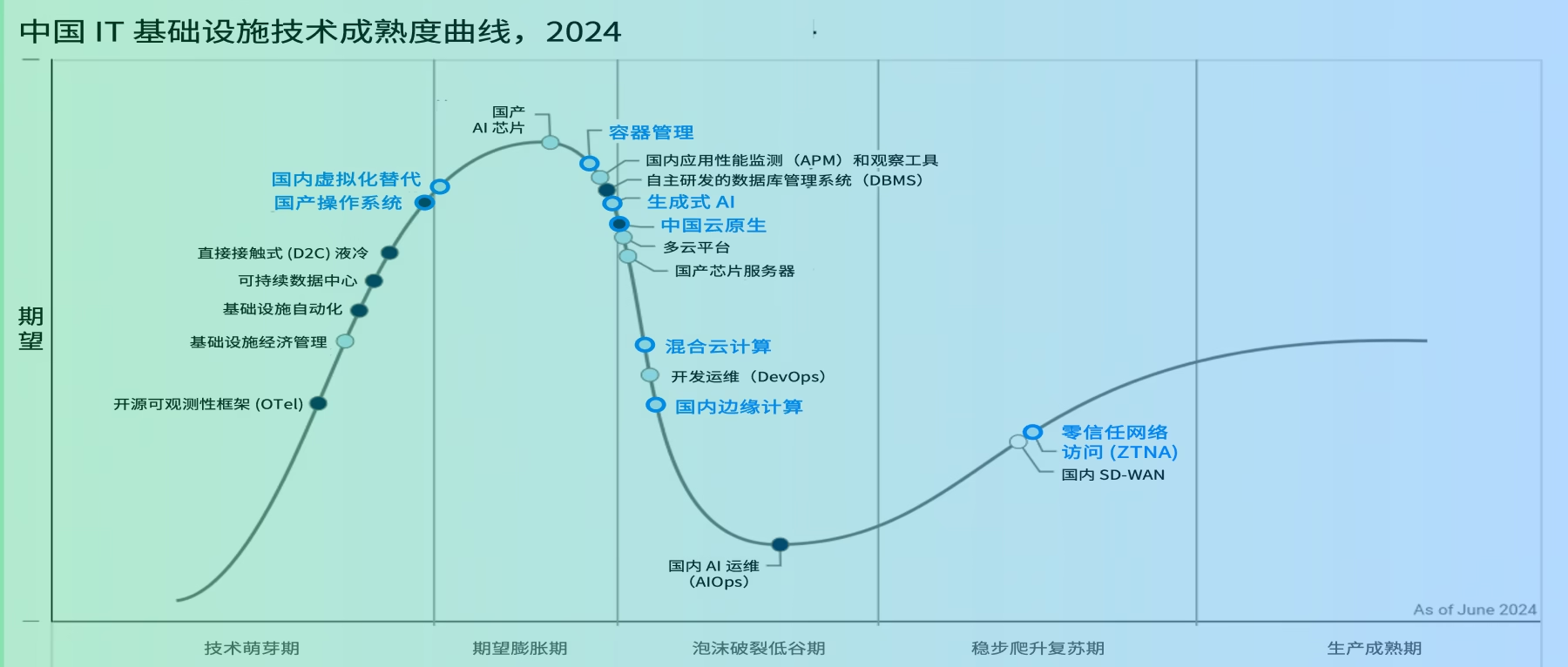
Gartner Hype Cycle Identifies Top AI Innovations in 2025 - AI2Work Analysis
Gartner Hype‑Cycle 2025: How Generative AI and Edge Infrastructure Are Reshaping Enterprise IT Strategy The 2025 Gartner Hype Cycle for AI Innovation is finally available, and its findings confirm a...