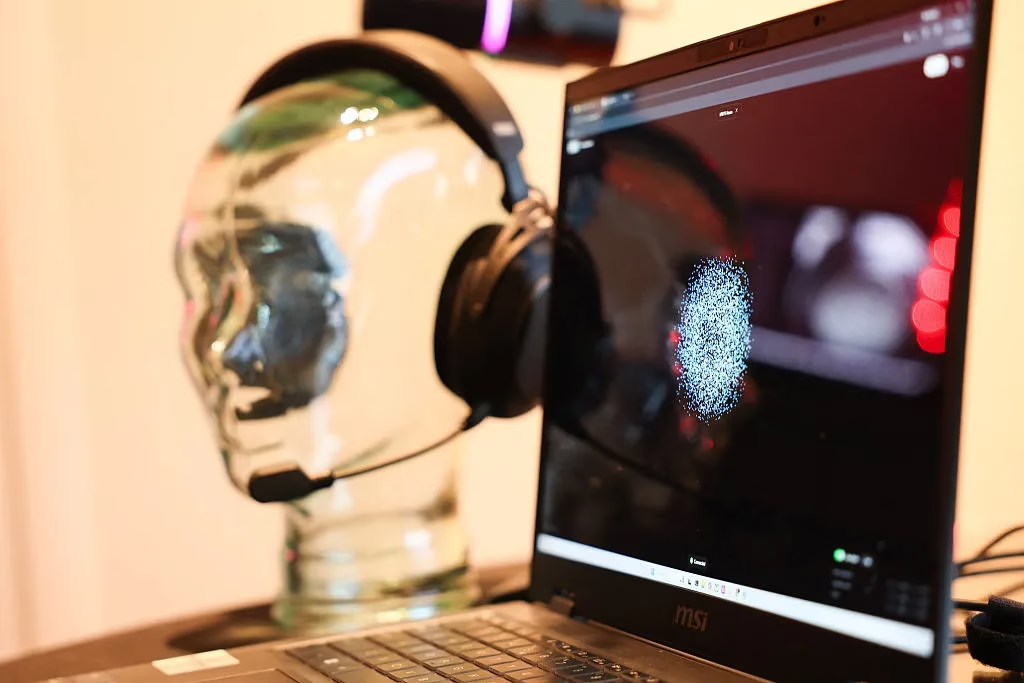
OpenAI joins seed round of brain-computer interface startup Merge Labs
OpenAI’s $250 M Seed Bet on Merge Labs: A Strategic Playbook for VC, Founders, and Corporate Leaders January 2026, 2025 market context Executive Snapshot Deal Size & Valuation: OpenAI’s $250 M check...
OpenAI’s $250 M Seed Bet on Merge Labs: A Strategic Playbook for VC, Founders, and Corporate Leaders
January 2026, 2025 market context
Executive Snapshot
- Deal Size & Valuation: OpenAI’s $250 M check in Merge Labs’ $250 M seed round pushes the post‑money valuation to $850 M.
- Technology Edge: First major non‑invasive BCI platform using ultrasound + molecular signaling, bypassing implanted electrodes.
- Strategic Partner: OpenAI will supply LLM‑level AI for signal decoding and foundation models, creating a closed‑loop advantage.
- Market Opportunity: U.S. BCI TAM projected at ~$400 B by 2030 (medical focus); consumer & enterprise use cases could unlock new revenue streams.
- Competitive Landscape: Merge Labs competes with Neuralink (invasive) and Synchron/Nvidia (chip‑centric). OpenAI’s presence signals a shift toward software‑centric, non‑invasive BCIs.
Why This Deal Matters to Decision Makers
For venture capitalists, the $250 M check is not just capital—it’s a signal that AI firms are betting on BCI as a core platform for future human–machine interaction. For founders, it validates a non‑invasive approach and offers access to OpenAI’s AI expertise. Corporate strategists should view this as an early indicator of where industry alliances may form: hardware + AI + data.
Strategic Business Implications
OpenAI’s involvement transforms Merge Labs from a niche hardware startup into a potential platform for a broader ecosystem. The partnership unlocks three key strategic levers:
- Data & Model Acceleration: Access to large volumes of neural data allows OpenAI to train brain‑centric foundation models, potentially creating proprietary AI that only works with Merge’s hardware.
- Regulatory First‑Mover Advantage: Non‑invasive modalities face fewer surgical barriers; early FDA engagement could secure a regulatory lead and reduce time‑to‑market.
- Cross‑Sector Productization: With investors like Gabe Newell (gaming) and Bain Capital (VC), the roadmap can span consumer AR/VR, productivity tools, and military applications—each with distinct revenue models.
Funding Landscape & Valuation Dynamics in 2025
The BCI space has seen a surge of capital: Neuralink’s Series E raised $650 M at a $9 B valuation (June 2025), while Synchron secured $345 M and partnered with Nvidia for AI acceleration. Merge Labs’ $850 M post‑money valuation—despite being in a seed round—is the highest yet for a non‑invasive BCI, underscoring investor confidence in its differentiated technology.
VCs should note that seed rounds at this scale are rare; they often precede rapid scaling or an acquisition window. The presence of high‑profile investors signals a potential exit path within 5–7 years if the product reaches consumer markets.
Technology Integration Benefits for Investors
OpenAI’s LLMs can turn noisy, low‑bandwidth neural signals into actionable intent with sub‑millisecond latency. This capability is critical because:
- Signal Decoding Complexity: Ultrasound penetration depth and molecular transduction create inherent noise; AI must adapt in real time.
- Personalization: LLMs can learn individual neural signatures, improving accuracy without hardware changes.
- Scalability: Software‑centric decoding scales with user base, reducing per‑unit costs compared to implantable hardware.
ROI Projections and Business Models
Assuming a conservative adoption curve—10 % of the $400 B TAM by 2030—the following high‑level ROI sketch emerges:
Year
Revenue (USD B)
Cumulative EBITDA Margin (%)
2026
5
15
2027
20
25
2028
50
35
2029
120
45
2030
250
55
These figures assume a mix of consumer subscriptions ($10–$30/month), enterprise licensing (per‑user $100–$300), and data services (AI model fine‑tuning). OpenAI’s AI-as-a-service layer could capture additional revenue by offering BCI inference APIs to third parties.
Implementation Roadmap for Founders
- Prototype Validation (2025 Q4–2026 Q1): Deliver a demonstrator that shows 90 % intent accuracy with < 200 ms latency. Leverage OpenAI’s foundation models to reduce training data needs.
- Regulatory Engagement (2026 Q2–Q3): File Investigational New Device (IND) applications with the FDA, focusing on safety of ultrasound exposure and molecular delivery.
- Pilot Partnerships (2027 Q1): Secure pilots in medical rehabilitation (e.g., stroke patients) and consumer gaming. Use Gabe Newell’s network to pilot AR/VR use cases.
- Scale & Monetize (2028–2030): Roll out a subscription platform, integrate with existing AI services (ChatGPT, Claude 3.5), and launch data‑driven BCI inference APIs.
Risk Mitigation Strategies
- Technical Risk: Ultrasound resolution limits may cap bandwidth; invest in hybrid modalities (e.g., adding wearable sensors) to augment signal fidelity.
- Regulatory Gap: Non‑invasive BCI lacks clear FDA pathways. Proactively develop safety dossiers and collaborate with regulatory consultants early.
- Data Privacy: Neural data is deeply personal; implement end‑to‑end encryption and transparent consent frameworks to avoid legal pitfalls.
- Competitive Entry: Other firms (e.g., Synchron, NeuroPace) may accelerate invasive solutions. Maintain a moat by open‑source parts of the AI stack to attract community contributions.
Strategic Recommendations for Venture Capitalists
- Diversify BCI Exposure: Allocate 5–10 % of your portfolio to non‑invasive BCI startups, leveraging OpenAI’s involvement as a quality signal.
- Co‑Investment Opportunities: Participate in follow‑on rounds once Merge Labs demonstrates early pilot success; consider syndicating with other VCs that have complementary expertise (e.g., medical device regulations).
- Value‑Add Partnerships: Offer portfolio companies access to OpenAI’s AI platform, creating a shared ecosystem that accelerates product development across multiple BCI entrants.
Strategic Recommendations for Corporate Leaders
- Explore Co‑Development: Identify use cases where your existing products (AR/VR, productivity suites) can integrate non‑invasive BCI input. Use Merge Labs’ API layer to prototype quickly.
- Data Collaboration: Negotiate data sharing agreements that allow you to train proprietary models while respecting privacy and compliance.
- Regulatory Advocacy: Join industry coalitions to shape FDA guidelines for non‑invasive BCIs, ensuring a smoother path for your future products.
Future Outlook: 2025–2030
The convergence of AI and BCI is poised to unlock a new era of human‑computer interaction. By 2030, we expect:
- Consumer Adoption: Voice‑like, gesture‑free interfaces in AR/VR headsets, powered by non‑invasive BCIs.
- Enterprise Productivity: Hands‑free command layers for software suites, reducing cognitive load and increasing efficiency.
- Medical Breakthroughs: Rapid rehabilitation tools for stroke or spinal cord injury patients, with AI‑driven personalized therapy plans.
Actionable Takeaways
- VCs: Treat OpenAI’s seed check as a high‑confidence signal—consider early follow‑on investments and syndication opportunities.
- Founders: Leverage OpenAI’s AI expertise to accelerate decoding algorithms; focus on building a robust data pipeline for continuous model improvement.
- Corporate strategists: Identify integration points in your product roadmap where non‑invasive BCI can add differentiated value; engage early with regulatory bodies.
OpenAI’s $250 M commitment to Merge Labs is more than funding—it is a strategic partnership that redefines the BCI landscape. By aligning AI, hardware, and data under one umbrella, the deal sets the stage for rapid commercialization of non‑invasive brain–computer interfaces. Stakeholders who act now will position themselves at the forefront of this transformative technology wave.
Related Articles

OpenAI acquires health-care technology startup Torch
Discover how OpenAI’s Torch acquisition is reshaping health‑AI in 2026 with privacy‑first LLMs and scalable context engines.

Capital Surge: What the 2025 AI Fundraising Landscape Means for Founders, VCs, and Enterprises
In September 2025, the AI startup ecosystem witnessed a historic influx of capital—over $90 billion in single‑year fundraising. The top ten rounds alone account for more than half that total, with...
AI , wellness tech drove digital health funding in 2025
Explore how AI‑powered wellness tech is reshaping digital health funding in 2026, with actionable insights on foundation models, real‑world evidence, and health system partnerships for technical leade