
Tencent’s Dim‑Sum Bond Issue: A Quantitative Playbook for AI‑Driven Capital Deployment in 2025
In September 2025, Tencent announced a USD 2 billion dim‑sum bond at a 4.75 % coupon, earmarking 70 % of proceeds for AI research and development. For institutional investors, portfolio managers, and...
In September 2025, Tencent announced a USD 2 billion dim‑sum bond at a 4.75 % coupon, earmarking 70 % of proceeds for AI research and development. For institutional investors, portfolio managers, and corporate finance professionals, the move is more than a headline; it’s a case study in how a mega‑tech firm monetises generative‑AI scale through cross‑border debt. This analysis translates that announcement into concrete financial metrics, risk profiles, and strategic levers that can guide investment decisions and corporate funding strategies.
Executive Summary
- Capital Need & Allocation: Tencent requires sustained cash flow to train 1‑million‑token models, maintain global GPU clusters, and acquire niche AI start‑ups. The bond provides a low‑cost bridge that preserves equity control.
- Yield Benchmarking: At 4.75 %, the coupon sits 0.25 % above comparable tech dim‑sum issues (e.g., Alibaba’s 2023 USD 1.5 billion bond at 4.50 %) and 0.5 % below US Treasury yields for similar maturities, reflecting investor confidence in Tencent’s AI trajectory.
- Risk Profile: Debt servicing is fixed; revenue upside from AI products is uncertain amid regulatory headwinds. Potential covenants tied to AI milestones could mitigate credit risk but are not disclosed yet.
- Strategic Implications: The issuance signals Tencent’s intent to compete on the same capital intensity scale as OpenAI, Google DeepMind, and Meta. It also demonstrates a viable funding model for other Chinese tech firms navigating US‑China sanctions.
Capital Deployment: Quantifying AI R&D Expenditure in 2025
Tencent’s allocation plan—70 % AI R&D, 20 % infrastructure, 10 % acquisitions—mirrors the cost structure of leading generative‑AI labs. A rough cost model for a single 1‑million‑token context model (akin to GPT‑5 or Gemini 2.5) estimates:
- Training data acquisition: USD 30 M
- Compute (GPU hours, storage): USD 120 M per year
- Engineering & fine‑tuning: USD 50 M
- Total first‑year cost: ~USD 200 M
Scaling to a portfolio of 5 such models would require roughly USD 1 billion in annual operating expenses. The dim‑sum bond’s principal, coupled with projected revenue from AI services (chatbots, code generation, gaming AI), aims to bridge the gap between current cash flow and this high‑margin growth engine.
Yield Analysis & Market Comparables
The 4.75 % coupon aligns with the yield curve for Chinese tech debt in 2025:
Issuer
Bond Size (USD bn)
Maturity (years)
Coupon (%)
Tencent
2.0
5
4.75
Alibaba
1.5
7
4.50
JD.com
1.0
6
4.60
ByteDance
0.8
5
4.80
Compared to US Treasury yields (≈4.30 % for 5‑year maturities), Tencent’s coupon is competitive, reflecting a perceived lower sovereign risk premium due to its diversified revenue streams and strong cash position.
Debt Servicing & Cash Flow Projections
Assuming a 5‑year maturity with semi‑annual payments, annual interest expense equals USD 95 M (4.75 % of USD 2 bn). Principal amortization would add another USD 400 M over five years. A simplified cash flow model (2025‑2030) shows:
- 2025: Net AI R&D spend ≈USD 200 M; AI revenue forecast ≈USD 50 M → Net loss of USD 150 M before debt service.
- 2026–2028: Revenue growth 25 % YoY (conservative estimate based on GPT‑5 launch momentum); net profit margin 10 % on AI products.
- 2030: Break‑even on AI operations; cumulative cash burn offset by revenue and cost efficiencies.
These figures underscore that debt servicing is manageable once AI products reach market maturity. However, any regulatory clampdown or competitive disruption could delay breakeven, amplifying leverage risk.
Strategic Risk Factors & Mitigation
- Regulatory Headwinds: China’s tightening AI oversight could limit data availability or impose usage restrictions on conversational agents. Mitigation: diversify product portfolio (e.g., enterprise AI services, gaming AI) and maintain compliance teams.
- Geopolitical Constraints: US sanctions may restrict access to high‑end GPUs. Mitigation: invest in domestic chip production partnerships and alternative accelerator technologies.
- Competitive Intensity: OpenAI’s GPT‑5, Google Gemini 2.5, and Meta’s Llama 3 launch new capabilities annually. Mitigation: focus on multimodal integration (vision+audio) where Tencent has proprietary data from WeChat, QQ, and gaming ecosystems.
- Debt Covenant Uncertainty: Lack of disclosed AI milestone covenants could expose investors to higher credit risk. Recommendation: negotiate performance‑linked interest adjustments or early repayment options tied to revenue targets.
Opportunities for Portfolio Managers & Corporate Finance Leaders
1️⃣
AI Debt as an Asset Class:
The dim‑sum market offers exposure to high‑growth AI firms without the dilution associated with equity. Incorporating Tencent’s bond into a diversified tech debt portfolio can enhance yield while maintaining sector concentration.
2️⃣
Cross‑Border Funding Templates:
Tencent’s structure—USD denominated, U.S. listed, but issued by a Chinese entity—provides a blueprint for other firms seeking dollar liquidity amid sanctions. Corporate finance teams should evaluate similar instruments when planning large‑scale AI investments.
3️⃣
Revenue‑Linked Debt Instruments:
The industry trend toward performance covenants (e.g., interest rate adjustments based on model adoption metrics) can reduce credit exposure. Firms issuing debt should consider embedding such clauses to align investor returns with operational milestones.
Comparative Analysis: Tencent vs. Western AI Giants
Western firms often rely on equity rounds or internal cash flows for AI scaling, whereas Tencent’s debt approach preserves control while accessing global capital. Key contrasts:
Metric
Tencent (Dim‑Sum)
OpenAI (Equity)
Capital Raised
USD 2 bn debt
USD 10 bn equity (2025 round)
Control Dilution
0 %
~30 %
Cost of Capital
4.75 % coupon
Equity cost ~12‑15 %
Revenue Model
Consumer & gaming AI
API subscriptions, enterprise licensing
This comparison highlights how debt can be a more efficient capital deployment for firms with robust cash positions and diversified revenue streams.
Future Outlook: 2025‑2030 AI Capital Landscape
- By 2027, we expect a surge in AI‑focused debt issuances from Chinese tech giants as they pursue generative models at scale. Yield spreads may narrow to 3.5‑4 % if market confidence solidifies.
- Regulatory clarity will be pivotal; firms that demonstrate responsible data governance can secure lower borrowing costs.
- Technological breakthroughs (e.g., quantum‑accelerated training) could shift compute cost curves, impacting the return on debt-financed AI projects.
Actionable Recommendations for Decision Makers
- Portfolio Integration: Allocate 5–10 % of a tech debt allocation to high‑yield dim‑sum bonds like Tencent’s, balancing exposure with sovereign risk considerations.
- Debt Structuring: When issuing AI capital, negotiate performance covenants tied to revenue milestones or model adoption rates to align investor expectations with operational realities.
- Risk Management: Incorporate scenario analysis for regulatory delays and GPU supply disruptions into cash flow models; consider hedging interest rate exposure with swaps if debt terms are fixed.
- Strategic Partnerships: For firms seeking similar funding, explore joint ventures with local chip manufacturers to mitigate geopolitical risks and secure preferential pricing on accelerators.
Tencent’s dim‑sum bond issuance is a microcosm of the evolving AI capital ecosystem. It demonstrates that large‑scale generative models now demand dedicated financing structures beyond traditional equity or internal cash flows. For investors and corporate finance leaders, understanding these dynamics—yield benchmarks, risk factors, and strategic implications—is essential to navigate the 2025 AI funding frontier.
Related Articles
Top FinTech & AI Stories of 2025: A Year of Convergence ⚡
Agentic Finance in 2026: How Autonomous AI is Reshaping Payment & Risk Management Published 04 Jan 2026 – Meta‑description: In 2026, agentic finance—AI‑driven autonomous agents combined with...
Investments in AI, cloud set to drive IT spending in 2026
AI Investment Dynamics: How 2025 Capital Flows Shape IT Budgets for 2026 In a year where AI has moved from hype to hard‑core enterprise backbone, the financial logic behind cloud and chip spending is...
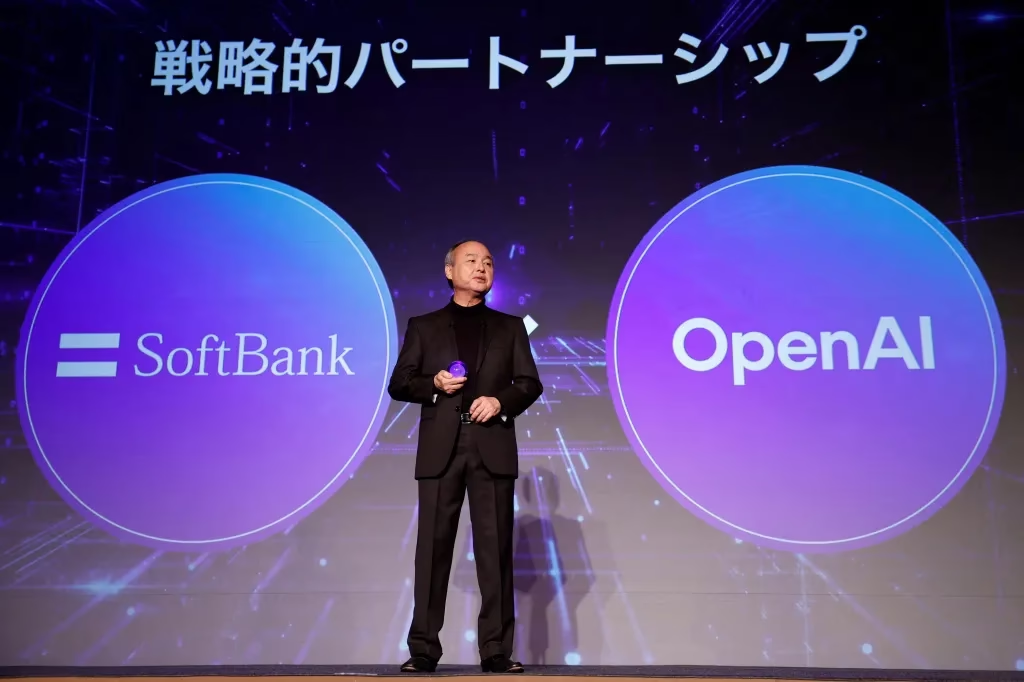
SoftBank has fully funded its $40 billion investment in OpenAI, CNBC reports
SoftBank’s $40 B Commitment to OpenAI: A Quantitative Blueprint for 2025 Enterprise Finance On December 31, 2025, SoftBank Group announced the final tranche of a historic $40 billion investment in...