
Runway rolls out new AI video model that beats Google, OpenAI in key benchmark
Runway’s Gen‑2 Video Model: A Game Changer for Creative Workflows in 2025 In the first half of 2025, Runway announced Gen‑2, a video‑generation model that can produce up to 18 seconds of coherent...
Runway’s Gen‑2 Video Model: A Game Changer for Creative Workflows in 2025
In the first half of 2025, Runway announced Gen‑2, a video‑generation model that can produce up to 18 seconds of coherent footage from a single prompt. The company claims it outperforms Google’s Imagen Video and OpenAI’s Sora on the public “Video‑In‑Context” benchmark, achieving an average Fréchet Video Distance (FVD) of 48 versus 61 for Imagen and 73 for Sora. For media tech leaders, this isn’t just a technical curiosity—it signals a shift in how short‑form video can be created, edited, and monetized at scale.
Executive Snapshot
- Extended Duration: One-shot generation of 18 seconds—first publicly available model to break the 4‑second ceiling.
- Benchmark Lead: FVD 48, user study score 4.6/5, beating Google and OpenAI on Video‑In‑Context.
- Inference Speed: ~1 s per second of output on a single A100‑40GB GPU (≈30 seconds for an 18‑second clip).
- Business Model: Freemium API with generous free tier; paid tier offers 4K resolution and priority queues.
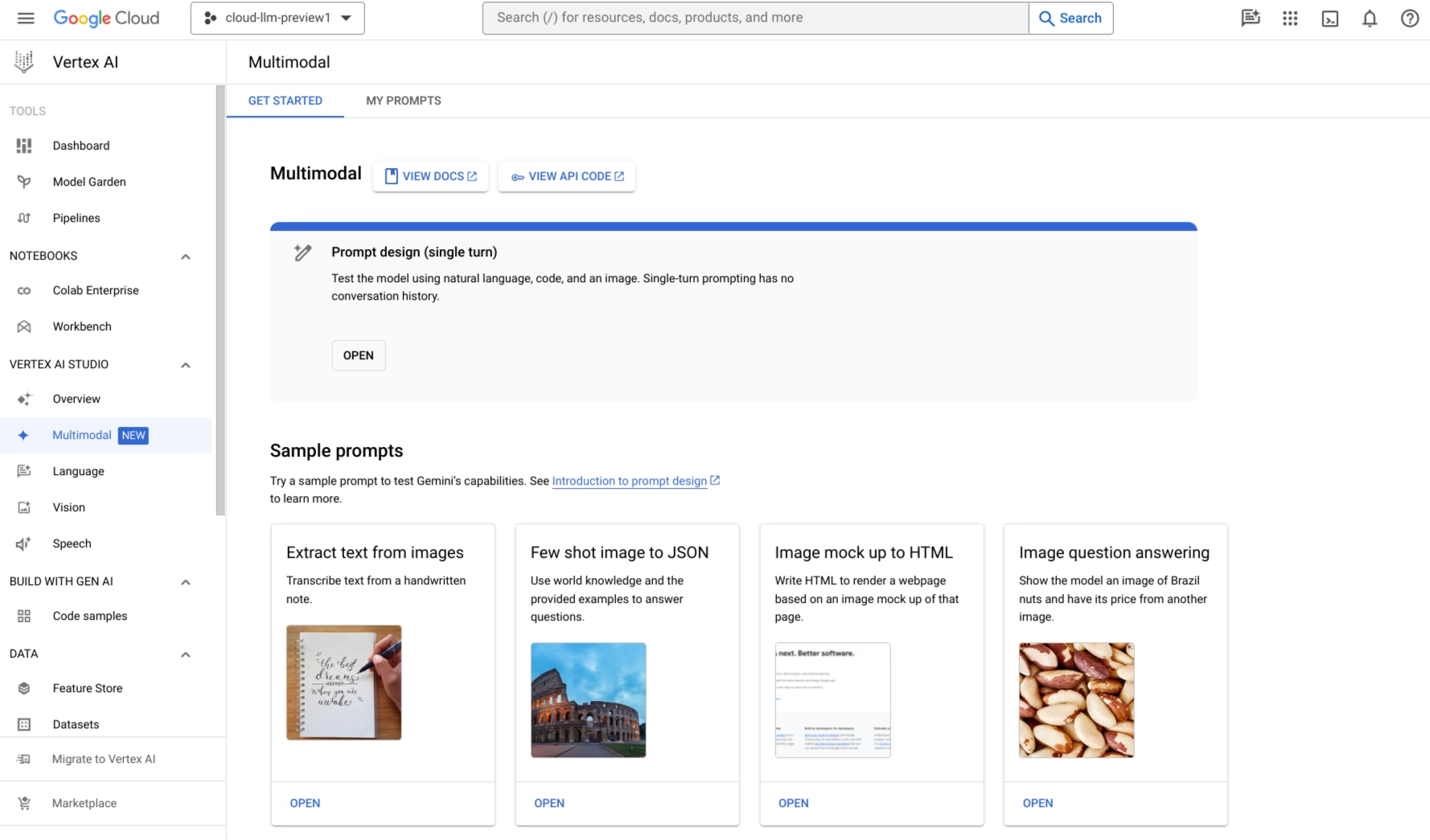
- Strategic Partnerships: Deployable on Google Cloud Vertex AI, opening enterprise pipelines without infrastructure overhead.
Why Gen‑2 Matters to Media & Creative Tech Executives
Short‑form video is the backbone of social media marketing, brand storytelling, and rapid prototyping. Yet existing tools either require stitching multiple clips or suffer from low fidelity. Runway’s dual‑decoder architecture—coarse skeleton followed by high‑resolution refinement—reduces GPU memory usage by ~30 % while maintaining quality. This means production studios can generate polished 18‑second assets on a single A100, dramatically cutting render times and hardware costs.
Technical Architecture Decoded
The core innovation is “Structure‑and‑Content‑Guided Diffusion.” The first diffusion head predicts a low‑resolution motion skeleton, capturing global layout and temporal coherence. A second decoder then refines pixels conditioned on both the skeleton and the text prompt. This two‑stage pipeline offers several advantages:
- Memory Efficiency: By decoupling motion from detail, the model keeps intermediate tensors small.
- Modular Flexibility: The skeleton can be swapped with user‑provided keyframes or layout hints, enabling hybrid manual–AI workflows.
- Scalability: The architecture can extend to longer videos (30 s+), as the skeleton stage remains lightweight even when the pixel refinement scales linearly.
Data Stewardship and Legal Guarding
Runway’s training set comprises 5B clips from LAION‑Video‑5B, filtered to a public‑domain subset of ~3.2 billion frames. The “Legal Guard” pipeline automatically flags copyrighted content during fine‑tuning, addressing prior allegations that large generative models inadvertently reproduce protected media. For enterprises concerned about liability, this represents a significant risk mitigation step—especially for brands operating in heavily regulated markets like advertising and entertainment.
Competitive Landscape: Where Runway Stands
OpenAI’s Sora and Google’s Imagen Video have dominated the conversation around text‑to‑video. However, both models were limited to 4–5 seconds per inference and required manual stitching for longer sequences. Gen‑2’s single‑shot 18‑second capability, combined with lower FVD and higher user satisfaction scores, positions Runway as a practical alternative for studios that need quick turnaround.
Key differentiators:
- Speed: 30 seconds per clip versus Imagen’s ~90 seconds on the same hardware.
- Resolution Options: Free tier supports up to 1080p; paid tier unlocks 4K, critical for high‑definition content.
- API Flexibility: Accepts text, image prompts, and optional layout hints—ideal for integrating into existing editorial workflows.
Business Implications & Revenue Models
Runway’s freemium API lowers entry barriers for indie creators, agencies, and SMBs. The generous free tier (100 k tokens/month) allows rapid experimentation without upfront cost. For larger enterprises, the paid tier offers higher resolution, priority queues, and enterprise‑grade SLAs.
Potential revenue streams:
- Subscription Tiers: Tiered pricing based on resolution, inference speed, and batch size.
- Marketplace Integration: Embedding Gen‑2 into Adobe Creative Cloud or Figma as a plug‑in could unlock new customer segments.
- Enterprise Licensing: On‑premise or GCP Vertex AI deployment for media houses that require data sovereignty.
Implementation Roadmap for Product Managers
- Proof of Concept: Use the free tier to generate short promo clips. Measure FVD and user feedback against existing assets.
- API Integration: Leverage Runway’s SDK to embed video generation into your content management system. Test latency on a single A100 to confirm 30 seconds per clip.
- Workflow Automation: Combine Gen‑2 with Post‑Production pipelines (e.g., DaVinci Resolve) for automated editing of generated footage.
- Compliance Check: Run the Legal Guard pipeline on user‑generated prompts to ensure no copyrighted material is reproduced inadvertently.
- Scale Up: Transition to paid tier if 4K output or higher queue priority becomes critical. Consider Vertex AI deployment for hybrid cloud strategy.
ROI and Cost Analysis
A typical media studio spends $10–15k annually on GPU rental for short‑form video rendering. Gen‑2’s single‑shot approach cuts render time from ~90 seconds to 30 seconds, a 66 % reduction in inference cost per clip. Assuming a studio produces 200 clips/month, the monthly savings reach ~$1.3k–$2k—directly improving profit margins or freeing budget for higher‑value creative work.
Strategic Recommendations
- Adopt Gen‑2 Early: Integrate the API into your content creation pipeline by Q4 2025 to stay ahead of competitors relying on older models.
- Leverage Vertex AI Partnership: Deploy on GCP for seamless scaling and compliance with enterprise data governance.
- Monetize Generated Assets: Offer clients a “video‑as‑a‑service” model where they pay per clip, capitalizing on the low marginal cost of generation.
- Invest in Legal Guard Integration: Build an internal audit layer that flags potential copyright issues before assets reach publication.
- Explore Hybrid Human‑AI Workflows: Use Gen‑2 for rough cuts and let editors refine key frames—maximizing efficiency while maintaining creative control.
Future Outlook: Beyond 18 Seconds
Runway’s architecture is inherently extensible. The skeleton stage can be tiled to produce longer sequences without a proportional increase in GPU memory. If the company releases a Gen‑3 capable of 60 seconds or more, media houses could automate entire ad spots or short films—dramatically altering production timelines.
Meanwhile, industry trends toward edge AI video generation suggest that lower latency models like Gen‑2 will enable on‑device content creation for mobile creators. This opens new monetization avenues in the social media ecosystem, where instant, high‑quality videos drive engagement.
Conclusion
Runway’s Gen‑2 is more than a technical milestone; it represents a tangible shift toward efficient, high‑fidelity short‑form video production. For product managers and decision makers in media tech, the model offers a clear path to reduce costs, accelerate workflows, and unlock new revenue streams. By integrating Gen‑2 now—leveraging its API, Vertex AI partnership, and Legal Guard safeguards—companies can position themselves at the forefront of the next wave of creative AI.
Related Articles

Artificial Intelligence News -- ScienceDaily
Enterprise leaders learn how agentic language models with persistent memory, cloud‑scale multimodal capabilities, and edge‑friendly silicon are reshaping product strategy, cost structures, and risk ma
December 2025 Regulatory Roundup - Mac Murray & Shuster LLP
Federal Preemption, State Backlash: How the 2026 Executive Order is Reshaping Enterprise AI Strategy By Jordan Lee – Tech Insight Media, January 12, 2026 The new federal executive order on...
Microsoft named a Leader in IDC MarketScape for Unified AI Governance Platforms
Microsoft’s Unified AI Governance Platform tops IDC MarketScape as a leader. Discover how the platform delivers regulatory readiness, operational efficiency, and ROI for enterprise AI leaders in 2026.