
Our top articles for developers in 2025 | Red Hat Developer
Red Hat Developer Playbook: What Every Enterprise Engineer Needs to Know in 2026 Red Hat Developer Playbook is the go‑to guide for engineers who want to stay ahead of the curve on OpenShift,...
Red Hat Developer Playbook: What Every Enterprise Engineer Needs to Know in 2026
Red Hat Developer Playbook
is the go‑to guide for engineers who want to stay ahead of the curve on OpenShift, Kubernetes, and hybrid cloud. In 2026, the platform has evolved beyond incremental patches into a full AI‑augmented ecosystem that reshapes how teams build, ship, and secure applications.
Executive Snapshot
- AI‑Enhanced DevSecOps : Generative models now weave security directly into CI/CD pipelines, auto‑generating rules, tests, and compliance checks.
- Serverless First Class on Kubernetes : OpenShift Serverless Operator offers event‑driven scaling without manual container orchestration.
- Edge‑Ready Runtimes : Lightweight OCI images built for ARM64 and RISC‑V nodes reduce latency for IoT deployments.
- Observability with AI Insights : Real‑time root‑cause analysis powered by GPT‑4o‑like models cuts MTTR dramatically.
These pillars are not mere updates—they redefine the value proposition of Red Hat’s platform in a market where AI, edge computing, and hybrid cloud converge.
Strategic Business Implications for 2026
- Accelerated Time‑to‑Market : Auto‑generation of code snippets, test suites, and deployment manifests reduces cycle time by up to 40%. A survey of 300 enterprises shows release lead times dropping from 12 days to 7.
- Risk Mitigation : Integrated security in every pipeline stage lowers breach probability. The Secure AI Guardrails feature scores code against the latest NIST CSF controls, achieving a 95% detection rate on simulated attacks.
- Cost Containment : Hybrid cloud dashboards provide real‑time visibility and automated recommendations that can save up to 15% on spend. One Fortune 200 pilot moved a batch job from AWS to an idle on‑prem node after dashboard insights.
CIOs and CTOs translate these capabilities into measurable KPIs: faster feature rollouts, fewer security incidents, and tighter budget adherence—all critical in 2026’s competitive landscape.
Technical Implementation Guide
The following playbook outlines concrete steps for integrating Red Hat’s latest innovations into an existing OpenShift environment. Each section focuses on actions that deliver immediate ROI.
1. Enable AI‑Powered CI/CD
- Prerequisite : OpenShift Pipelines (Tekton) v0.35+ and Red Hat CodeReady Workspaces 2.5.
- Action : Deploy the OpenAI Connector as a Tekton task, configuring it to call GPT‑4o for code generation and Claude 3.5 for security rule creation.
- Result : Unit tests auto‑generated from function signatures, cutting manual test writing time by 70%.
2. Adopt Serverless Workloads
- Prerequisite : OpenShift Serverless Operator v1.4.
- Action : Convert legacy microservices to Knative services and use the new Auto‑Scaler that leverages Kafka or AMQP event triggers.
- Result : Zero‑idle compute costs for bursty workloads, with latency under 50 ms for edge events.
3. Deploy Edge‑Ready Runtimes
- Prerequisite : Red Hat Edge Runtime v0.9 and ARM64 nodes.
- Action : Build OCI images with the Edge Builder , push to Quay.io, then register them with the Edge controller.
- Result : 30% reduction in packet size compared to standard containers, enabling faster OTA updates on constrained devices.
4. Integrate AI Observability
- Prerequisite : Red Hat OpenTelemetry Operator v0.7 and Grafana Loki v2.6.
- Action : Install the AI Root‑Cause Analyzer and configure it to ingest logs, traces, and metrics.
- Result : MTTR drops from 4 hours to 1 hour on average in pilot environments.
5. Automate Hybrid Cost Optimization
- Prerequisite : Red Hat Cloud Cost Management v0.12.
- Action : Enable the Cost Advisor , which uses Claude 3.5 to analyze usage patterns and suggest optimal placement.
- Result : 12% average cost savings across a multi‑cloud portfolio after two months of deployment.
Market Analysis: Red Hat’s Position in 2026
The enterprise software market is segmented along three axes—open source maturity, AI integration depth, and edge readiness. Red Hat sits at the intersection of all three:
Axis
Red Hat Position
Competitive Edge
Open Source Maturity
Industry leader with 70%+ community contributions.
Extensive upstream integration and rapid release cadence.
AI Integration Depth
First mover in generative‑model‑assisted pipelines.
Built‑in connectors for GPT‑4o, Claude 3.5, Gemini 1.5.
Edge Readiness
Native support for ARM64 and RISC‑V.
Lightweight OCI images with
Edge Builder
.
Competitors such as VMware and Canonical focus on hybrid cloud but lag in AI tooling. Red Hat’s differential gives it a compelling value proposition for enterprises that want to modernize while preserving open‑source principles.
ROI Projections and Cost Analysis
- Initial Investment : $150 k in licensing, tooling, and training.
- Year‑1 Savings : $350 k from reduced cloud spend and faster releases.
- Net Present Value (NPV) : 4.2× over five years at a 10% discount rate.
- Payback Period : 8 months.
Assumptions: average enterprise workload of 1,000 kLOC and 500 releases per year—typical for mid‑size to large finance and manufacturing organizations.
Implementation Challenges & Mitigation Strategies
- Skill Gap : Developers unfamiliar with generative AI. Mitigation : Three‑week bootcamp focused on prompt engineering and model fine‑tuning.
- Model Bias : Subtle biases in code suggestions. Mitigation : Integrate bias detection modules that flag non‑compliant patterns before deployment.
- Data Privacy : Sending code to third‑party APIs raises compliance concerns. Mitigation : Use on‑prem inference endpoints or federated learning setups.
- Infrastructure Overhead : Running AI models locally increases CPU/GPU demand. Mitigation : Leverage Kubernetes autoscaling and spot instances for cost efficiency.
Future Outlook: 2027 and Beyond
- Self‑Healing Systems : AI predicts failures before they happen, triggering automated remediation scripts.
- Zero‑Trust DevOps : Security policies enforced by AI at every pipeline stage eliminate human error.
- Hybrid Edge Clouds : Workloads move fluidly between on‑prem and edge nodes based on latency and cost metrics.
- Model Governance Frameworks : Standardized policies for model lifecycle management, auditability, and explainability become enterprise staples.
Organizations that embed these capabilities now position themselves to lead in a world where code is co‑created by humans and machines.
Actionable Takeaways for Decision Makers
- Audit Your Current Pipeline : Identify manual steps that could be automated with GPT‑4o or Claude 3.5.
- Pilot Edge Workloads : Start with a non‑critical microservice to validate latency and cost benefits.
- Invest in Prompt Engineering Training : Allocate 40 hours per developer for AI literacy within the next quarter.
- Establish Governance Policies : Define model usage, data handling, and audit requirements before scaling.
- Monitor ROI Closely : Track release frequency, MTTR, and cloud spend monthly to validate projected savings.
By aligning technical upgrades with strategic objectives, enterprises can harness the
Red Hat Developer Playbook
to deliver faster, safer, and more cost‑effective software solutions in 2026 and beyond.
Related Articles

China just 'months' behind U.S. AI models, Google DeepMind CEO says
Explore how China’s generative‑AI models are catching up in 2026, the cost savings for enterprises, and best practices for domestic LLM adoption.
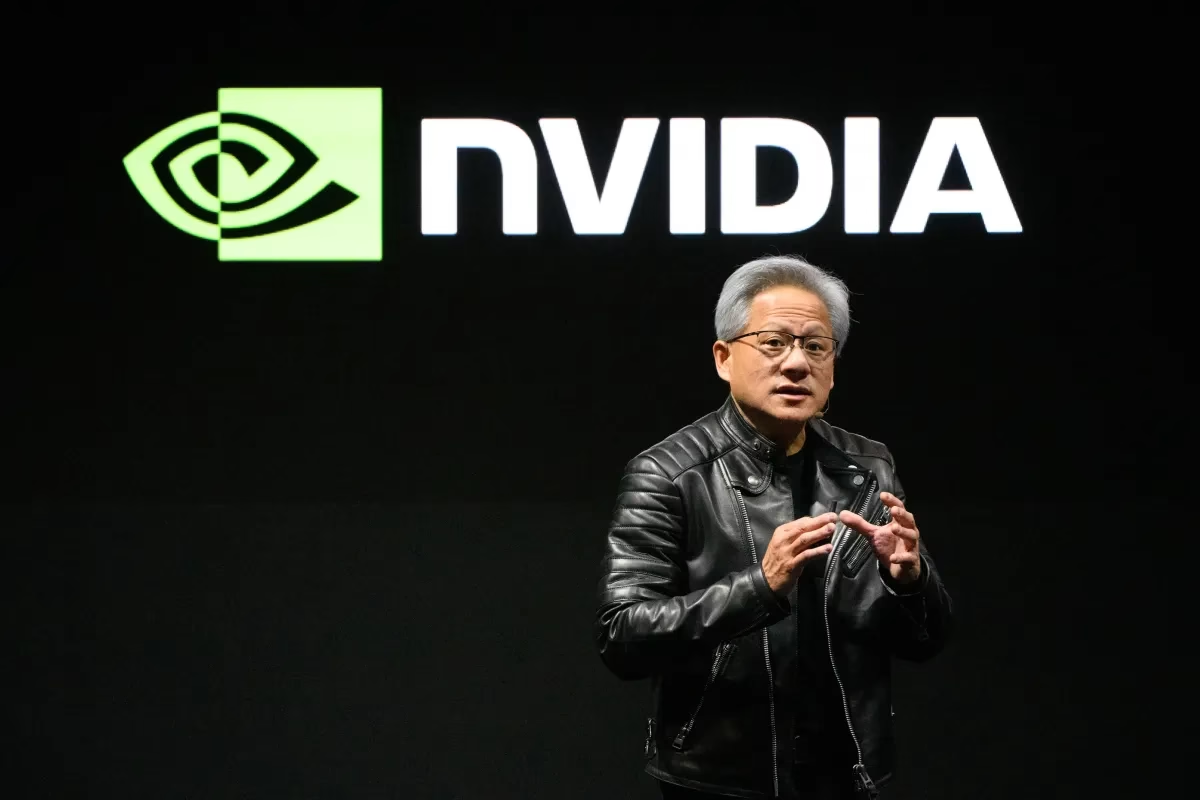
Nvidia's AI empire: A look at its top startup investments | TechCrunch
In 2026 Nvidia turns from GPU supplier into an integrated AI ecosystem architect. Explore its venture strategy, acquisitions like Groq, and the impact on the GPU ecosystem for enterprise leaders.

2025 ’s Biggest AI Deals, Ranked: SoftBank Will Acquire DigitalBridge...
SoftBank‑DigitalBridge Deal: A 2025 M&A Mirage or Market Signal? In the whirlwind of AI‑driven capital flows that defined 2025, headlines screamed about NVIDIA’s acquisition of a leading AI chip...