Social media trolls OpenAI over its new non-profit foundation: ‘Tobacco company funding cancer research’ - AI2Work Analysis
OpenAI public‑benefit pivot in 2025 reshapes AI governance, funding, and health‑AI innovation. Explore the $130 billion impact for enterprise leaders.
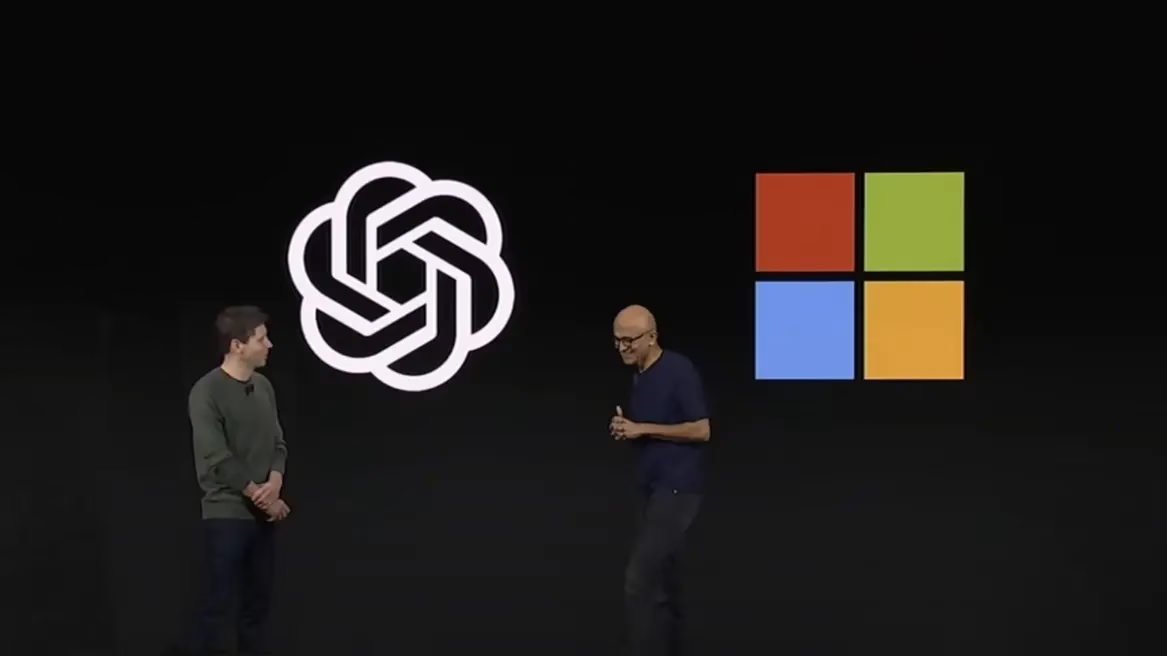
OpenAI’s 2025 Public‑Benefit Pivot: $130 B Impact on AI Strategy OpenAI’s 2025 Public‑Benefit Pivot: $130 B Impact on AI Strategy Published 2025-10-29 | Updated 2025-10-29 The OpenAI public‑benefit pivot—announced in March 2025—catapulted the organization into a new governance paradigm backed by a $130 billion valuation. The shift from a pure commercial model to an open‑benefit corporation has immediate ramifications for AI strategy, funding flows, and regulatory compliance across enterprise ecosystems. OpenAI Public‑Benefit Corporation: A New Governance Blueprint In 2025, OpenAI formalized the OpenAI Foundation as a public‑benefit corporation (PBC). This structure embeds independent philanthropists and industry experts on the board, aligning capital deployment with societal impact. Key implications include: Mission Alignment : Enterprises can co‑develop health AI solutions that meet both regulatory standards and the foundation’s ethical framework. Risk Mitigation : The PBC status obliges OpenAI to prioritize safety, reducing reputational exposure for partners who might otherwise be linked to opaque development practices. Regulatory Anticipation : As the EU AI Act tightens, the foundation’s compliance model offers a ready‑made benchmark for corporate governance. Microsoft’s Diluted Stake: Corporate‑Nonprofit Collaboration in Practice Microsoft now holds 27 % equity—down from ~32.5 % pre‑pivot—while retaining IP control until 2032. This balance allows the foundation to attract non‑Microsoft donors without ceding strategic influence. IP Control vs. Mission Freedom : Microsoft can commercialize technologies, whereas the PBC focuses on philanthropic grants. Funding Diversification : The reduced stake encourages third‑party foundations (e.g., American Cancer Society ) to invest in AI research. Competitive Positioning : Other AI firms may emulate this hybrid model, creating a new category of “public‑benefit AI enterprises.” The Independent AGI Verification Panel: Industry
Related Articles

OpenAI researchers delete X posts claiming a GPT-5 math breakthrough after pushback from Hassabis, others; LeCun says they were "hoisted by their own GPTards" (Matthias Bastian/The Decoder) - AI2Work Analysis
OpenAI’s GPT‑5 Math Claim Fallout: A 2025 Blueprint for Responsible AI Marketing and Enterprise Adoption The October 2025 controversy surrounding OpenAI’s alleged “Erdős problem breakthrough” offers...

OpenAI could reportedly run out of cash by mid-2027 — analyst paints grim picture after examining the company's finances
OpenAI’s 2026 cash‑runway challenge: What enterprise partners and investors need to know about GPT‑4 Turbo, Claude 3.5, token volumes, and funding prospects.

Startup Monday: Latest tech trends & news happening in the global...
Capitalizing on the Reasoning Era: A Growth Blueprint for AI Startups in 2026 AI startup growth strategy is no longer driven by sheer model size; it hinges on how effectively a company can...