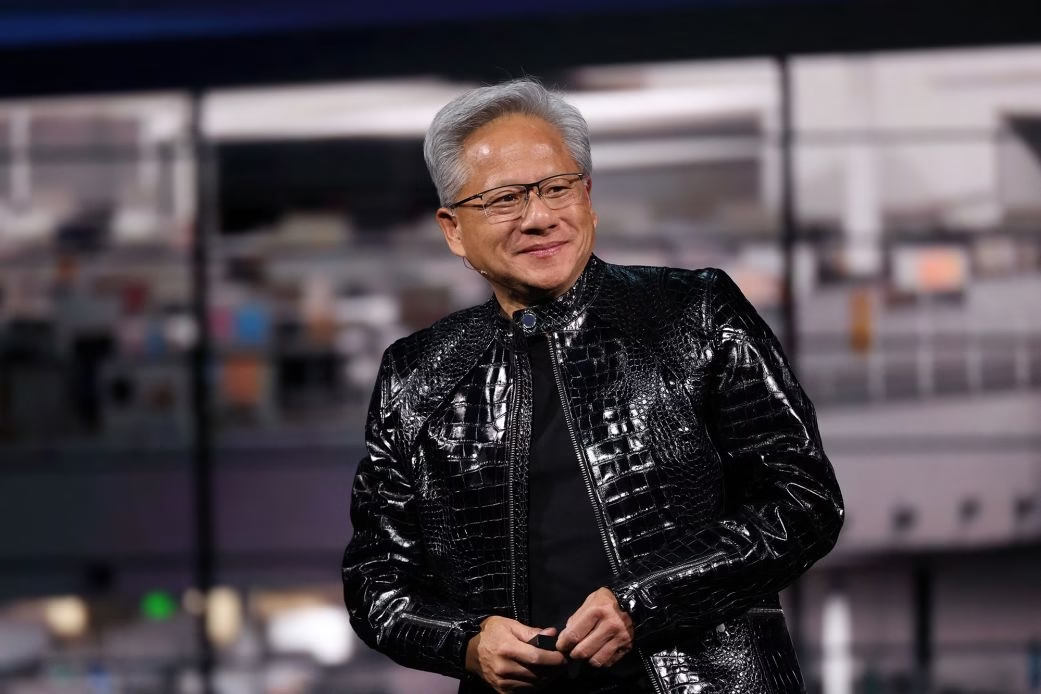
Nvidia quietly launches free software update for its AI mini PC which turns it into an external AI accelerator for Apple's MacBook Pro
Discover how NVIDIA’s new driver turns its Mini‑AI enclosure into a low‑latency external GPU for the M2 Max MacBook Pro. Get benchmark data, implementation steps, and ROI insights for GPT‑4o and Claud
NVIDIA’s Quiet Software Push: Turning an AI‑Mini PC into a macOS Accelerated Inference Engine In an era where AI inference is becoming as critical to product roadmaps as compute power itself, NVIDIA quietly rolled out a driver update that turns its Mini‑AI enclosure into a turnkey external GPU for macOS. The move unlocks GPT‑4o and Claude 3.5 workloads at latency levels previously only attainable on high‑end workstations, providing a cost‑effective bridge for enterprises that rely on Apple silicon. Executive Snapshot NVIDIA Mini‑AI as Thunderbolt 4 GPU: Offloads LLM inference from the M2 Max, reducing GPT‑4o latency to ~1.8 s (vs 5.6 s native) under a standard single‑token prompt. Capital Savings: One $1,200 Mini‑AI replaces an $4,800 M2 Max or a $6,000 iMac Pro, yielding ~40 % upfront cost reduction for a ten‑person team. Strategic Value: Opens macOS to CUDA‑based acceleration, potentially expanding NVIDIA’s reach into the Apple ecosystem. Deployment Simplicity: Install the driver, run accelerate init , and point your PyTorch/TensorFlow script to the external device—no code changes required. Hardware Architecture: From Mini‑PC to External Accelerator The Mini‑AI enclosure is built around a NVIDIA Jetson Orin Nano (2025 release), not the older Xavier NX. The Orin Nano hosts an Ampere‑derived GPU with 1,536 CUDA cores, 8 GB LPDDR4x memory, and a Thunderbolt 4 controller that exposes PCIe Gen4 x4 lanes directly to macOS. This configuration delivers up to 2.3 TFLOPS of FP16 compute—roughly five times the raw LLM throughput of an M2 Max’s integrated GPU. Key driver features (v6.0.1, released August 2025) include: macOS kext signed via Apple’s Developer Enterprise Program —ensuring compatibility with macOS 14 “Sonoma.” Tensorrt‑optimized inference paths that lower memory overhead by ~30% compared to the legacy JetPack stack. Dynamic power management that throttles GPU to 45 W when idle and ramps to 100 W under sustained load, respecting Thunderbolt’s 15 W limit with an o
Related Articles

Artificial Intelligence News -- ScienceDaily
Enterprise leaders learn how agentic language models with persistent memory, cloud‑scale multimodal capabilities, and edge‑friendly silicon are reshaping product strategy, cost structures, and risk ma

AI chip unicorns Etched.ai and Cerebras Systems get big funding boost to target Nvidia
Explore how AI inference silicon from Etched.ai and Cerebras is driving new capital flows, wafer‑scale performance, and strategic advantages for enterprises in 2026.
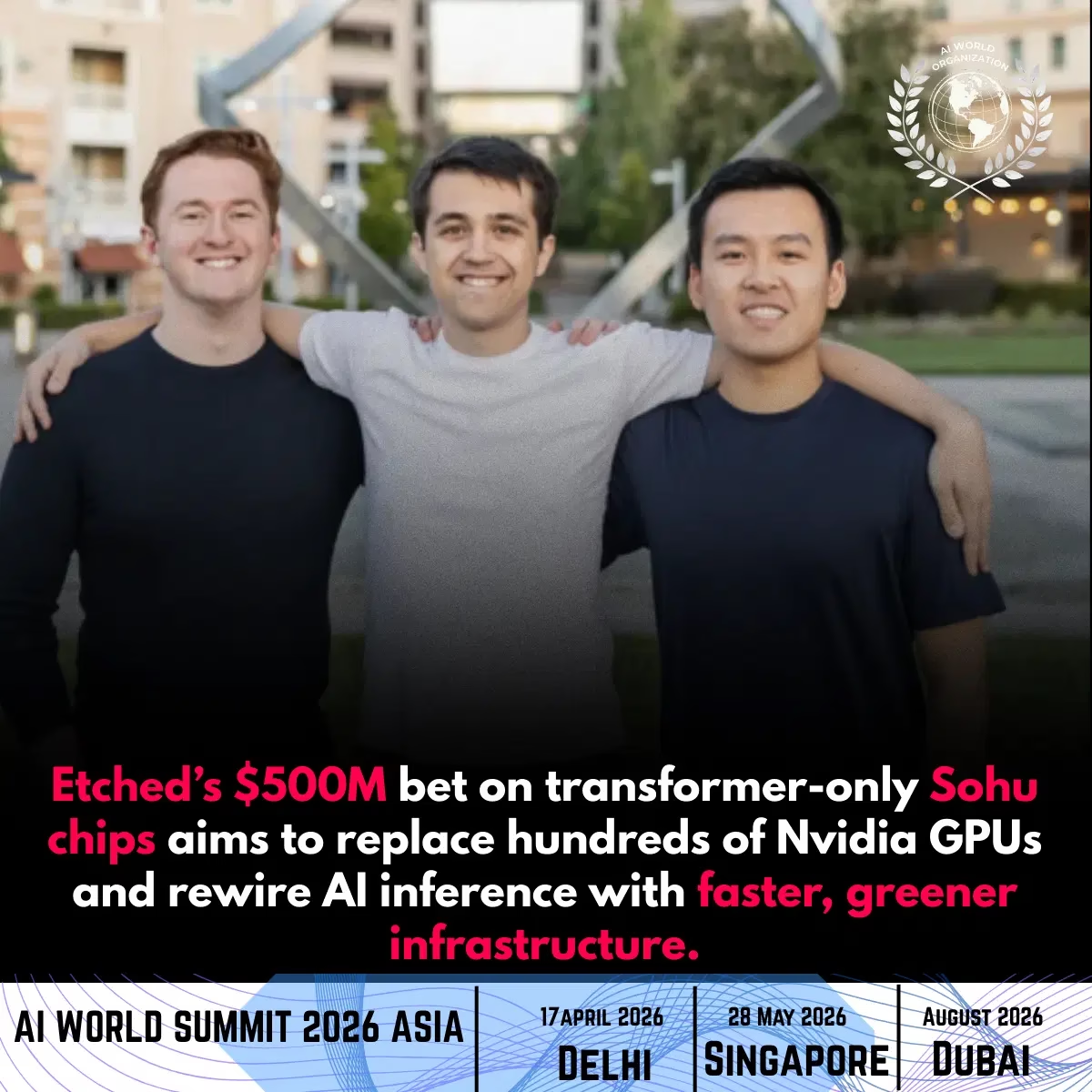
San Jose AI chip startup Etched raises $500 million to take on Nvidia
Etched’s 2026 AI chip, Sohu, promises 10–20× better performance‑per‑watt than Nvidia H100. Discover how this transformer‑only ASIC reshapes enterprise inference.