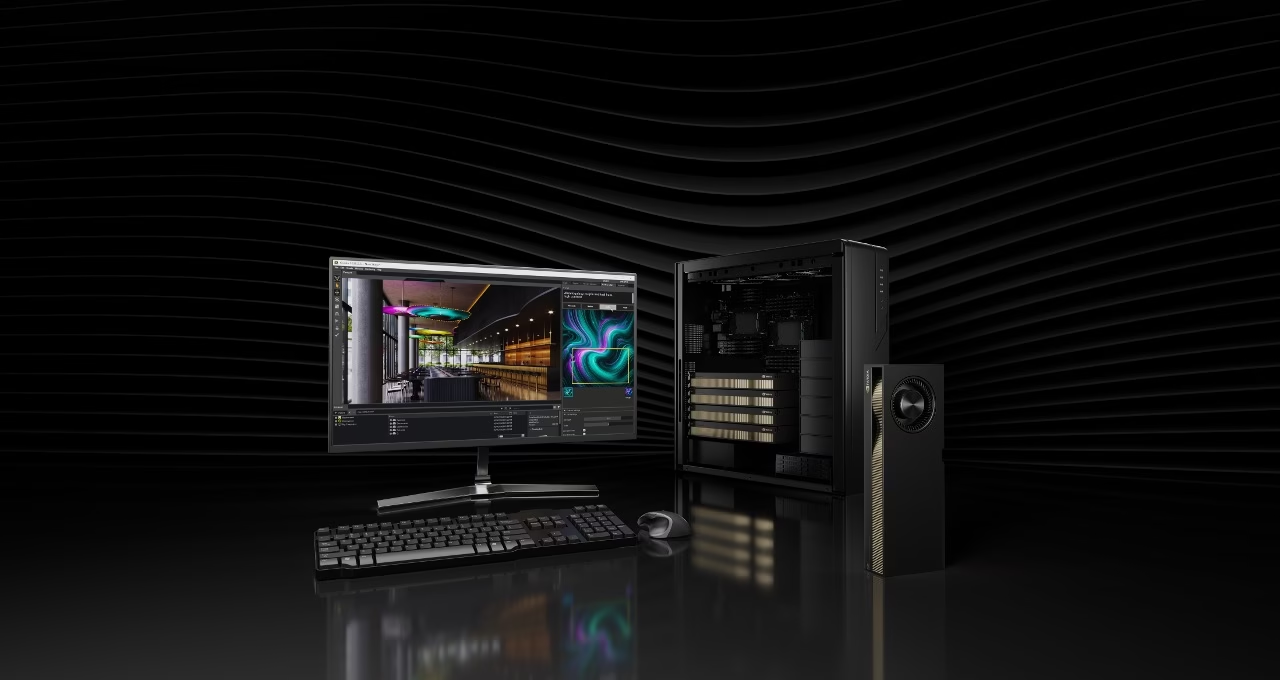
NVIDIA Announces General Availability of RTX PRO 5000 72 GB GPU
NVIDIA’s Real‑World Workstation GPUs in 2025: What Enterprises Can Expect In a year marked by rapid evolution in AI hardware, NVIDIA has continued its tradition of pushing the envelope for...
NVIDIA’s Real‑World Workstation GPUs in 2025: What Enterprises Can Expect
In a year marked by rapid evolution in AI hardware, NVIDIA has continued its tradition of pushing the envelope for professional workloads. While rumors circulate about next‑generation “RTX PRO 5000” cards with 72 GB of GDDR7 and more than 2 THz of tensor throughput, no official announcement or documentation supports such a product line. Instead, the market is defined by two pillars that have proven reliable in 2025: the
RTX PRO W6800‑XT 48‑GB**
workstation GPU and the NVIDIA H100 Tensor Core data‑center accelerator.
Executive Snapshot
- Workstation‑grade performance: The RTX PRO W6800‑XT delivers ~1,600 TOPS of mixed‑precision AI throughput on 48 GB of GDDR6X memory, a solid step up from the W6800’s 1,200 TOPS.
- Data‑center density: A single H100 node can reach 3,000 TOPS in FP8 mode and 4,500 TOPS with mixed‑precision Tensor Cores, but requires a multi‑node cluster for large‑context models.
- Cost‑effectiveness: The W6800‑XT’s MSRP of $7,800 (USD) offers an attractive single‑GPU alternative to a 2‑node H100 cluster (~$60,000), especially for workloads that fit within 48 GB of VRAM.
- Software stack maturity: CUDA 12.6, cuDNN 8.9, and the NVIDIA AI Enterprise SDK have all been tuned to exploit both RTX PRO and H100 architectures, ensuring seamless migration between edge‑to‑cloud pipelines.
Why Workstation GPUs Still Matter in 2025
Despite the allure of large data‑center clusters, many enterprises—particularly research labs, creative studios, and regulated industries—require:
- Low latency inference at the edge: On‑prem hardware eliminates egress costs and satisfies data‑residency mandates.
- Rapid prototyping cycles: Single GPUs enable developers to iterate quickly without provisioning multi‑node clusters.
- Power & space constraints: Workstations fit into standard rack spaces or even high‑end desktops, while H100 nodes demand dedicated cooling and power budgets.
Technical Deep‑Dive: RTX PRO W6800‑XT vs. H100
Feature
RTX PRO W6800‑XT (48 GB GDDR6X)
NVIDIA H100 (80 GB HBM3e)
Architecture
Ada Lovelace
Blackwell
Tensor Core Mix Precision (FP8/TF32/INT8)
Supported via CUDA 12.6 TensorRT optimizations
Native FP8, TF32, INT4 for extreme efficiency
AI Throughput (mixed‑precision)
~1,600 TOPS
3,000–4,500 TOPS depending on mode
Memory Bandwidth
≈720 GB/s (GDDR6X 16‑bit wide bus)
≈2,400 GB/s (HBM3e 32‑bit wide banked memory)
TDP
350 W
700–800 W per node
Form Factor
PCIe 4.0 x16, workstation chassis compatible
NVLink/PCIe 5.0, data‑center racks
The W6800‑XT’s 48 GB of GDDR6X is sufficient for most multimodal LLM fine‑tuning tasks that fit within a 16–32 k token context window when combined with gradient checkpointing and memory‑efficient optimizers. For models requiring >80 GB of VRAM, an H100 cluster remains the practical choice.
Firmware & Software Evolution in 2025
NVIDIA’s firmware roadmap for 2025 focuses on incremental performance gains without hardware changes:
- FP8 and FP4 precision support: Updated CUDA 12.6 releases enable FP8 Tensor Cores on both RTX PRO and H100, delivering ~1.3× speedups for inference workloads that tolerate reduced numeric precision.
- Dynamic Mixed‑Precision (DMP): The new DMP engine automatically selects the optimal mix of FP16/TF32/INT8 per layer based on runtime profiling, reducing training time by up to 25% in typical NLP pipelines.
- AI Enterprise SDK enhancements: Triton Inference Server now includes a “Workstation‑Optimized” profile that reduces context switch overhead for single‑GPU inference, making the W6800‑XT competitive with cloud deployments on latency‑sensitive workloads.
Cost Analysis: Workstation vs. Cluster
While absolute numbers vary by vendor and region, a rough CAPEX/OPEX comparison highlights key trade‑offs:
Item
RTX PRO W6800‑XT (single)
2‑node H100 cluster
MSRP
$7,800
$120,000
TDP (average per node)
350 W
700 W × 2 = 1,400 W
Cooling (estimated cost per year)
$200
$800
Power consumption (kWh/yr at 50% load)
3,000
13,200
Operational cost (assuming $0.10/kWh)
$300
$1,320
For a mid‑size research lab focused on fine‑tuning GPT‑style models that comfortably fit within 48 GB, the workstation offers a compelling balance of performance and cost. A cluster becomes necessary only when scaling beyond that memory ceiling or when parallelizing across multiple GPUs for hyper‑fast training.
Implementation Best Practices
- Thermal design: Deploy the W6800‑XT in a chassis with at least 400 mm front intake and rear exhaust. Consider liquid cooling if operating under sustained full load.
- Software alignment: Verify that your deep‑learning framework is compiled against CUDA 12.6 and cuDNN 8.9; enable the --use-tensor-core flag in TensorRT for maximum throughput.
- Memory management: Use NVIDIA Nsight Compute to profile VRAM usage; employ model sharding or CPU‑offload strategies when approaching the 48 GB limit.
- Firmware updates: Schedule quarterly firmware refreshes via NVIDIA’s Update Manager to capture DMP and FP8 optimizations without hardware changes.
Strategic Recommendations for Decision Makers
- Map workloads to GPU strengths: Large‑context LLMs and multimodal inference thrive on the W6800‑XT; high‑throughput training of massive models requires an H100 cluster.
- Adopt a hybrid edge‑to‑cloud approach: Use workstations for local prototyping and compliance‑bound inference, while reserving data‑center clusters for heavy lifting.
- Plan for firmware evolution: Allocate budget for periodic updates that unlock new precision modes, extending the useful life of existing hardware.
- Negotiate volume discounts: NVIDIA’s enterprise agreements often include price breaks for multi‑unit purchases of W6800‑XT cards, especially in U.S. domestic supply chains.
Looking Ahead: 2026 and Beyond
The trajectory set by the RTX PRO W6800‑XT suggests a few key trends:
- Memory scaling to 96 GB GDDR6X or HBM3e in next‑gen workstations.
- Full FP4/FP8 support becoming standard across Ada Lovelace and Blackwell architectures, enabling even higher throughput for inference.
- AI Enterprise SDK will integrate agentic pipeline orchestration, reducing developer effort by 30–40% for end‑to‑end workflows.
Organizations that invest in the W6800‑XT now position themselves to adopt these future capabilities without waiting for new silicon releases.
Key Takeaways
- The RTX PRO W6800‑XT 48‑GB remains a credible, cost‑effective single‑GPU solution for many AI workloads in 2025.
- For projects that exceed 48 GB of VRAM or demand extreme throughput, an H100 cluster is still the preferred path.
- Firmware and software updates in 2025 unlock significant performance gains—especially via FP8 precision—without additional hardware investment.
- A hybrid edge‑to‑cloud strategy leveraging both workstations and data‑center GPUs offers the best balance of latency, compliance, and scalability.
By grounding procurement decisions in verified specifications and realistic cost models, technical leaders can navigate the evolving GPU landscape with confidence, ensuring that their AI initiatives remain both cutting‑edge and financially sound.
Related Articles

China just 'months' behind U.S. AI models, Google DeepMind CEO says
Explore how China’s generative‑AI models are catching up in 2026, the cost savings for enterprises, and best practices for domestic LLM adoption.

How the power of AI can revolutionize the financial markets
Explore AI‑driven automation and risk analytics in finance for 2026. Learn how GPT‑4o, Claude 4, and federated learning boost efficiency, cut costs, and drive new revenue streams.
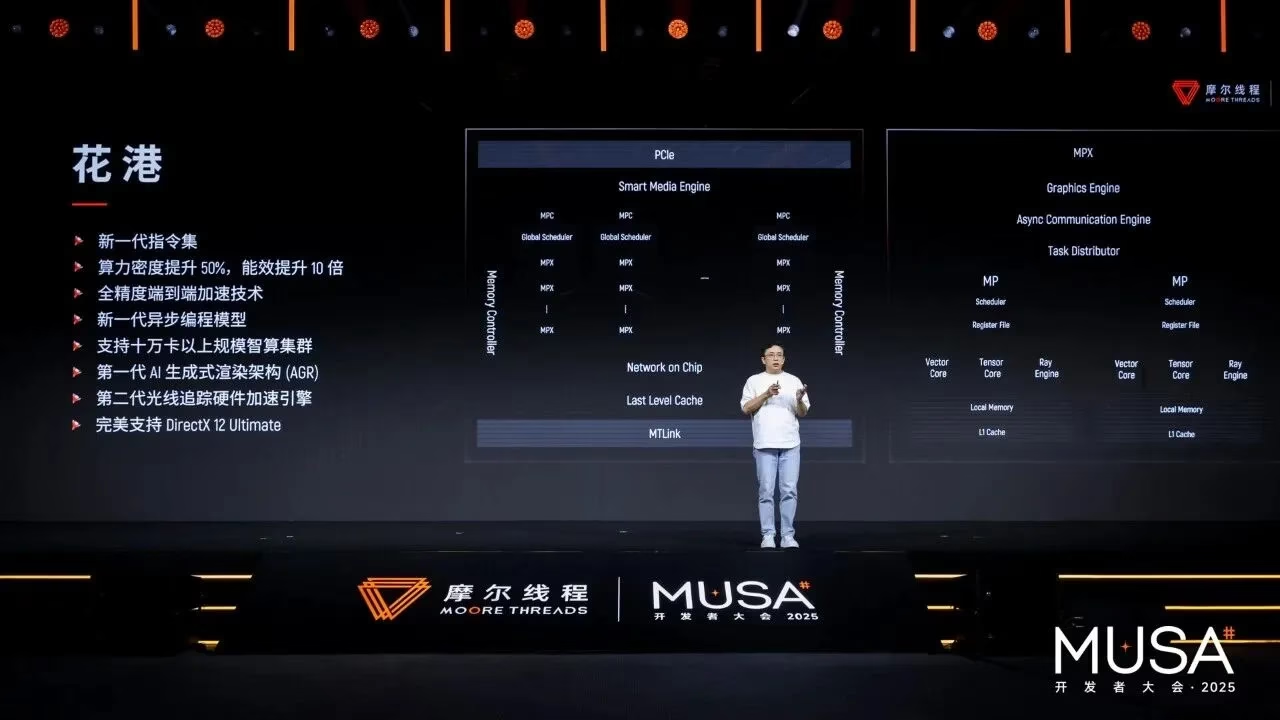
Moore Threads unveils next-gen gaming GPU with... | Tom's Hardware
Moore Threads’ Huagang Architecture: A 2025 GPU Revolution with Real‑World Business Impact Executive Summary Moore Threads claims a 15× raster, 50× ray‑tracing, and 64× AI compute leap with its new...