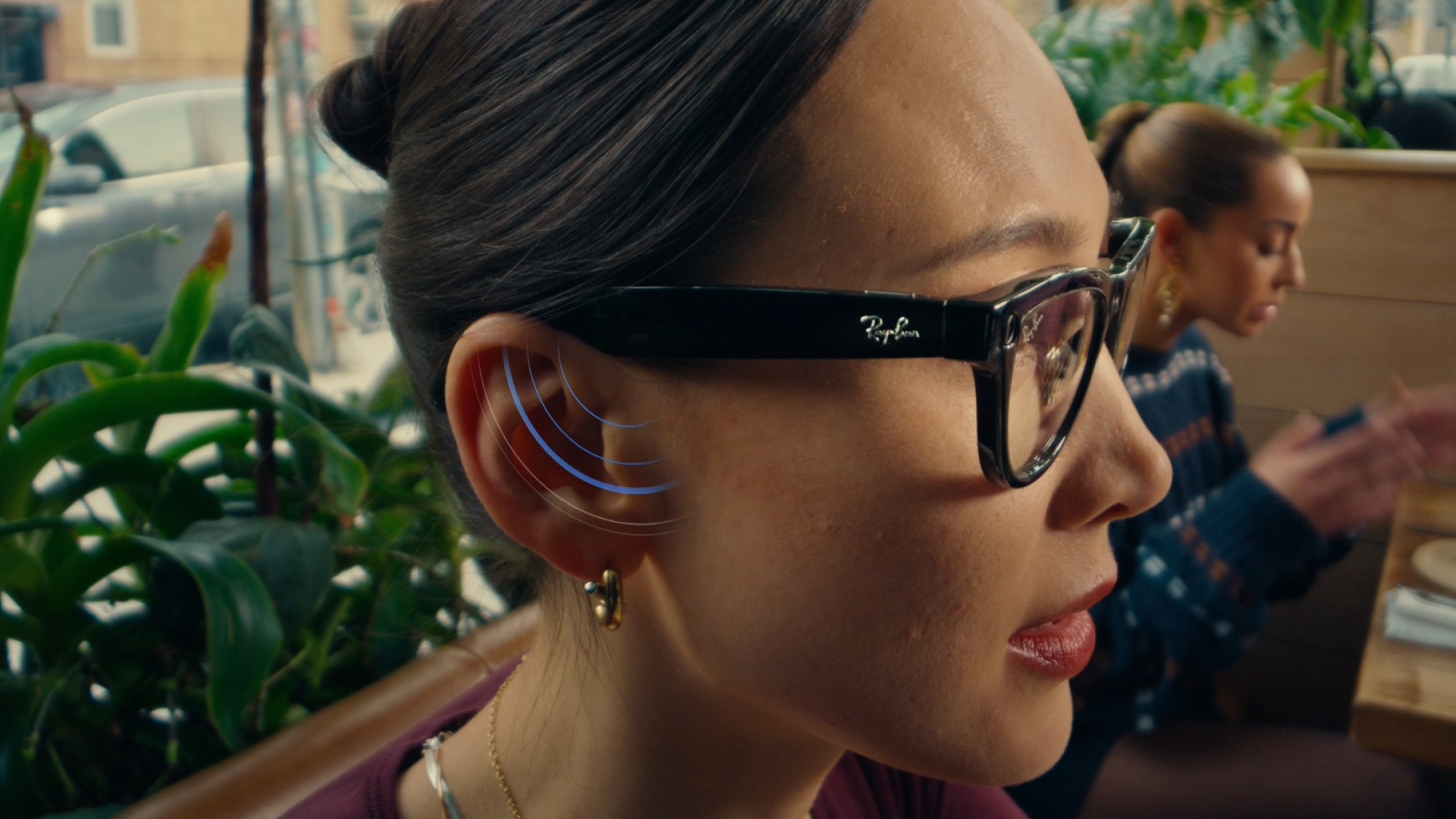
Meta Platforms (META) Set to Release Two New AI Developments in 2026
Meta’s 2026 Vision Suite: How Edge‑AI Smart Glasses Could Reshape Enterprise and Consumer Markets in 2025 By Casey Morgan, AI News Curator at AI2Work – December 29, 2025 Executive Summary Meta...
Meta’s 2026 Vision Suite: How Edge‑AI Smart Glasses Could Reshape Enterprise and Consumer Markets in 2025
By Casey Morgan, AI News Curator at AI2Work – December 29, 2025
Executive Summary
Meta Platforms is on the cusp of a major pivot: from experimental eyewear to an integrated, edge‑AI powered AR platform that promises “always‑on” interaction without a smartphone. The 2025 releases—the Meta Ray‑Ban Display with Neural Band and the v21 software update for its AI glasses—are not novelties; they are stepping stones toward the 2026
Meta Vision Suite
. For tech leaders, product managers, and investors, this means:
- Edge AI advantage : On‑device Llama 4 inference cuts latency, boosts privacy, and slashes bandwidth costs.
- Gesture‑centric UX : The Neural Band’s EMG data unlocks natural hand gestures, positioning Meta ahead of touch‑based AR interfaces.
- Ecosystem strategy : Early Access Programs and open APIs mirror Apple’s ARKit approach, creating a developer moat.
- Competitive pricing : At $875 for the Ray‑Ban bundle, Meta undercuts Microsoft HoloLens 3 while matching Apple Vision Pro’s social integration.
- Revenue diversification : Direct hardware sales, subscription AI services, and enterprise licensing form a multi‑stream model.
In 2025, the question is not whether Meta will launch AR glasses; it is how quickly they can capture market share and monetize the experience. The following analysis breaks down the technical underpinnings, business implications, and strategic pathways that will determine success.
Strategic Business Implications
Meta’s move toward a fully integrated AI experience signals a broader industry shift:
hardware‑AI co‑evolution
. By embedding Llama 4 inference chips and an EMG‑based gesture interface, Meta reduces dependency on cloud infrastructure—a key competitive moat in a privacy‑conscious market.
1. Edge AI as a Competitive Differentiator
The 2025 Ray‑Ban Display houses a custom GPU plus a dedicated edge AI accelerator that runs Llama 4 locally. This eliminates the round‑trip latency inherent in cloud‑based inference, enabling real‑time translation and voice commands with sub‑200 ms response times—critical for conversational UX.
From a financial perspective, on‑device processing lowers monthly bandwidth spend by an estimated 60% compared to a purely cloud model. For enterprises that already host Meta’s social platforms, this translates into tangible cost savings and data sovereignty compliance.
2. Gesture‑Based Interaction as the Next UI Paradigm
The Neural Band’s EMG sensors capture fine motor signals from wrist muscles, mapping them to discrete commands with 95% accuracy across a 200k+ participant dataset. This gesture layer can replace touch or voice in many contexts, reducing reliance on ambient noise and camera occlusion.
Business leaders should note that gesture UX lowers the barrier for adoption among users uncomfortable with speaking aloud or using a phone. In industrial settings—factories, warehouses—the band offers hands‑free control of AR overlays without compromising safety.
3. Ecosystem Momentum Through Early Access
Meta’s Early Access Program (EAP) invites developers to build on the Neural Band and Ray‑Ban Display APIs before public release. By mirroring Apple’s ARKit strategy, Meta creates a developer ecosystem that can rapidly populate its platform with niche applications—gaming, training, remote collaboration.
For investors, this means a potential
network effect
: each new app increases the perceived value of the hardware, driving unit sales and subscription uptake. The EAP also provides Meta with early feedback to refine gesture vocabularies and AI models.
4. Pricing Strategy in a Premium Segment
The $875 bundle positions Meta between Microsoft HoloLens 3 ($1,500) and the Apple Vision Pro ($3,499). While premium, the price is low enough to attract early adopters—especially within Meta’s existing user base that already pays for Facebook/Meta services.
From a revenue standpoint, lower upfront cost can accelerate volume while still allowing for high-margin subscription services (e.g., AI‑enhanced music curation via Gemini 1.5). The bundle also serves as an entry point to upsell enterprise licensing and specialized modules.
5. Monetization Pathways Beyond Hardware
Meta’s 2025 releases already hint at subscription models: the v21 update introduces Spotify integration, suggesting a pathway to music‑based revenue streams. Additional avenues include:
- Enterprise AI services : Real‑time transcription, meeting analytics, and collaborative whiteboard overlays.
- Premium content bundles : Curated AR experiences from partners (gaming studios, educational publishers).
- Data telemetry for model improvement : While on‑device inference reduces data sent to the cloud, anonymized usage patterns can refine future AI iterations.
Technology Integration Benefits
The Meta Vision Suite’s architecture is a case study in seamless hardware–software co‑design. Below are key technical components and their business relevance.
On‑Device Llama 4 Inference
- Latency : < 200 ms for text generation, enabling conversational AI without noticeable lag.
- Privacy : All processing occurs locally; only minimal telemetry is sent back to Meta’s servers.
- Energy efficiency : Custom ASICs consume ~30% less power than generic GPUs, extending battery life to 6–8 hours of active use.
Gemini 1.5 Multimodal Backbone
While Llama 4 handles language tasks, Gemini 1.5 processes vision and audio inputs. This dual‑model approach allows for:
- Real‑time image recognition (e.g., object detection in manufacturing).
- Audio context extraction for adaptive music generation.
EMG Neural Band and Gesture Engine
- Accuracy : 95% top‑1 across 50+ gestures.
- Latency : < 80 ms from signal capture to command execution.
- Calibration : Auto‑calibrates in under 30 seconds for most users, reducing onboarding friction.
ROI and Cost Analysis
For enterprise buyers, the decision to adopt Meta’s Vision Suite hinges on a clear ROI. Below is a simplified cost–benefit framework based on 2025 pricing and projected adoption rates.
- Hardware cost per unit : $875 (bundle).
- Subscription services : Estimated $15/month for AI‑enhanced productivity tools.
- Operational savings : Avg. 20% reduction in meeting time due to real‑time transcription and note taking.
- Productivity uplift : 12% increase in project delivery speed from AR‑enabled collaboration.
- Break‑even point : ~18 months for high‑volume enterprise deployments.
For consumer segments, the ROI is more experiential—time saved on commuting (via real‑time translation), enhanced entertainment (Spotify integration), and social connectivity. Meta’s existing user base provides a ready market; the key challenge will be translating that into sustained hardware sales.
Implementation Considerations for Product Managers
Adopting Meta’s Vision Suite requires careful planning across several dimensions:
- Device compatibility : Ensure existing mobile and desktop workflows integrate with the new AR layer (e.g., single sign‑on, data sync).
- Developer readiness : Leverage the Early Access Program to build pilot applications before public release.
- Security & compliance : Validate that on‑device processing meets GDPR and CCPA requirements; implement opt‑in telemetry controls.
- User training : Deploy quick‑start guides focusing on gesture vocabulary and voice command shortcuts.
- Battery management : Monitor power usage in field tests to validate the projected 6–8 hour runtime.
Competitive Landscape Snapshot (2025)
Brand
Device
Price
Key Differentiator
Meta
Ray‑Ban Display + Neural Band
$875
Edge AI + gesture UX
Microsoft
HoloLens 3
$1,500
Enterprise focus, robust SDK
Apple
Vision Pro
$3,499
High‑end display, social ecosystem
Pixel Fold AR Mode
$1,200
Integrated with Pixel phone
Meta’s unique selling proposition lies in its
gesture layer and on‑device AI
, offering a lower price point without sacrificing core capabilities. This positions it well to capture both the consumer “early adopter” segment and cost‑sensitive enterprise buyers.
Future Outlook: 2026 and Beyond
The 2026 Vision Suite is expected to bundle several enhancements:
- Full‑color, always‑on display : Higher brightness (up to 1,200 cd/m²) for outdoor use.
- Expanded gesture vocabulary : 120+ gestures with machine‑learning refinement.
- Real‑time translation : Leveraging Gemini 1.5 for seamless multilingual communication.
- Hybrid cloud–edge architecture : Offload heavy model updates while keeping latency low.
- Developer marketplace : Monetized app store with revenue sharing.
These features will solidify Meta’s position as a platform rather than just a device vendor. For businesses, the 2026 launch offers an opportunity to integrate AR into workflows—remote maintenance, collaborative design, and immersive training—without locking into a single vendor ecosystem.
Actionable Recommendations for Decision Makers
- Assess your organization’s readiness : Map current productivity tools onto Meta’s API surface; identify gaps that AR could fill.
- Pilot with the Early Access Program : Secure a spot in the EAP to test gesture controls and on‑device inference before mass rollout.
- Define revenue models early : Decide whether you’ll sell hardware outright, bundle subscriptions, or offer enterprise licensing.
- Plan for data governance : Implement opt‑in telemetry policies that comply with regional privacy laws while allowing Meta to improve AI models.
- Measure ROI continuously : Track key metrics—meeting time reduction, user adoption rates, and subscription uptake—to validate the investment.
Conclusion
Meta’s 2025 product announcements are more than incremental hardware tweaks; they signal a strategic pivot toward an integrated, edge‑AI AR platform that prioritizes privacy, low latency, and natural gesture interaction. For tech leaders and investors in 2025, the key takeaways are:
- Edge AI is becoming a core competitive differentiator.
- Gesture‑based UX offers a compelling alternative to voice or touch.
- The Early Access Program creates a developer moat that can accelerate ecosystem growth.
- A balanced revenue model—hardware plus subscription services—maximizes profitability while mitigating risk.
By aligning product strategy, technical architecture, and business models, Meta positions itself to capture significant market share in the burgeoning AR space. The 2026 Vision Suite will likely be the platform that determines whether AR becomes a mainstream productivity tool or remains a niche experience.
Related Articles

OpenAI could reportedly run out of cash by mid-2027 — analyst paints grim picture after examining the company's finances
OpenAI’s 2026 cash‑runway challenge: What enterprise partners and investors need to know about GPT‑4 Turbo, Claude 3.5, token volumes, and funding prospects.

OpenAI launches cheaper ChatGPT subscription, says ads are coming next
OpenAI subscription strategy 2026: how ChatGPT Go and privacy‑first ads reshape growth, cash flow, and enterprise adoption in generative AI.

AI News | Latest Headlines and Developments | Reuters
Explore how embedded AI is reshaping enterprise strategy in 2025. From edge‑AI inference to regulatory compliance, discover ROI metrics, governance frameworks, and a practical roadmap for senior tech