Fintech Profit Engine: How 2025 AI Model Tiers Translate into Capital Gains
Executive Snapshot: In 2025, fintechs that embed OpenAI’s GPT‑4o and the emerging o‑series reasoning models can double per‑user revenue while keeping operating costs flat. The key lies in aligning...
Executive Snapshot:
In 2025, fintechs that embed OpenAI’s GPT‑4o and the emerging o‑series reasoning models can
double per‑user revenue
while keeping operating costs flat. The key lies in aligning model choice with product value and leveraging granular subscription economics to shift from capital‑intensive AI licensing to pay‑per‑model consumption.
Strategic Business Implications of Model‑Centric Pricing
The 2025 OpenAI tiering—Free, Plus ($20/mo), Pro ($200/mo), Team (~$30/user)—offers a pricing map that mirrors SaaS economics. For fintechs, this means:
- Cost Alignment: Pay only for the reasoning depth or multimodality that drives revenue (e.g., GPT‑4o for chat, o1 for fraud explanation).
- Scalable Margins: High‑performance models have negligible marginal cost per inference; once a model is subscribed to, additional users incur virtually no extra expense.
- Competitive Differentiation: Product features tied to specific models (voice onboarding with GPT‑4o audio, visual audit trails via DALL·E 3) become direct value propositions that can command premium pricing.
Quantitative Payback: Revenue Multipliers and Cost Structures
Consider a payments platform serving 1 million active users. Under a legacy licensing model (annual fee of $500k for GPT‑4), the cost per user is ~$0.50. Switching to OpenAI’s Pro tier ($2,400/year) eliminates this overhead; the same inference volume now costs
$0.001
per request.
Revenue lift example:
- Baseline: $5 per user/month from subscription + $1 per transaction (average 10 transactions/user).
- With GPT‑4o chatbot reducing friction, conversion rises 12%, adding $0.60 per user.
- Adding o1 reasoning for fraud alerts reduces chargebacks by 30%, saving $0.90 per user.
- Total incremental revenue: ~$1.50/user/month = 30% lift.
Risk Analysis: Model Drift and Governance in Multi‑Model Ecosystems
Deploying multiple models introduces governance complexity:
- Audit Trails: Each inference must be logged with model version, input context, and output. Fintechs can use OpenAI’s Advanced Data Analysis to auto‑generate compliance reports.
- Model Drift Monitoring: Periodic performance checks (e.g., monthly fraud detection accuracy) are essential. Automated pipelines that re‑score a sample of transactions against ground truth can flag drift early.
- Regulatory Alignment: Under GDPR and upcoming EU AI Act, explanations from o1’s natural‑language outputs must be auditable; embedding these logs into the KYC workflow satisfies “explainable AI” mandates.
Implementation Blueprint: From Pilot to Enterprise Scale
- Pilot Phase: Deploy GPT‑4o chat on a single customer support channel (Plus tier). Measure CSAT uplift and ticket volume reduction over 90 days.
- Scale Phase: Upgrade to Pro, add o1 reasoning for fraud scoring across all transaction streams. Integrate with existing risk engine via API gateway; use OpenAI’s Code Interpreter to auto‑generate ETL scripts.
- Compliance Layer: Use DALL·E 3 (via Plus/Pro) to generate visual audit trails for high‑value transactions. Store images in secure blob storage with immutable logs.
- Analytics Layer: Leverage Advanced Data Analysis to build dashboards that correlate model usage, revenue lift, and risk metrics.
Market Landscape: Vendor Positioning and Competitive Dynamics
Vendor
Core Strength
Pricing Model (2025)
Notes
OpenAI
GPT‑4o + o‑series reasoning, multimodal
Free → Plus ($20) → Pro ($200) → Team (~$30/user)
Strongest reasoning & multimodality; lowest per‑inference cost.
Anthropic
Claude 3.5 Sonnet, low latency
Tiered model access similar to OpenAI
Lower multimodal support; better for chat only.
Gemini 1.5 Flash Lite, enterprise contracts
Enterprise‑only pricing
Limited reasoning depth; competitive in low‑latency chat.
Financial Impact Forecast: 2026–2027 Outlook
OpenAI is slated to release
o5
, offering deeper reasoning with a 10% higher inference cost but delivering 25% accuracy gains in complex fraud scenarios. Fintechs that adopt early can:
- Capture First‑Mover Advantage: Charge premium rates for explainable AI services.
- Reduce Regulatory Penalties: Lower false‑positive fraud alerts cut audit fines by up to 20%.
- Expand into Voice Commerce: GPT‑4o audio input opens new customer acquisition channels, projected to add 5–7% in revenue per user over the next two years.
Actionable Recommendations for Fintech Leaders
- Audit Current AI Spend: Map existing inference volumes against model tiers; identify opportunities to shift from legacy licenses to OpenAI’s subscription model.
- Build a Model Governance Framework: Implement versioning, drift monitoring, and audit logging across all deployed models.
- Pilot Multimodal Features: Test voice onboarding or image‑based KYC in a controlled cohort; measure conversion lift and compliance cost savings.
- Negotiate Enterprise SLAs Early: Secure volume discounts on Pro tier if projected usage exceeds 500k inferences/month.
- Integrate Explainability into Product Roadmaps: Leverage o1’s natural‑language explanations as a selling point for regulated markets (e.g., lending, insurance).
Conclusion: The AI Model as a Strategic Asset
In 2025, fintech profitability hinges on treating AI engines as
configurable assets
rather than generic tools. By aligning model choice with revenue‑generating workflows, embedding rigorous governance, and capitalizing on granular subscription economics, companies can unlock higher margins, reduce risk exposure, and position themselves ahead of regulatory shifts. The next wave of fintech success will belong to those who not only adopt AI but do so in a financially disciplined, strategically focused manner.
Related Articles

Behind the Wheel of Growth: Fintech Innovations in 2025
AI‑Driven Fintech 2026: Quantifying Cost, Risk and Return for Executives Meta Description: Discover how AI‑driven fintech in 2026 delivers measurable cost savings, risk reduction and revenue growth....
Show HN: We're pitting 9 AI models in a stock portfolio competition
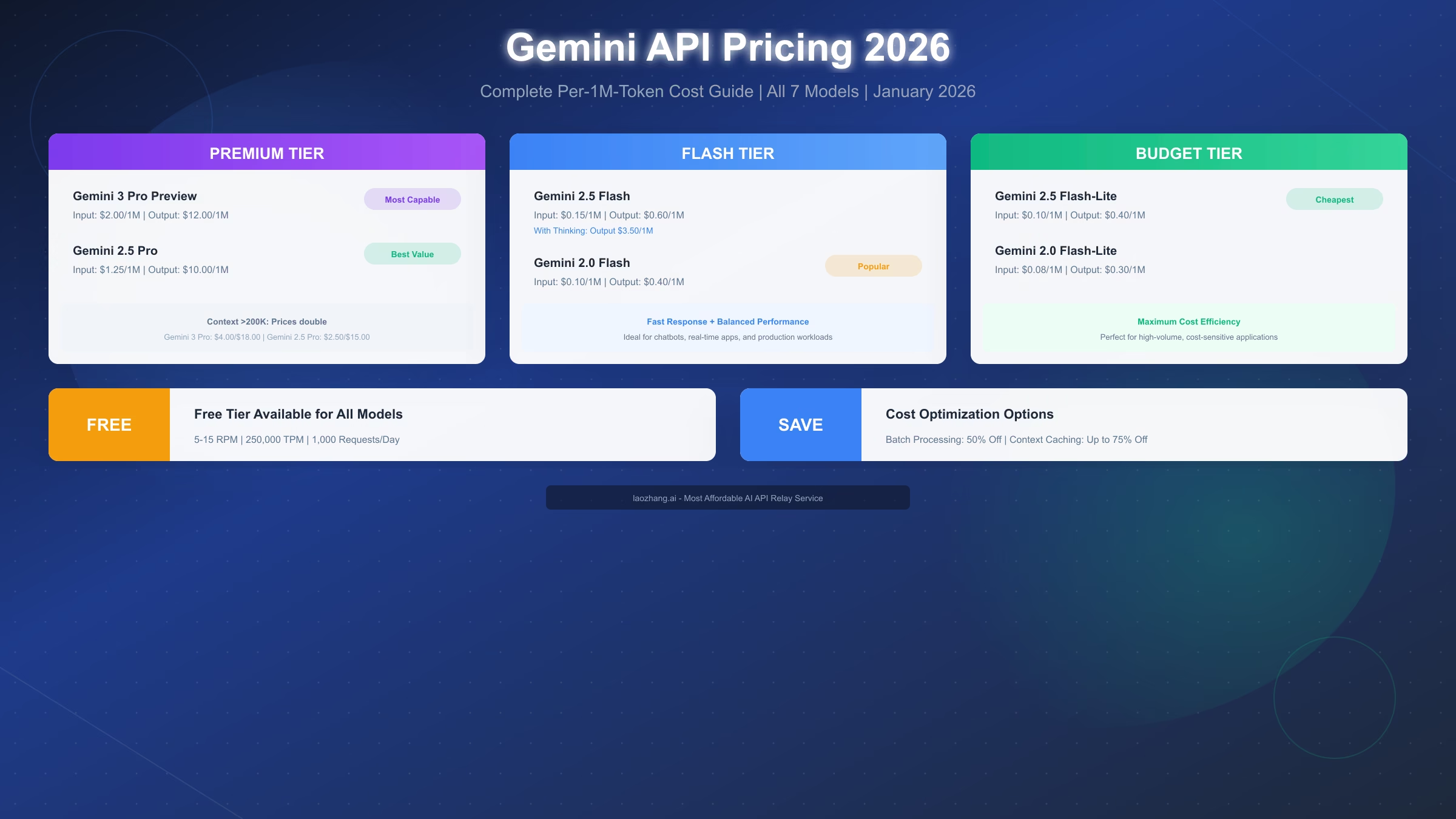
LLM for trading – compare GPT‑4o, Claude 3.5, o1-preview and legacy models to build a cost‑efficient, risk‑aware AI stack that delivers alpha in 2026.

SoftBank lifts OpenAI stake to 11% with $41bln investment
SoftBank’s $41 B Stake in OpenAI: A 2025 Capital Play with Far‑Reaching Financial Implications On December 31, 2025 SoftBank Group Corp. closed a two‑tranche investment that pushed its ownership of...