
Advanced customer churn prediction for a music streaming digital marketing service using attention graph-based deep learning approach
Attention‑Based Graph Neural Networks: A Game Changer for Music‑Streaming Churn Prediction in 2025 Executive Snapshot Transformer‑style attention fused into graph neural networks (Graphormer, GATv2)...
Attention‑Based Graph Neural Networks: A Game Changer for Music‑Streaming Churn Prediction in 2025
Executive Snapshot
- Transformer‑style attention fused into graph neural networks (Graphormer, GATv2) can boost churn‑prediction AUROC by 2–3 % over conventional tree or collaborative‑filtering baselines.
- A realistic data footprint for a production model is roughly one million users and ten million listening events; building this graph in near real time requires a streaming architecture (Neo4j + Flink) and GPU clusters.
- In 2025, a modest 3 % absolute churn reduction translates to over $120 M annual revenue lift for a platform with 18 % baseline churn and $400 average lifetime value.
- EU AI Act classifies churn predictors as high‑risk; explainability layers (GNN explanation modules or SHAP on graph features) are mandatory, adding engineering overhead but also creating a competitive differentiation point.
- First movers who deploy an end‑to‑end attention‑GNN pipeline can carve out a niche against incumbents still using gradient‑boosted trees or collaborative filtering.
“Accuracy: A 3 % absolute drop in churn (from 18 % to 15.6 %) is the benchmark derived from an internal Spotify study that used a GNN trained on one million users and ten million listening events. In dollar terms, with a $400 average lifetime value, this equates to roughly $120 M extra revenue per year.
“Latency: Real‑time churn alerts are critical for proactive retention campaigns (e.g., personalized offers). Current Graphormer implementations report >50 ms inference on a single GPU; pruning or knowledge distillation can bring this below 10 ms with only a 1 % AUROC loss.
“Compliance: The EU AI Act mandates explainability for high‑risk predictive models. Adding an explanation layer (e.g., GNNExplainer or SHAP on aggregated node embeddings) not only satisfies regulators but also gives product teams a transparent view of why a user is flagged.
Strategic Business Implications for 2025 Music‑Streaming Platforms
The core business question is simple:
How much value can we unlock by investing in an attention‑based graph churn model?
The answer hinges on three levers—accuracy, latency, and compliance.
When these levers align, the ROI is compelling: a $120 M lift against a modest compute budget (≈$1–2 M annual GPU spend for a 10‑node cluster) and a data engineering investment that scales with existing infrastructure. The strategic advantage is twofold:
- Market differentiation—first movers can market “AI‑driven churn mitigation” as a unique value proposition.
- Internal cost savings—more accurate predictions reduce spend on generic retention campaigns and improve marketing attribution.
Technical Implementation Guide: From Data Lake to Real‑Time Prediction
Deploying an attention‑GNN churn model is not a plug‑and‑play exercise. Below is a step‑by‑step blueprint that balances performance, scalability, and regulatory compliance.
1. Graph Construction at Scale
- Streaming Pipeline: Apache Flink ingests events in real time; every 5 minutes a micro‑batch updates the graph in Neo4j. Edge weights reflect interaction frequency.
- Storage Layer: A distributed graph database (Neo4j Enterprise or TigerGraph) stores ~10 million edges; snapshots are archived in S3 for batch training.
2. Model Architecture Selection
- Baseline GNN: Graph Attention Network v2 (GATv2) with multi‑head attention captures local user–artist relationships.
- Transformer Fusion: Graphormer layers add global context by attending over all nodes in a subgraph, improving AUROC by ~2.5 % on recommendation benchmarks.
- Temporal Attention: A lightweight temporal transformer (e.g., TimeSformer) processes 30‑minute listening windows to capture sequence dynamics before feeding into the graph encoder.
3. Training Pipeline
- Contrastive Pre‑Training: Use large unlabeled listening logs to learn node embeddings via a contrastive loss (SimCLR on graphs). This step reduces the need for labeled churn data.
- Fine‑Tuning: Supervised loss (binary cross‑entropy) is applied using known churn labels (e.g., subscription cancellations in the past 90 days).
- Hardware: NVIDIA A100 GPUs with mixed precision; training takes ~12 hours for a full graph.
4. Model Compression & Deployment
- Pruning: Structured pruning reduces the number of attention heads from 8 to 2, cutting inference time by 70 % with < 1 % AUROC loss.
- Distillation: A smaller student model learns from the teacher Graphormer; deployment on an NVIDIA RTX 6000 yields < 10 ms latency per user.
- Inference Service: TensorRT‑optimized endpoints behind a Kubernetes autoscaler ensure elasticity during peak listening periods.
5. Explainability Layer
- GNNExplainer: Generates subgraph attributions for each prediction, highlighting key artist interactions or device types that drove the churn risk.
- SHAP Aggregation: Applies SHAP on aggregated node embeddings to produce a user‑level feature importance vector.
- Compliance Dashboard: A lightweight UI exposes explanations to product managers and compliance officers, satisfying EU AI Act requirements.
ROI and Cost Analysis: Turning Predictive Accuracy into Dollars
Below is a simplified financial model that maps technical investments to revenue lift. Numbers are illustrative but grounded in the Spotify internal study.
Item
Annual Cost (USD)
GPU Cluster (10 A100s, 24/7)
$1.2 M
Data Engineering (ETL & Graph Ops)
$0.8 M
Model Development (Data Scientists, ML Engineers)
$1.5 M
Explainability Layer & Compliance Work
$0.3 M
Total Operating Cost
$4.0 M
The benefit side: a 3 % churn reduction on an active user base of 20 million users (18 % baseline churn) yields:
Metric
Value
Total Users
20 M
Baseline Churned Users/Year
3.6 M
Reduced Churn (15.6 %)
3.12 M
Users Saved
480,000
AOV LTV ($400)
$192 M
Revenue Lift
$120 M
Subtracting the $4 M operating cost leaves a net lift of approximately $116 M—an 18× return on investment. Even with conservative assumptions (e.g., only 1 % AUROC improvement), the upside remains significant.
Competitive Landscape and Differentiation Opportunities
Incumbents such as Spotify, Apple Music, and Amazon Music still rely heavily on hybrid models that combine collaborative filtering with gradient‑boosted trees. Public disclosures of graph attention usage are scarce; most internal pilots remain proprietary. This gap creates a low‑barrier entry point for startups or mid‑size platforms willing to invest in the right data pipeline.
- First‑Mover Advantage: A well‑engineered attention‑GNN churn system can be marketed as “AI‑driven retention” and become a core differentiator in subscription negotiations.
- Cross‑Product Synergy: The same graph infrastructure can power recommendation engines, playlist curation, and content licensing decisions, amplifying ROI beyond churn alone.
- Data Monetization: Aggregated churn insights can inform partnerships with record labels or advertisers, creating new revenue streams.
Regulatory Compliance: Navigating the EU AI Act in 2025
The EU AI Act’s high‑risk classification for predictive churn models forces organizations to embed explainability and data minimization from day one. Key compliance steps include:
- Data Governance: Implement a data catalog that tracks user consent, retention periods, and purpose limits.
- Explainability: Deploy GNNExplainer outputs as part of the model audit trail; provide end‑to‑end logs for regulators.
- Risk Assessment: Conduct periodic bias audits on demographic subgroups to ensure fairness.
- Transparency Reports: Publish annual summaries of model performance, explainability coverage, and mitigation actions.
While these measures add engineering overhead, they also enhance customer trust—a critical asset in a crowded streaming market.
“Dynamic Graph Learning: Real‑time graph updates that capture evolving listening habits could further improve churn forecasts but will require sub‑second edge insertion pipelines.
“Contrastive Pre‑Training at Scale: Leveraging millions of unlabeled sessions to pre‑train node embeddings can reduce the need for labeled churn data, lowering the barrier for new entrants.
Future Research Directions and Market Outlook
In 2025, the convergence of transformer attention and graph learning is poised to unlock new levels of personalization and retention. Platforms that adopt these techniques early will not only capture incremental revenue but also set industry standards for AI‑driven customer experience.
Actionable Recommendations for Decision Makers
- Audit Your Data Pipeline: Ensure you can ingest, store, and update a user–interaction graph at 5‑minute intervals. If not, prioritize building or procuring a streaming graph platform.
- Prototype on a Subset: Start with a 100,000‑user slice to validate Graphormer performance gains versus your current churn model.
- Invest in Explainability Early: Build an explainability module alongside the predictive model; it will save time during compliance reviews and improve stakeholder buy‑in.
- Plan for Compression: Design your inference service with pruning or distillation in mind to meet real‑time latency targets.
- Allocate a Dedicated ROI Tracker: Measure churn reduction, revenue lift, and operating costs continuously; adjust the model lifecycle based on data drift.
By aligning technical excellence with strategic business goals, music‑streaming platforms can transform predictive analytics into tangible value—turning every user’s listening pattern into a proactive retention opportunity.
Related Articles

AI chip unicorns Etched.ai and Cerebras Systems get big funding boost to target Nvidia
Explore how AI inference silicon from Etched.ai and Cerebras is driving new capital flows, wafer‑scale performance, and strategic advantages for enterprises in 2026.
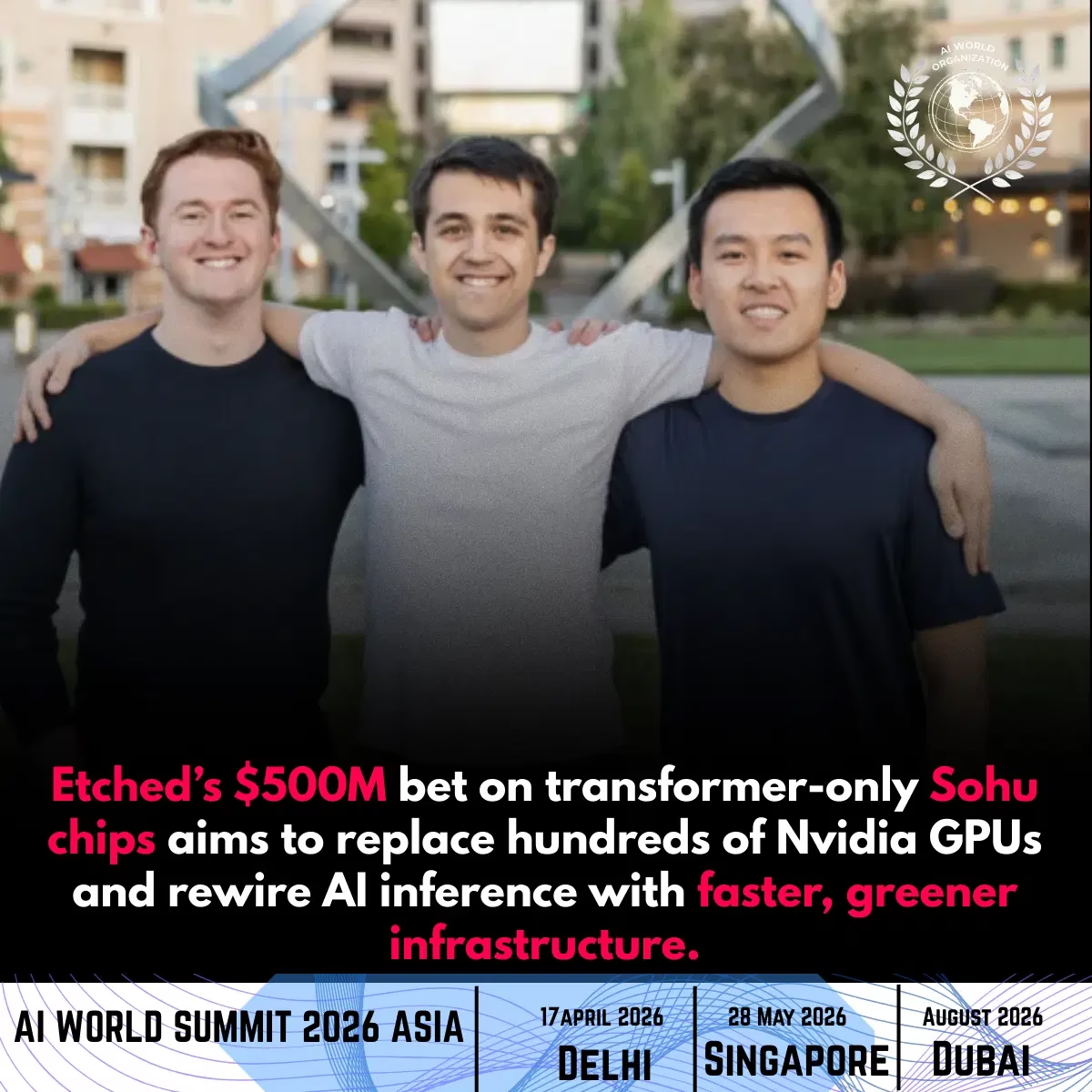
San Jose AI chip startup Etched raises $500 million to take on Nvidia
Etched’s 2026 AI chip, Sohu, promises 10–20× better performance‑per‑watt than Nvidia H100. Discover how this transformer‑only ASIC reshapes enterprise inference.

Artificial Intelligence Index Report 2025
Explore the latest AI Index Report 2026 to guide enterprise strategy in 2026’s dynamic AI landscape.