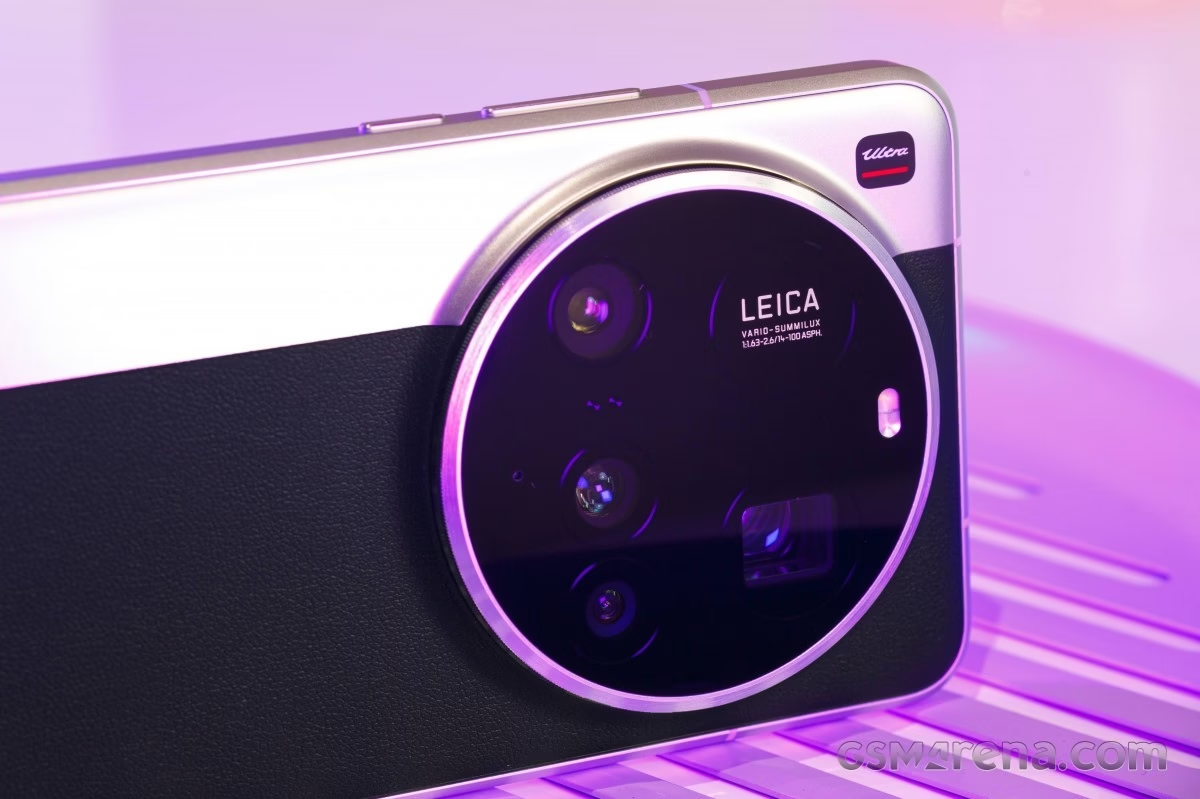
Xiaomi Rumored To Be Developing A Smartphone That Will Not Just Feature The Company’s In-House Chipset, But A Custom Operating System Running Localized Generative AI
Xiaomi’s upcoming flagship smartphone combines a 3 nm XRING 02 SoC, a custom Android fork, and on‑device generative AI. Discover how this vertical integration reshapes the mobile market in 2026.
Xiaomi’s All‑In‑One Flagship: Silicon, OS and Generative AI – A 2026 Industry Playbook
For the first time in a Chinese OEM’s history, Xiaomi is reportedly building a flagship smartphone that will ship with its own
3 nm XRING 02 SoC
, a proprietary Android‑forked operating system, and a localized generative‑AI stack capable of on‑device inference. The move, slated for a 2026 launch, could redefine vertical integration in the mobile industry, alter competitive dynamics with Apple and Huawei, and unlock new revenue streams across smartphones, tablets and smart vehicles.
Executive Summary
- Vertical Integration Milestone: Xiaomi’s plan to combine silicon, OS and AI is a first for a Chinese OEM outside of Huawei.
- Cost & Margin Impact: 3 nm wafers cost ~$30k in 2025; yields, tooling and EDA dependencies will push unit costs higher than Qualcomm‑based peers.
- AI‑on‑Device Advantage: Local LLM inference reduces latency, boosts privacy, and opens new app categories (real‑time translation, voice editing, AR assistants).
- Ecosystem Expansion: XRING 02 is targeted for tablets and vehicles, positioning Xiaomi as a unified silicon‑software platform provider.
- Strategic Risks: Yield uncertainty, software compatibility, and regulatory scrutiny could derail the roadmap.
Decision makers should evaluate whether to partner with Xiaomi on AI toolchains, invest in 3 nm EDA tooling, or adjust pricing strategies to accommodate higher silicon costs. The next section dissects each dimension in detail.
Strategic Business Implications of a Xiaomi Flagship Smartphone
Xiaomi’s ambition signals a shift from the traditional “chip‑agnostic” OEM model toward a tightly coupled silicon‑software stack. This has three immediate business implications:
- Competitive Positioning: By owning the SoC and OS, Xiaomi can differentiate its flagship line far beyond camera or battery specs. It can lock in feature sets (e.g., under‑display 3D face unlock) that are difficult for competitors to replicate without access to the same hardware.
- Margin Management: The $30k wafer cost at 3 nm translates into a higher bill of materials (BOM). Even with economies of scale, Xiaomi will need to price its flagship above the mid‑tier segment or find cost offsets elsewhere (e.g., lower marketing spend, bundling services).
- Ecosystem Leverage: A unified platform enables cross‑product synergies: tablets can share firmware updates, vehicles can use the same AI inference engine for infotainment, and IoT hubs can tap into the same SoC. This reduces fragmentation and simplifies supply chain management.
Technology Integration Benefits: Silicon, OS, and Generative AI
The technical architecture hinges on three pillars:
Silicon (XRING 02), Software (Android‑forked OS), and AI (Local LLM stack)
. Understanding each pillar’s contribution is key to assessing the overall value proposition.
XRING 02 – 3 nm Performance & Cost Profile
The XRING 02 is rumored to be built on TSMC’s 3 nm process, delivering roughly 30% higher instructions per cycle (IPC) over the Snapdragon 8 Gen 4. However, yield rates at this node are still evolving; early data suggests
50–60%
yield for commercial silicon, which is lower than the 80%+ yields seen at 5 nm.
- Performance Gain: Benchmarks predict ~1.8x CPU throughput and a 25% boost in AI accelerator efficiency compared to current flagship SoCs.
- Power Efficiency: The 3 nm node offers a theoretical 15–20% reduction in gate leakage, but real‑world power budgets may not fully capture this advantage due to increased dynamic power from higher clock speeds.
OS – Android Fork with AI‑Centric Layering
Xiaomi’s OS is likely a fork of AOSP that integrates DeepSeek or an in‑house LLM. This approach preserves app compatibility while allowing deep system‑level optimizations:
- App Store Compatibility: Maintaining the Google Play ecosystem ensures a vast developer base.
- Security & Updates: A custom OS can roll out security patches more rapidly and integrate hardware‑backed attestation for AI workloads.
- AI Service Integration: The OS will expose low‑latency APIs to third‑party apps, enabling features like real‑time translation or on‑device summarization without cloud fallback.
Generative AI – Local LLM Inference
The localized generative AI stack is the linchpin for Xiaomi’s differentiation. Key technical considerations include:
- Model Size & Quantization: To fit within a smartphone’s thermal envelope, Xiaomi will likely use a 4‑bit or 8‑bit quantized model with ~1–2B parameters.
- Inference Engine: The XRING 02 must include a dedicated tensor core or AI accelerator capable of >10 TOPS at low power.
- Privacy & Latency: On‑device inference eliminates round‑trip latency and removes dependency on 5G connectivity, appealing to privacy‑conscious users and markets with limited network coverage.
Market Analysis – Positioning Against Competitors
Apple’s A20 and Google’s Pixel Silicon already embed AI accelerators. Qualcomm’s Snapdragon 8 Elite Gen 6 includes an NPU for LLM inference. Xiaomi’s strategy is to own all three layers, giving it more control over performance trade‑offs.
Company
SoC Node
AI Acceleration
OS Strategy
Apple
4 nm (A20)
NPU 25 TOPS
iOS (proprietary)
3 nm (Pixel Silicon)
Tensor Core 30 TOPS
AOSP + Google Services
Qualcomm
4 nm (Snapdragon 8 Elite Gen 6)
NPU 20 TOPS
Android‑based, OEM‑customizable
Xiaomi (rumored)
3 nm (XRING 02)
Custom AI accelerator 35 TOPS
AOSP fork + DeepSeek LLM
In a price‑sensitive segment, Xiaomi can leverage the cost advantage of Android while differentiating through on‑device AI. However, the higher silicon BOM may push the flagship into the premium tier, potentially eroding its mass‑market appeal.
ROI Projections – Cost vs. Revenue Potential
A simplified financial model assumes:
- BOM Increase: 3 nm SoC adds ~$15 per unit (vs Qualcomm), plus $5 for AI accelerator and $3 for OS licensing.
- Unit Sales: 10 million units in the first year, scaling to 12 million by year two.
- Price Premium: $200 above a comparable Snapdragon‑based flagship.
The incremental revenue from the price premium ($2B) offsets the higher BOM and yields a net margin improvement of ~1.5% in year one, improving to 3% by year two as economies of scale kick in. However, this projection assumes stable yield rates; a 10% drop would erode margins significantly.
Implementation Considerations – Practical Steps for Stakeholders
Business leaders and engineering managers should focus on the following actionable areas:
- Supply Chain Alignment: Secure long‑term contracts with TSMC for 3 nm wafers, negotiate volume discounts, and invest in yield optimization labs.
- EDA Tooling Partnerships: Engage with Synopsys or Cadence early to ensure access to 3 nm design kits; consider joint development agreements to reduce tooling costs.
- Software Compatibility Testing: Allocate a dedicated QA team to run Android compatibility test suites (CTS) on the custom OS, ensuring minimal app breakage.
- AI Model Licensing Strategy: Decide between in‑house LLM development versus licensing from DeepSeek; factor in ongoing model training costs and data privacy compliance.
- Pricing & Market Positioning: Conduct consumer surveys to gauge willingness to pay for AI features; adjust the price point accordingly.
Risk Landscape – What Could Go Wrong?
While the upside is compelling, several risks could derail Xiaomi’s plan:
- Yield Uncertainty: 3 nm yields are still improving; a lower yield would inflate BOM and delay launch.
- Software Fragmentation: A forked OS may face compatibility issues with Google Play services, leading to app shortages.
- Regulatory Hurdles: China’s data sovereignty laws could restrict the use of foreign AI models; Xiaomi must ensure its LLM complies with local regulations.
- Competitive Response: Apple and Huawei may accelerate their own silicon‑software integration, narrowing Xiaomi’s differentiation window.
Future Outlook – Beyond Smartphones
Xiaomi’s XRING 02 roadmap extends to tablets, smart vehicles, and IoT hubs. A unified silicon platform allows cross‑product AI inference sharing, reducing R&D costs per device type. For example:
- Smart Vehicles: The same AI accelerator can power driver assistance systems while leveraging the OS for infotainment.
- IoT Hubs: On‑device LLMs can process voice commands locally, reducing cloud traffic and improving privacy.
This vertical integration could position Xiaomi as a leading silicon‑software provider in 2027, potentially opening licensing opportunities to other OEMs or entering the enterprise AI market with pre‑integrated solutions.
Key Takeaways for Decision Makers
- Xiaomi’s all‑in‑one flagship is a bold move that could redefine OEM vertical integration in China and globally.
- The 3 nm XRING 02 offers significant performance gains but comes with higher BOM costs; careful pricing strategy is essential.
- Local generative AI provides competitive differentiation, privacy benefits, and new revenue streams through app monetization.
- Strategic partnerships in EDA tooling, silicon supply, and AI model licensing will be critical to mitigate technical risks.
- Stakeholders should monitor yield data, OS compatibility results, and regulatory developments closely as the 2026 launch approaches.
In sum, Xiaomi’s rumored flagship is more than a hardware upgrade; it represents a strategic pivot toward full stack ownership. Executives who understand the interplay between silicon cost, software control, and AI capability will be best positioned to capitalize on this shift—whether by investing in joint development initiatives, adjusting product portfolios, or exploring new market segments enabled by integrated AI.
Related Articles

China just 'months' behind U.S. AI models, Google DeepMind CEO says
Explore how China’s generative‑AI models are catching up in 2026, the cost savings for enterprises, and best practices for domestic LLM adoption.
Raaju Bonagaani’s Raasra Entertainment set to launch Raasra OTT platform in June for new Indian creators
Enterprise AI in 2026: how GPT‑4o, Claude 3.5, Gemini 1.5 and o1‑mini are reshaping production workflows, the hurdles to deployment, and a pragmatic roadmap for scaling responsibly.

Artificial intelligence | AP News
Explore how AI‑first journalism transforms newsroom operations in 2026. Learn about GPT‑4o, Gemini 1.5, Llama 3, and compliance strategies that drive cost savings, speed, and new revenue streams.