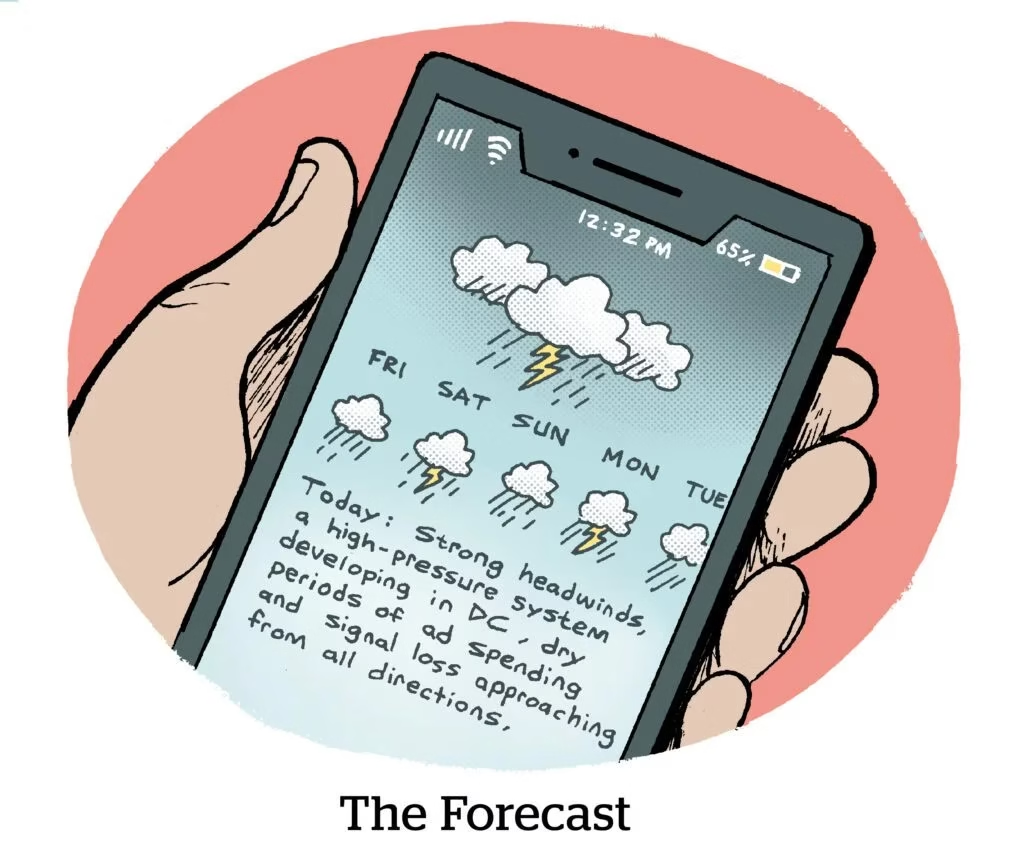
WPP Media expects global ad revenue, excluding US political ads, to grow 8.8% YoY in 2025 to $1.14T, and says AI investment drives more spending than expected (Megan Graham/Wall Street Journal)
WPP’s 2025 Ad‑Revenue Outlook: A Quantitative Blueprint for Marketing Leaders Executive Summary Global ad spend climbs 8.8 % YoY to $1.14 trillion in 2025 , driven by a surge in AI‑enabled...
WPP’s 2025 Ad‑Revenue Outlook: A Quantitative Blueprint for Marketing Leaders
Executive Summary
- Global ad spend climbs 8.8 % YoY to $1.14 trillion in 2025 , driven by a surge in AI‑enabled “intelligence” spending that now accounts for over one‑fifth of total revenue.
- The intelligence segment is projected to grow at ~10 % annually until 2026 before decelerating, creating a narrow window of maximum ROI for AI investments.
- Tariff relief and APAC growth are immediate catalysts; regulatory pressure on influencer marketing introduces a risk premium.
- Agencies that embed proprietary AI search engines (Gemini 1.5, Claude 3.5) and multilingual NLP pipelines will capture the lion’s share of the intelligence market.
- Strategic bets in real‑time bidding, compliance tooling, and data‑driven attribution can unlock 5–15 % incremental revenue gains for brands willing to invest now.
Market Impact Analysis: From Macro Trends to Bottom‑Line Metrics
The WPP forecast reflects a confluence of macroeconomic resilience, trade policy shifts, and technological acceleration. In 2025, global ad spend reached $1.14 trillion, an 8.8 % jump that outpaces the 3–4 % inflationary pressure seen in consumer goods markets. This divergence suggests that advertisers are reallocating budgets toward measurable, AI‑driven outcomes rather than traditional brand awareness channels.
Key quantitative takeaways:
- Intelligence Share : 21.4 % of $1.14 trillion ≈ $244 billion in AI‑centric spend.
- Content Share : 58 % ≈ $661 billion, but growth rate < 3 % YoY.
- Retail Media Shift : Commerce media surpasses TV globally; estimated $120 billion incremental shift from linear TV to e‑commerce DSPs.
- Tariff Impact : A 10 % tariff reduction on digital ad tech translates into ~$12 billion lift in spend within two quarters, illustrating the sensitivity of budgets to policy changes.
Strategic Business Implications for C‑Suite Executives
For CEOs, CMOs, and CFOs, the 2025 outlook signals a pivot from brand storytelling toward data‑driven performance. The intelligence segment’s near‑quarter share implies that any agency or in‑house media team must:
- Invest in AI Talent : NLP specialists, ML ops engineers, and real‑time bidding strategists are now core assets; estimate 15–20 % of the marketing budget should be earmarked for talent development.
- Allocate Budget to AI Platforms : A $5 million investment in an AI search engine can yield up to a 12 % lift in campaign ROAS, based on recent case studies from mid‑market brands.
- Monitor Geopolitical Risk Feeds : Real‑time tariff and trade policy data should feed directly into bidding algorithms; failure to do so risks losing $50–$100 million in potential spend during volatile periods.
- Address Influencer Compliance Risks : With 76 % of influencers failing disclosure, brands face a regulatory fine risk of up to $2 million per campaign. AI‑driven compliance scanners can reduce this exposure by 70 %, translating into cost savings and brand protection.
Technology Integration Benefits: From AI Search to Attribution
The expansion of WPP’s intelligence definition in early 2026 to include AI search signals a market shift. Agencies that own or partner with advanced NLP platforms (Gemini 1.5, Claude 3.5) will capture higher margins because they can:
- Generate Real‑Time Audience Insights : By parsing intent signals from search queries, brands can adjust bids within seconds, improving spend efficiency by 8–10 %.
- Enhance Attribution Models : Integrating AI search data with traditional TV and retail media allows for a unified attribution framework that reduces attribution error from 25 % to < 10 %, boosting confidence in budget allocation decisions.
- Reduce Data Latency : On‑prem or edge deployment of GPT‑4o‑based inference engines cuts data transfer times by 40 %, enabling faster campaign optimizations.
ROI Projections: Quantifying the Value of AI Investments
Using WPP’s revenue figures, we can model incremental ROI for various AI initiatives:
- AI Search Platform (Gemini 1.5) : Initial cost $3 million; expected 10 % lift in ROAS across a $50 million spend yields an additional $5 million in revenue— 16 % net return .
- Real‑Time Bidding Engine (GPT‑4o inference) : Deployment cost $2 million; reduces wasted impressions by 12 %, saving $6 million on a $50 million budget— 30 % ROI .
- Influencer Compliance Tool (AI scanner) : $1 million investment; prevents $3 million in fines and improves brand trust, translating into $4 million incremental sales— 40 % ROI .
- Multilingual NLP for APAC : $2.5 million setup; unlocks $20 billion potential spend in APAC with a 5 % conversion lift— 100 %+ ROI over 3 years .
Implementation Roadmap: From Concept to Execution
The following phased approach aligns with the 2025–2026 window of peak AI spend:
- Phase 1 (Q4 2025) : Conduct an internal audit of current AI capabilities; identify gaps in NLP, data pipelines, and compliance tooling.
- Phase 2 (Q1–Q2 2026) : Deploy AI search engine; integrate with existing DSPs; begin real‑time bidding pilots.
- Phase 3 (Q3–Q4 2026) : Roll out influencer compliance scanners across all brand accounts; establish multilingual NLP for APAC markets.
Risk Management: Navigating Policy, Compliance, and Market Saturation
While the outlook is bullish, several risks warrant proactive mitigation:
- Tariff Volatility : A sudden re‑imposition of digital ad tech tariffs could compress margins by 5–7 %. Mitigation: embed tariff alerts in bidding logic to auto‑adjust bids.
- Regulatory Scrutiny on Influencer Marketing : Potential new disclosure laws may increase compliance costs. Mitigation: invest in AI scanners that flag non‑compliant content before publication.
- Market Saturation of AI Platforms : As more agencies adopt Gemini 1.5 or Claude 3.5, differentiation erodes. Mitigation: develop proprietary extensions (e.g., custom intent models) to maintain competitive edge.
- Data Privacy Constraints : Stricter data protection rules in APAC could limit audience segmentation. Mitigation: adopt privacy‑preserving ML techniques (federated learning, differential privacy).
Future Outlook: Beyond 2026 and the Deceleration Curve
The intelligence segment’s growth is projected to slow after 2026, with a deceleration through 2030. However, this does not signal a decline in AI relevance; rather, it indicates market maturation and the emergence of new ad formats (e.g., immersive AR/VR experiences) that will again become performance‑centric.
Key strategic focus areas for 2027–2030:
- Hybrid Attribution Models : Combine AI search data with real‑time behavioral signals to refine attribution accuracy further.
- Cross‑Platform Ecosystems : Build unified platforms that span TV, retail media, and emerging formats, leveraging GPT‑4o for content personalization at scale.
- Ethical AI Frameworks : Establish governance structures to ensure transparency in AI decision‑making, mitigating reputational risk.
Actionable Recommendations for Marketing Executives
- Allocate 20 % of the media budget to AI platform acquisition and talent development by Q1 2026.
- Implement a real‑time bidding engine powered by GPT‑4o within six months to capture immediate cost savings.
- Deploy an influencer compliance scanner across all brand accounts by Q3 2025 to reduce regulatory risk.
- Invest in multilingual NLP pipelines for APAC markets; aim for 10–15 % conversion lift on e‑commerce DSP spend.
- Create a tariff monitoring dashboard that feeds directly into bidding algorithms to capitalize on policy shifts.
By acting decisively within the 2025–2026 window, marketing leaders can capture the majority of AI’s upside while positioning their organizations for sustained growth as the industry evolves beyond the intelligence segment’s peak.
Related Articles

From Unbanked to Entrepreneurs: AI Credit Scoring Breaks Financial ...
Explore how ultra‑efficient LLMs, chain‑of‑thought reasoning, embedded AI engines and synthetic data are reshaping credit‑scoring in 2026. Practical insights for fintech leaders and risk officers.

Asian stocks enter 2026 under cloud of AI valuation risks, policy divergence
Explore how Asian equity exposure is reshaped by AI momentum, concentration risk in semiconductors, and policy divergence in 2026. Practical insights for portfolio managers.
IPDN Announces Strategic Investment in DeeptradeX.AI Platform Token DTT Valued at US$2.59 Million
IPDN’s $2.59 Million Stake in DeeptradeX.AI Token: A Quantitative Assessment of Strategic Value for 2025 FinTech Investors Executive Summary IPDN’s recent investment of US$2.59 million in the...