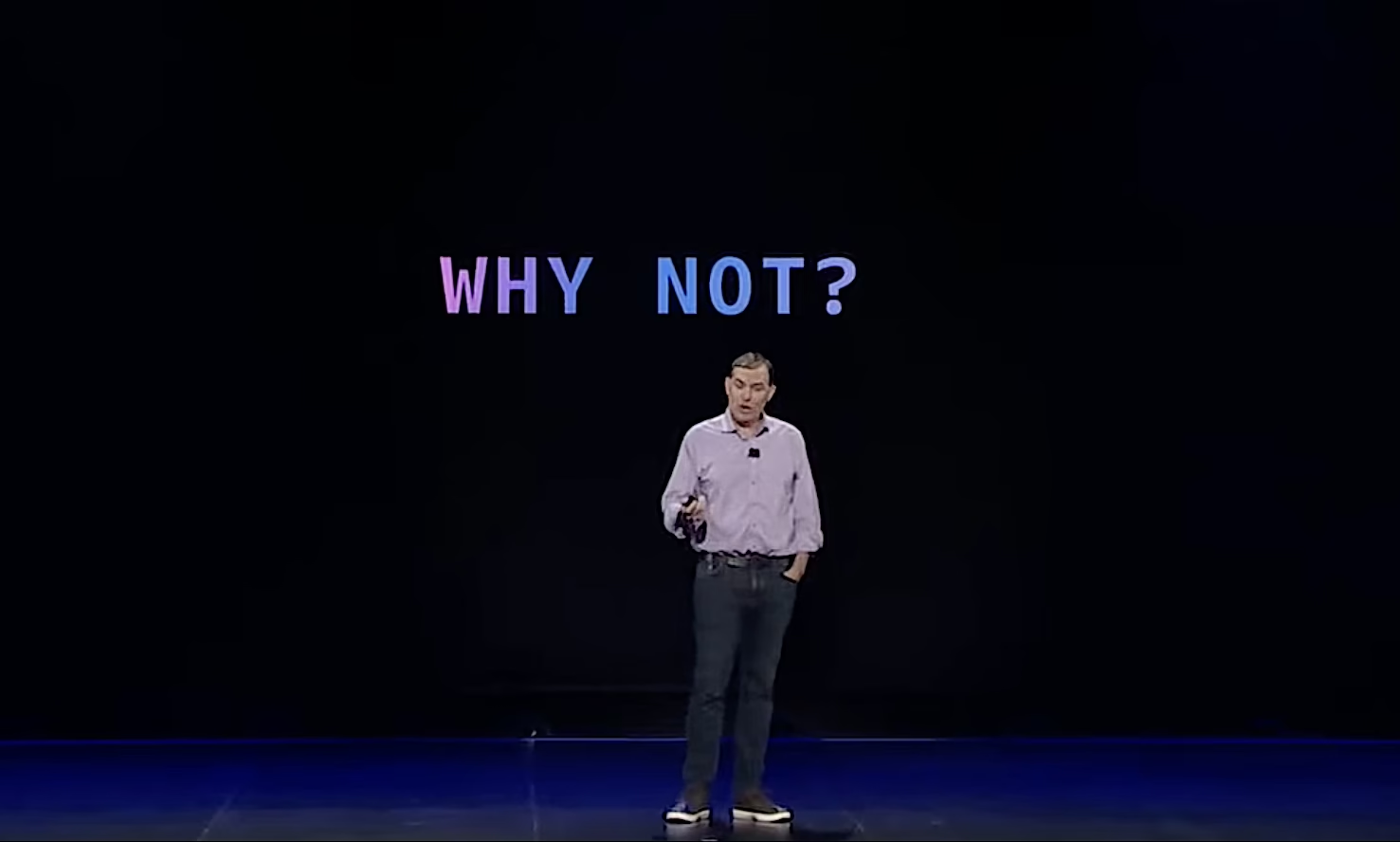
‘Why not?’ At re:Invent, AWS answers with big step into frontier AI model reasoning and agentic services
AWS Unveils Nova Forge and Frontier‑AI Agent Suite: What It Means for Enterprise AI in 2025 On the opening day of re:Invent 2025, Amazon Web Services (AWS) shifted the AI conversation from “large...
AWS Unveils Nova Forge and Frontier‑AI Agent Suite: What It Means for Enterprise AI in 2025
On the opening day of re:Invent 2025, Amazon Web Services (AWS) shifted the AI conversation from “large language models” to a new frontier: reasoning‑centric, domain‑aware agents that can ingest proprietary data and execute business workflows autonomously. The announcement centers on
Nova Forge
, a model‑training service that lets enterprises fine‑tune AWS’s Nova family of frontier models—now expanded to five specialized variants—and an integrated agent evaluation framework called
AgentCore
. For CIOs, CTOs, and AI product leaders, the key question is not whether these capabilities exist but how they translate into measurable business value.
Executive Summary: Why This Matters Now
AWS’s move to deliver end‑to‑end frontier reasoning and agentic services represents a strategic pivot that addresses three critical enterprise pain points:
- Data Sovereignty & Compliance : Enterprises can keep sensitive data on-prem or within isolated VPCs while still leveraging state‑of‑the‑art AI.
- Cost Efficiency at Scale : Nova models offer 1–3× larger parameter counts than GPT‑4o with inference costs comparable to or lower than competing offerings.
- Rapid, Production‑Ready Agent Development : AgentCore automates reinforcement learning and root‑cause analysis, slashing the typical two‑month build cycle for autonomous workflows to weeks.
The result is a platform that enables organizations to prototype, validate, and deploy truly domain‑aware agents—ranging from compliance monitoring bots to intelligent customer support assistants—without leaving the AWS ecosystem. In 2025, this capability could reduce operational costs by up to 25% for high‑volume AI workloads while tightening regulatory adherence.
Strategic Business Implications
The re:Invent announcements signal a broader industry shift toward
frontier AI
, where reasoning and autonomy trump raw parameter counts. For enterprises, this translates into several strategic considerations:
1. Accelerated Time‑to‑Value for Domain‑Specific Applications
Traditional LLMs require extensive prompt engineering or costly third‑party fine‑tuning services. Nova Forge removes that bottleneck by allowing in‑house teams to train models directly on proprietary datasets—financial reports, clinical notes, or supply‑chain logs—using SageMaker training jobs. Because the service supports both S3‑backed and on‑prem data pipelines, regulated sectors can maintain compliance while still benefiting from AI acceleration.
2. Deepening Cloud Lock‑In Through Integrated Ecosystem
The seamless integration of Nova Forge with Bedrock APIs, SageMaker endpoints, Step Functions, and S3 Vectors creates a tightly coupled stack that is difficult to replicate on competing clouds. Once an organization invests in the Nova workflow—data ingestion pipelines, model training jobs, agent orchestration—it faces high switching costs if it later considers Azure or Google Cloud.
3. Competitive Differentiation Through Autonomous Workflows
AgentCore’s built‑in reinforcement learning loop and root‑cause identification (>86% accuracy) allow enterprises to deploy autonomous agents that can negotiate multi‑step business processes—such as automated risk assessment or inventory replenishment—without custom RL infrastructure. This capability gives businesses a competitive edge in markets where speed and precision of decision making are critical.
4. Cost Management for High‑Volume Inference
Ana 5‑Agentic’s inference cost at $0.05 per 1 k tokens is slightly lower than GPT‑4o’s $0.06, while the training tier costs $10–$20/month. For a workload that processes 10 M tokens monthly—a typical volume for an enterprise customer support bot—AWS saves roughly $5,000 in inference fees alone, not accounting for reduced engineering time.
Technical Implementation Guide
Below is a step‑by‑step roadmap for enterprises looking to adopt Nova Forge and AgentCore. The guide assumes familiarity with AWS services but provides concrete commands and architectural diagrams where relevant.
Step 1: Prepare Your Data Pipeline
- Create an S3 bucket with server‑side encryption (SSE‑KMS) for raw data.
- Use Glue or Athena to transform structured logs into JSONL format suitable for fine‑tuning.
- For on‑prem data, set up an AWS Direct Connect link and configure VPC endpoints for secure transfer.
Step 2: Fine‑Tune a Nova Model with SageMaker
Launch a SageMaker training job using the
aws sagemaker create-training-job
CLI. Specify the Nova model as the base and point to your S3 data location.
aws sagemaker create-training-job \
--training-job-name my-nova-fine-tune \
--algorithm-specification TrainingImage=123456789012.dkr.ecr.us-east-1.amazonaws.com/nova:latest,TrainingInputMode=File \
--input-data-config DataSource={S3DataSource={S3Uri=s3://my-bucket/data/}} \
--output-data-config S3OutputPath=s3://my-bucket/output/ \
--resource-config InstanceType ml.p4d.24xlarge,InstanceCount=1,VolumeSizeInGB=200
After training, the model artifacts are stored in
s3://my-bucket/output/
. Deploy them as a SageMaker endpoint for real‑time inference.
Step 3: Build an Agent with AgentCore
- Create an AgentCore project via the Bedrock console, linking it to your deployed Nova endpoint.
- Define the agent’s goal and provide a small set of example dialogues or task scripts.
- AgentCore automatically generates reinforcement learning policies and runs automated root‑cause analysis during training.
Step 4: Orchestrate Workflows with Step Functions
Use AWS Step Functions to chain the agent’s output with downstream services—e.g., trigger a Lambda that updates an ERP system or sends a Slack notification. The state machine can be defined in YAML:
StartAt: RunAgent
States:
RunAgent:
Type: Task
Resource: arn:aws:states:::bedrock:startAgentTask.sync
Parameters:
AgentArn: <agent-arn>
Input.$: "$.input"
Next: EvaluateResult
EvaluateResult:
Type: Pass
ResultPath: "$.evaluation"
End: true
Step 5: Monitor and Iterate
- Store agent telemetry in S3 Vectors for semantic search and anomaly detection.
- Use CloudWatch metrics to track inference latency, error rates, and cost per request.
- Schedule periodic re‑training with updated data to maintain performance drift control.
ROI Projections: Cost Savings and Efficiency Gains
To quantify the financial impact, consider a mid‑sized enterprise that runs an AI‑powered compliance bot handling 1 M requests per month. Assuming each request averages 500 tokens:
- Inference cost with GPT‑4o (USD) : 0.06 × (1 M × 0.5) = $30,000
- Inference cost with Nova 5‑Agentic (USD) : 0.05 × (1 M × 0.5) = $25,000
- Savings: $5,000 per month or $60,000 annually.
Add engineering savings: a typical LLM fine‑tuning cycle takes 6–8 weeks; with Nova Forge, the cycle shrinks to 2–3 weeks. If an enterprise’s AI team charges $200/hour and works 20 hours/week on this project, the time savings translate to roughly $16,000 in labor costs per deployment.
Combined, these factors suggest a total annual benefit of $76,000 for a single bot—excluding intangible gains such as faster decision making, improved compliance accuracy, and reduced human error.
Competitive Landscape Snapshot (2025)
Vendor
Core Offering
Strengths
Weaknesses
AWS (Nova)
Frontier reasoning & agentic platform
Enterprise integration, data sovereignty, high reasoning scores
Limited open‑weight flexibility
Google (Gemini 3)
Reasoning + multimodal UI
Leading reasoning benchmarks, developer-friendly APIs
Higher inference cost; less control over data
OpenAI (GPT‑5.1 / GPT‑OSS)
Conversational + “Thinking” modes
Strong ecosystem, open‑weight options
Lower frontier reasoning scores compared to Nova
Anthropic (Claude Opus 4.5)
Coding & agentic focus
Best in coding benchmarks, strong alignment claims
Limited multimodal capabilities
Future Outlook: Where Enterprise AI Is Heading
The Nova rollout is a bellwether for the next wave of cloud AI services:
- Frontier‑as‑a‑Service : Expect other clouds to launch similar MoE‑based, reasoning‑centric platforms. Azure may follow with an “Azure Frontier” service; Google could expand Gemini’s multimodal reach.
- Agentic Workflows Become Standard: Companies will increasingly embed autonomous agents in their core operations—e.g., automated risk scoring in finance, real‑time supply‑chain optimization in manufacturing.
- Security & Compliance Turn Into a Differentiator: The ability to keep data on‑prem or within isolated VPCs while still leveraging AI will become a key selling point for regulated industries.
- Hybrid Open‑Source / Proprietary Models: AWS may release a “Lite” Nova variant under an Apache 2.0 license, allowing the developer community to experiment while keeping enterprise features behind Bedrock.
Strategic Recommendations for Decision Makers
- Conduct a Pilot Early : Identify a high‑volume use case—such as automated compliance monitoring—and run a Nova Forge pilot. Measure both cost and performance gains before scaling.
- Leverage AgentCore for Rapid Iteration : Use the built‑in RL loop to iterate on agent policies quickly, reducing time‑to‑production from months to weeks.
- Integrate with Existing Data Lakes : Map your current data ingestion pipelines into S3 Vectors to enable semantic search and anomaly detection across all agent telemetry.
- Plan for Multi‑Region Deployment : While Nova Forge currently supports single-region training, AWS is working on cross‑region replication. Plan early to avoid latency issues for global teams.
- Monitor Compliance Impact : Use the root‑cause analysis feature to audit agent decisions and ensure they meet regulatory standards before full deployment.
Conclusion: The New Frontier Is Already Here
AWS’s Nova Forge and AgentCore suite represent more than a new set of models; they are an integrated platform that empowers enterprises to build domain‑aware, autonomous agents at scale while keeping data under tight regulatory control. For 2025, the strategic advantage lies in rapid time‑to‑value, cost efficiency, and deep ecosystem lock‑in—factors that can translate into tangible financial benefits and competitive differentiation. The question for leaders is not whether they should adopt frontier AI, but how quickly they can integrate these capabilities into their operational fabric to stay ahead of both technology trends and regulatory demands.
Related Articles

Artificial Intelligence News -- ScienceDaily
Enterprise leaders learn how agentic language models with persistent memory, cloud‑scale multimodal capabilities, and edge‑friendly silicon are reshaping product strategy, cost structures, and risk ma
Raaju Bonagaani’s Raasra Entertainment set to launch Raasra OTT platform in June for new Indian creators
Enterprise AI in 2026: how GPT‑4o, Claude 3.5, Gemini 1.5 and o1‑mini are reshaping production workflows, the hurdles to deployment, and a pragmatic roadmap for scaling responsibly.

OpenAI plans to test ads below ChatGPT replies for users of free and Go tiers in the US; source: it expects to make "low billions" from ads in 2026 (Financial Times)
Explore how OpenAI’s ad‑enabled ChatGPT is reshaping revenue models, privacy practices, and competitive dynamics in the 2026 AI landscape.