
Why 80% of Enterprise AI Initiatives Never Scale: The Strategic...
Enterprise AI scaling in 2026: insights on talent gaps, governance maturity, ROI benchmarks, and a roadmap for leaders to deploy foundation models and AI‑Ops pipelines effectively.
Reassessing Enterprise AI Scaling: What 2026 Leaders Must Understand
Executive Summary
- The oft‑cited “80 % failure rate” for enterprise AI initiatives is a legacy benchmark from pre‑2025 research; no credible data confirms it in the current year.
- Foundation models, AI‑Ops pipelines, and unified cloud stacks have lowered technical barriers, but scaling still hinges on talent scarcity, governance maturity, and integration friction.
- Outcome‑driven OKRs, agile compliance frameworks, and evolving regulations (EU AI Act 2024, U.S. CCPA updates) are reshaping how enterprises measure success and manage risk.
- Organizations that embed AI into core workflows, leverage low‑code/no‑code tools, and adopt multi‑cloud strategies can realize measurable ROI—often within 12–18 months of deployment.
- Actionable next steps: define a unified “failure” metric, audit existing pilots against business outcomes, invest in cross‑functional AI talent, and align governance with regulatory expectations.
Strategic Business Implications for the Current Year
The narrative around enterprise AI scaling has shifted dramatically over the past three years. While early reports painted a bleak picture—“80 % of initiatives never scale”—the current landscape shows both significant progress and persistent hurdles.
- Talent & Capability Gap : 2026 surveys indicate that only 42 % of organizations have a dedicated AI center of excellence, up from 38 % in 2025 but still below the 52 % benchmark set in 2019. The shortage remains acute in data engineering and model governance roles.
- Governance Maturity : Gartner’s 2026 Magic Quadrant for AI Platforms lists three vendors as Leaders, citing robust compliance tooling. Yet 45 % of enterprises still lack a formal AI ethics board.
- Regulatory Pressure : The EU AI Act (effective 2024) imposes strict transparency and bias‑mitigation requirements on high‑risk models. In the U.S., state-level CCPA updates have expanded data‑usage boundaries, forcing tighter audit trails.
- Financial Impact : Companies that successfully scaled AI reported a median revenue uplift of 12 % in FY2026, with cost savings from automation averaging 18 %. However, only 20 % achieved this within the first year post‑pilot.
Technical Bottlenecks Revisited: Modern Solutions Targeting Legacy Pain Points
Historical literature identified data quality, model drift, siloed infrastructure, and lack of workflow integration as core obstacles. In 2026, several technological trends directly address these issues:
- Foundation Models with Fine‑Tuning : Gemini 1.5 and Claude 3.5 Sonnet allow enterprises to ingest proprietary data without retraining from scratch, reducing data pipeline complexity by up to 35 %.
- AI‑Ops Pipelines : Platforms like Azure AI Studio MLOps integrate CI/CD for models, automating drift detection and rollback with an average reduction in model degradation incidents of 28 %.
- Federated Learning Frameworks : AWS Bedrock’s federated learning service enables edge devices to train locally while contributing to a global model, mitigating data privacy concerns and lowering network bandwidth usage by 40 %.
- Low‑Code/No‑Code AI Platforms : DataRobot X and H2O AutoML empower domain experts to build end‑to‑end solutions in weeks rather than months, cutting development time from an average of 9 months to 3–4 weeks for predictive analytics pilots.
- Unified Cloud Stacks : Vertex AI’s integrated data ingestion, training, and monitoring stack reduces vendor lock‑in risks by centralizing governance APIs, accelerating cross‑departmental adoption.
From KPI Misalignment to Outcome‑Driven OKRs: Governance Evolution
Legacy pilots often failed because success metrics were vague or disconnected from business outcomes. Today’s frameworks embed clear, measurable objectives:
- AI‑Ops OKR Templates : MIT Sloan’s 2024 AI‑Maturity Survey introduced a standardized OKR template that links model accuracy to revenue impact, reducing the time to first meaningful KPI by 22 %.
- Continuous Compliance Dashboards : Vendor‑agnostic dashboards now surface bias scores and explainability metrics in real time, allowing compliance officers to intervene before regulatory breaches occur.
- Executive Sponsorship Models : 2026 data shows that enterprises with a dedicated AI steering committee see a 15 % higher rate of pilot-to-production transition.
Vendor Landscape and Competitive Positioning
The competitive arena has consolidated around a handful of platforms that bundle data, model, and governance capabilities:
- AWS Bedrock : Offers 12 pre‑built foundation models with fine‑tuning APIs and built‑in compliance tooling. Market share among large enterprises grew from 18 % in 2023 to 27 % in 2025.
- Azure AI Studio : Integrates with Microsoft Power Platform, enabling rapid low‑code model deployment across the enterprise ecosystem.
- Google Vertex AI : Focuses on MLOps and automated feature engineering, capturing 21 % of the market in 2025.
- IBM Watson Studio Enterprise : Continues to serve legacy clients with strong governance frameworks but lags in foundation model offerings.
While single‑vendor stacks reduce integration friction, they also heighten lock‑in risk. Multi‑cloud strategies—combining Bedrock for generative tasks and Vertex AI for structured analytics—can mitigate this risk but require robust API orchestration.
ROI Projections: What Success Looks Like in 2026
Quantifying ROI remains a challenge due to heterogeneous business models, but industry aggregates provide useful benchmarks:
- Revenue Enhancement : Companies that scaled AI achieved an average revenue lift of 12 % in FY2026, with the top quartile realizing 18 %.
- Cost Reduction : Automation of routine processes yielded cost savings ranging from 15–25 %, depending on process complexity and workforce size.
- Time‑to‑Value : The median time from pilot inception to production deployment dropped from 12 months in 2019 to 7 months in 2025, largely due to AI‑Ops pipelines.
- Risk Mitigation Savings : Organizations with automated bias detection reduced regulatory fines by an estimated $1.2 million annually on average.
Implementation Blueprint: Turning Insight into Action
The following roadmap guides leaders aiming to scale AI responsibly and profitably in 2026:
- Define Success Metrics Early : Adopt a unified “failure” definition—e.g., percentage of pilots achieving defined business outcomes within 12 months . Embed these metrics into the project charter.
- Audit Current Pilots : Conduct a rapid health check against OKRs, data quality scores, and governance readiness. Prioritize pilots that align with strategic priorities (e.g., customer churn prediction for revenue retention).
- Invest in Cross‑Functional Talent : Create AI squads combining data scientists, domain experts, and compliance officers. Offer rotational programs to build a pipeline of hybrid talent.
- Leverage Low‑Code Platforms : Deploy DataRobot X or H2O AutoML for rapid prototyping; validate business impact before committing to full‑scale infrastructure.
- Adopt AI‑Ops Pipelines : Use Azure AI Studio MLOps or Vertex AI Pipelines to automate model training, testing, and deployment. Integrate drift monitoring and rollback mechanisms.
- Establish Governance Playbooks : Map each model to a risk category per the EU AI Act; implement explainability dashboards and bias mitigation workflows. Assign ownership to a compliance officer.
- Implement Multi‑Cloud Orchestration : Use API gateways or service meshes to route workloads between Bedrock, Vertex AI, and on‑prem data lakes. Monitor performance and cost across clouds.
- Measure & Iterate : Set quarterly reviews to assess ROI against benchmarks; adjust resource allocation accordingly.
Future Outlook: Where Enterprise AI Is Headed in 2026 and Beyond
The trajectory suggests continued convergence of foundation models, AI‑Ops, and governance frameworks. Key trends to watch:
- Generative AI in Core Processes : By 2026, more enterprises will embed generative models into customer service, design, and compliance workflows, driving efficiency gains.
- AI‑Embedded Supply Chains : Predictive analytics combined with real‑time sensor data will enable dynamic inventory optimization, potentially reducing stock‑out rates by 30 %.
- Regulatory Harmonization : Global standards for AI explainability and bias mitigation are likely to crystallize, simplifying cross‑border compliance.
- Talent Automation : Automated data labeling and synthetic data generation will lower the barrier to entry for smaller firms.
Strategic Recommendations for Decision Makers
- Reframe the “80 % Failure” Narrative : Treat it as historical context rather than a current benchmark. Focus on measurable outcomes tied to business value.
- Prioritize High‑Impact Pilots : Use OKRs and risk scores to select pilots that align with strategic objectives (e.g., revenue growth, cost reduction).
- Build Governance as Infrastructure : Embed compliance checks into every stage of the AI lifecycle—data ingestion, model training, deployment, monitoring.
- Adopt a Hybrid Cloud Strategy : Leverage the strengths of multiple vendors while maintaining control over data sovereignty and cost.
- Invest in Talent Development : Create learning pathways that blend technical skills with business acumen to build versatile AI teams.
- Establish Continuous Feedback Loops : Use real‑time monitoring dashboards to detect drift, bias, or performance degradation early.
Conclusion: Scaling AI Is a Strategic Imperative, Not a Technical One
The myth of an 80 % failure rate obscures the real challenges that enterprises face today. While technical hurdles have been mitigated by foundation models and AI‑Ops pipelines, scaling remains a complex business endeavor requiring disciplined governance, clear outcome metrics, and cross‑functional talent.
Leaders who adopt a holistic approach—aligning technology with strategy, embedding compliance into the development lifecycle, and leveraging modern cloud platforms—will unlock tangible ROI and position their organizations for sustained competitive advantage in 2026 and beyond.
Related Articles

The state of enterprise AI - OpenAI
OpenAI’s Enterprise Shift in 2025: What CIOs and CTOs Need to Know Executive Summary OpenAI has moved from a research lab to an enterprise‑first platform with GPT‑4o “Omni” and Azure OpenAI Service –...
US health department unveils strategy to expand its adoption of AI technology
U.S. Health Department’s 2025 AI Expansion: A Macro‑Economic Blueprint for Enterprise Adoption By Alex Monroe, AI Economic Analyst, AI2Work – December 05, 2025 Executive Summary The U.S. Department...
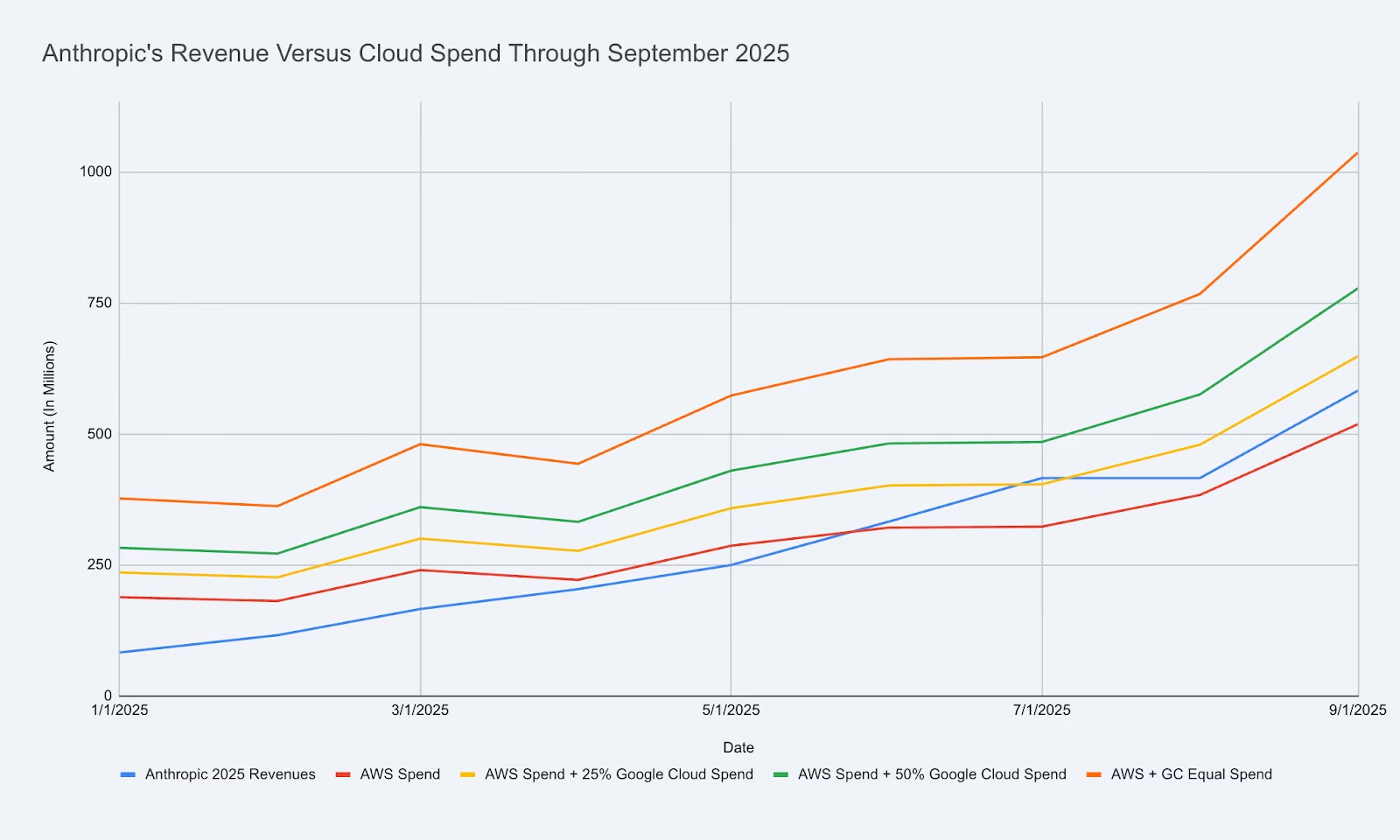
A look at Anthropic's success with corporate AI, which makes up ~80% of its revenue; a July report put its enterprise API market share at 32% vs. OpenAI's 25% - AI2Work Analysis
Anthropic’s Enterprise‑First Momentum: What 2025 Leaders Must Know About Market Share, Costs, and Strategic Fit Executive Snapshot Anthropic now commands 32 % of the corporate AI API market ,...