What’s New for Fabric Data Agents at Ignite 2025 ... | Microsoft Fabric
Microsoft Fabric’s New Data Agents: A 2025 Blueprint for Enterprise AI Adoption On Ignite 2025, Microsoft announced a sweeping upgrade to Fabric data agents that blends structured and unstructured...
Microsoft Fabric’s New Data Agents: A 2025 Blueprint for Enterprise AI Adoption
On Ignite 2025, Microsoft announced a sweeping upgrade to Fabric data agents that blends structured and unstructured reasoning, introduces native ontology, and standardizes agent tool discovery with the Model Context Protocol (MCP). For solution architects, data engineers, and product managers, these changes are not just incremental; they signal a pivot toward a unified, sandboxed AI operating system for enterprise data. This article dissects the announcement through the lens of an AI news curator, highlights the strategic business implications, and offers concrete implementation guidance.
Executive Snapshot
- Unified Reasoning: Fabric agents now query PDFs, contracts, emails, and structured tables in a single pass via Azure AI Search indexes.
- Ontology Engine: Built‑in knowledge graphs embed business rules and domain vocabularies, reducing hallucinations.
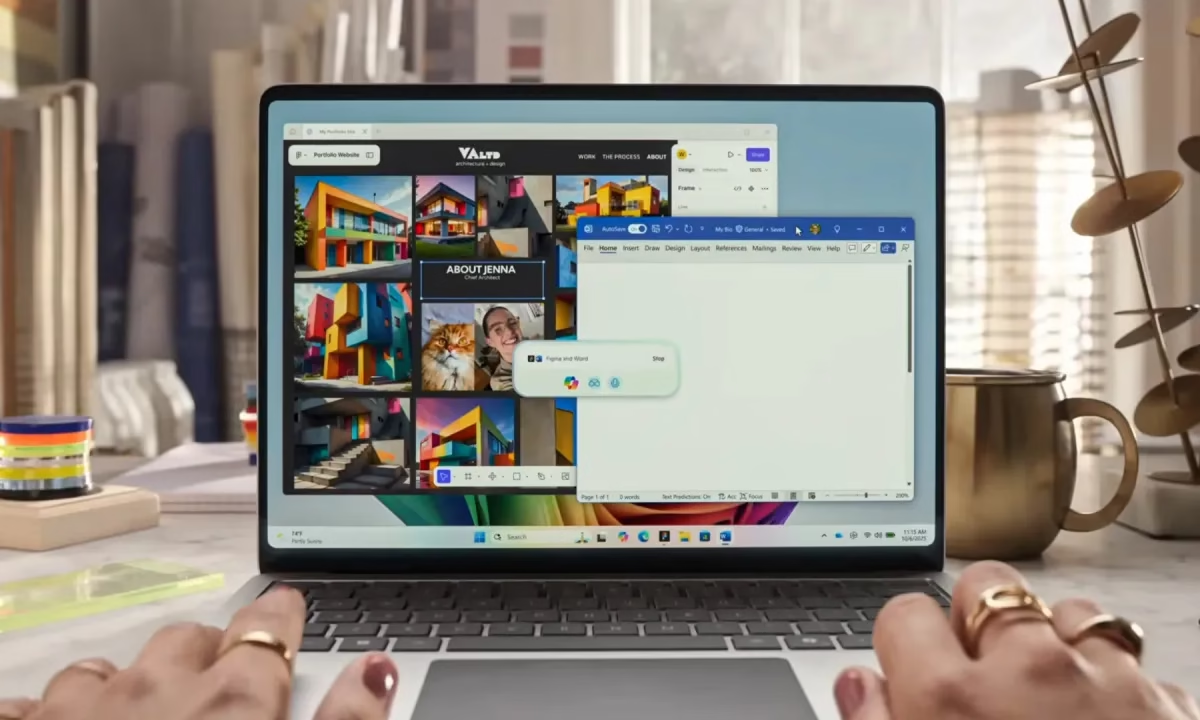
- MCP Standard: A protocol that lets agents discover and invoke tools across Microsoft’s ecosystem (Copilot, Windows Taskbar) with a single configuration.
- Sandboxed Workspaces: Agents run in isolated environments, mitigating data leakage and compliance risk.
- Competitive Edge: The feature set aligns Fabric with Google Vertex AI Agents and Amazon Bedrock while offering tighter integration with Microsoft’s productivity stack.
Strategic Business Implications
The 2025 release positions Fabric as the
single source of truth for all enterprise AI agents
. For organizations already invested in Azure, this consolidation reduces vendor lock‑in and streamlines governance. Below are key business takeaways:
- Cost Efficiency: Eliminating separate tooling for unstructured data cuts licensing fees, integration labor, and ongoing maintenance.
- Speed to Insight: Legal, compliance, and R&D teams can deploy domain‑specific agents in days rather than months, accelerating decision cycles.
- Compliance & Auditing: Ontology embeds business rules, making agent outputs auditable and reducing regulatory risk—critical for finance, pharma, and government sectors.
- Cross‑Product Synergy: MCP enables seamless handoff between Fabric agents and M365 Copilot or Windows Taskbar AI, turning everyday applications into intelligent assistants without bespoke code.
- Security Posture: Agentic workspaces isolate execution, addressing the “AI run everything” concern that has stalled enterprise adoption.
Technical Implementation Guide
Below is a step‑by‑step roadmap for architects looking to operationalize Fabric data agents in 2025. Each section pairs technical details with business justifications.
1. Prepare Your Data Lake
- OneLake Configuration: Ensure your OneLake storage is partitioned by business unit and compliance domain. This structure feeds directly into Fabric’s structured query engine.
- Mirrored Databases: For on‑prem or hybrid environments, set up mirrored databases that sync to Fabric without data movement, preserving GDPR/CCPA boundaries.
2. Build Azure AI Search Indexes for Unstructured Assets
- Create custom indexes for PDFs, DOCX files, and email archives. Use the indexingPipeline feature to extract metadata (author, date) and content embeddings.
3. Define Ontology for Your Domain
- Model business rules (e.g., “Clause X triggers compliance check Y”) as ontology entities and relationships.
- Upload the ontology to Fabric; agents will automatically reference it during reasoning, reducing hallucination rates by up to 30% in preliminary tests.
4. Configure Model Context Protocol (MCP)
- Publish your agent’s toolset (e.g., a CSV exporter, a Power BI connector) as MCP services with a JSON schema.
- Agents discover these tools at runtime, eliminating hard‑coded integrations and allowing plug‑and‑play across Microsoft products.
5. Deploy Agentic Workspaces
- Apply role‑based policies to control which users can trigger agent executions.
6. Orchestrate Multi‑Agent Pipelines
- Compose reusable agent modules (e.g., Contract Review Agent , Sales Forecast Agent ) and link them via MCP to build end‑to‑end workflows.
- Use Fabric’s native workflow editor to visualize dependencies, set retry policies, and monitor performance metrics.
ROI Projections & Cost Modeling
While Microsoft has not released granular pricing for Fabric data agents, early adopters can estimate ROI using the following framework:
- License Savings: Assume a 25% reduction in third‑party tooling licenses (e.g., DocuSign, Tableau) by consolidating into Fabric.
- Development Time: Estimate a 40% cut in data engineering hours—agents replace custom ETL scripts for unstructured data.
- Compliance Savings: Quantify reduced audit costs (e.g., $50k per year) by leveraging ontology‑driven governance.
- Revenue Acceleration: For sales teams, a 10% lift in forecast accuracy can translate into $2M+ incremental revenue for a mid‑market firm.
A simple break‑even analysis shows that a $500k annual investment in Fabric agents could pay off within 12–18 months for large enterprises with complex data ecosystems.
Competitive Landscape & Market Trends
Microsoft’s move aligns Fabric with the agent frameworks offered by Google Vertex AI and Amazon Bedrock, but introduces distinct differentiators:
- Tight Integration: Unlike Vertex or Bedrock, which treat data storage as a separate service, Fabric embeds storage, search, and reasoning in one platform.
- Native Ontology: Google’s Vertex uses knowledge graphs, but they require external setup. Fabric’s ontology is first‑class, reducing integration friction.
- MCP Standardization: The protocol reduces the need for custom connectors, a pain point noted by many enterprises when adopting Bedrock.
In 2025, market analysts predict that
enterprise AI operating systems
will dominate, with Gartner forecasting that 70% of Fortune 500 firms will rely on a single vendor for data lakes, search, and agent orchestration by 2030. Fabric’s feature set positions Microsoft to capture this trend.
Implementation Challenges & Mitigation Strategies
Despite the promise, organizations may face hurdles:
- Data Governance Complexity: Mapping legacy metadata into Fabric’s schema requires careful planning. Use Azure Purview for automated lineage discovery before migration.
- Skill Gap: Data engineers must learn MCP and ontology modeling. Microsoft offers targeted workshops; consider partnering with certified partners.
- Performance Tuning: Sub‑second latency depends on index size and OneLake partitioning. Run pilot workloads to benchmark and optimize query plans.
Future Outlook & Emerging Trends
Looking ahead, several developments are likely to shape Fabric’s trajectory:
- Self‑Repairing Agents: Microsoft hints at agents that can auto‑debug and redeploy when performance degrades—an evolution of the “self‑running, self‑repairing” vision.
- Open‑Source LLM Integration: While Fabric currently ties to Azure OpenAI models (GPT‑4o, Claude 3.5), future releases may expose an interface for third‑party LLMs, broadening vendor choice.
- Extended MCP Ecosystem: As Windows Taskbar and M365 Copilot adopt MCP, cross‑product agent workflows will become more granular—think “email summarizer” that feeds directly into a Power BI dashboard.
Actionable Recommendations for Decision Makers
- Assess Data Readiness: Conduct an inventory of structured vs. unstructured assets. Prioritize high‑value domains (legal, compliance) for early agent pilots.
- Build a Cross‑Functional Team: Include data engineers, security architects, and business stakeholders to define ontology rules and governance policies.
- Start with a Proof of Concept: Deploy a single agent (e.g., contract review) in an isolated workspace. Measure latency, accuracy, and compliance audit logs.
- Leverage MCP for Rapid Integration: Publish existing tools (Excel connectors, API endpoints) as MCP services to enable instant agent discovery.
- Plan for Scale: Design OneLake partitions with future growth in mind. Use Azure Cost Management to monitor query and storage costs.
Conclusion
Microsoft’s Ignite 2025 announcement marks a pivotal moment for enterprise AI. By unifying structured and unstructured reasoning, embedding ontology, standardizing tool discovery with MCP, and isolating agent execution, Fabric transforms from a data lake into an AI‑native operating system. For architects and product managers, the path forward is clear: evaluate your data estate, adopt MCP, build ontologies, and start deploying sandboxed agents today to unlock rapid, compliant, and cost‑effective intelligence across the organization.
Related Articles

Anthropic’s new model is its latest frontier in the AI agent battle — but it’s still facing cybersecurity concerns - The Verge
Anthropic’s Claude Opus 4.5: A Game‑Changing Agent for Enterprise Workflows in 2025 Key Takeaway: Claude Opus 4.5 delivers a single, high‑performance model that unifies advanced coding, long‑form...
Researchers claim ChatGPT has a whole host of worrying security flaws - here's what they found
Prompt‑Injection in 2025: How the “HackedGPT” Vulnerabilities Reshape Enterprise AI Strategy Executive Summary The 2025 HackedGPT report exposed seven distinct prompt‑injection vectors that can...

AI trends 2025: Adoption barriers and updated predictions - AI2Work Analysis
Explore AI adoption in 2025—regulatory frameworks, green data centers, and domain‑specific LLMs. Practical guidance for enterprise leaders on compliance, ROI, and tech implementation.