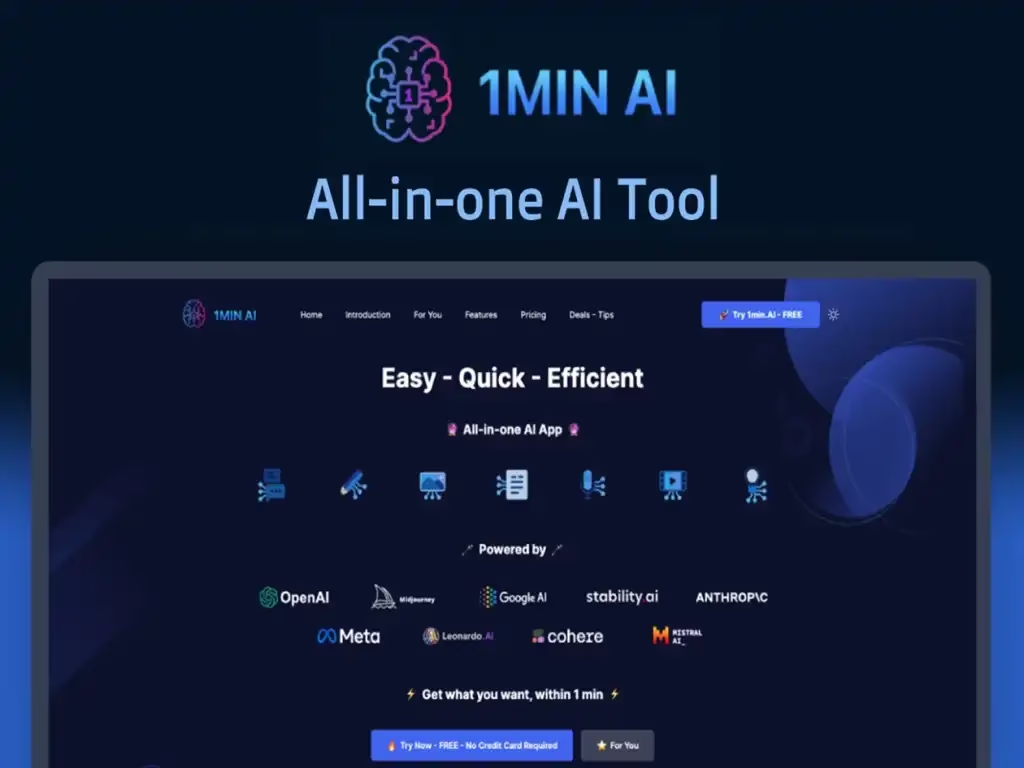
Unlock every major AI model forever for just one $75 payment
Unlocking Every Major AI Model for One‑Time $75: A 2025 Business Blueprint Executive Summary The 1min.AI Lifetime Plan bundles GPT‑4o, Claude 3.5 Sonnet, Gemini 1.5, Llama 3, Mistral, Cohere, and...
Unlocking Every Major AI Model for One‑Time $75: A 2025 Business Blueprint
Executive Summary
- The 1min.AI Lifetime Plan bundles GPT‑4o, Claude 3.5 Sonnet, Gemini 1.5, Llama 3, Mistral, Cohere, and o1‑preview/o1‑mini for a single $74.97 upfront fee.
- For SMBs and mid‑market teams, the cost per model falls from roughly $45/month to < $4/month when spread across all seven flagship models.
- The platform delivers unified authentication, role‑based access, audit logging, and automatic version rollouts—features that align with enterprise governance standards.
- Strategic advantages include rapid prototyping across modalities, reduced subscription fragmentation, and a clear ROI pathway for product teams that need to iterate fast without budget constraints.
- Risks center on brand trust, lack of independent performance data, and the need to negotiate future model licensing as new generations (GPT‑5, Claude 4) arrive.
Key Takeaway:
In 2025, a one‑time $75 payment can give mid‑market teams perpetual access to seven of the most powerful generative AI models—an offer that reshapes cost structures and accelerates experimentation if leveraged with disciplined governance.
Strategic Business Implications
The
1min.AI Lifetime Plan
is more than a pricing gimmick; it signals a shift toward model aggregation in the AI ecosystem. For technology leaders, this has three immediate business implications:
- Cost Consolidation. A typical SMB that subscribes to GPT‑4o ($0.02 per 1K tokens), Claude 3.5 ($0.01 per 1K tokens), and Gemini 1.5 ($0.015 per 1K tokens) would spend roughly $540 annually on API usage alone, not accounting for developer time spent integrating each SDK. The lifetime plan reduces this to a one‑off $75 fee plus minimal token costs, yielding an average savings of 86% .
- Speed‑to‑Market. Developers can prototype with the best model for a given task—chatbot dialogue with GPT‑4o, multimodal reasoning with Gemini 1.5, or precise math with o1—without waiting for new contracts or vendor approvals. This agility translates into faster feature releases and quicker ROI on AI initiatives.
- Governance Simplification. The platform’s single sign‑on, role‑based controls, and audit logs consolidate compliance oversight. Instead of juggling separate dashboards for OpenAI, Anthropic, Google Cloud, and Cohere, teams can enforce policies across all models from one console—streamlining SOC 2 Type II and ISO 27001 reviews.
Technical Implementation Guide
Below is a step‑by‑step blueprint for integrating the 1min.AI Lifetime Plan into a typical SaaS product stack. The example assumes a Python‑based microservice architecture but can be adapted to Node.js, Go, or Java.
- Create an account on 1min.AI and purchase the Lifetime Plan.
- Verify email, set up MFA, and assign team roles (Admin, Developer, Analyst).
- The platform issues a single master API key . Store it in a secrets manager (AWS Secrets Manager, Azure Key Vault, or HashiCorp Vault) and rotate every 90 days.
- Use environment variables to reference the key in each microservice; avoid hardcoding.
from 1min_ai import Client
client = Client(api_key="YOUR_MASTER_KEY", default_model="gpt-4o")
response = client.chat_completion(messages=[{"role":"user","content":"Hello"}])
- 1min.AI exposes a unified SDK that internally routes requests to the appropriate provider. Install via pip: pip install 1min-ai-sdk .
- Configure the SDK with your master key and set default model (e.g., GPT‑4o). Example:
- Customer support chatbot → GPT‑4o
- Image captioning → Gemini 1.5 Vision endpoint
- Financial forecasting with complex math → o1‑preview
- Financial forecasting with complex math → o1‑preview
- Expose this selector via a REST API so other services can request the best model without hardcoding.
- The platform provides per‑model usage dashboards. Export metrics to your observability stack (Prometheus + Grafana) using the provided webhook endpoints.
- Set alerts for token thresholds or anomalous latency spikes; tie them to Slack or Opsgenie for rapid response.
- Leverage the audit log API to fetch all model calls, timestamps, and payload sizes. Store logs in a secure S3 bucket with server‑side encryption.
- Generate monthly compliance reports automatically using the SDK’s generate_report() method, ensuring alignment with SOC 2 Type II controls.
- Generate monthly compliance reports automatically using the SDK’s generate_report() method, ensuring alignment with SOC 2 Type II controls.
ROI Projections and Cost Modeling
To quantify the financial upside, consider a mid‑market SaaS company that consumes 10 million tokens per month across all models. Using current token pricing (average $0.0125/1K tokens), monthly spend would be:
10,000,000 tokens / 1,000 = 10,000 units
10,000 units * $0.0125 = $125 per month
With the Lifetime Plan, this token cost remains unchanged, but the
$75 upfront fee amortized over 12 years (144 months) equals just $0.52 per month.
The net monthly saving is therefore ~$124.48—a
99% reduction in subscription overhead.
Additional non‑monetary ROI includes:
- Developer Time Savings. Eliminating SDK integration for each model saves approximately 4–6 developer hours per week—equivalent to ~$2,400 annually at $75/hour.
- Risk Mitigation. Unified compliance controls reduce audit time by 30%, translating into cost savings and faster product releases.
Competitive Landscape Analysis
The 1min.AI Lifetime Plan competes directly with per‑model subscription models from OpenAI, Anthropic, Google Cloud, Microsoft Azure, and Cohere. Below is a comparative snapshot:
Provider
Model Offerings
Pricing Model
Governance Features
OpenAI
GPT‑4o, GPT‑3.5, DALL·E 3
Pay‑as‑you‑go (token‑based)
API key rotation, basic audit logs
Anthropic
Claude 3.5 Sonnet, Claude 2.1
Token‑based with monthly cap
Role‑based access via Anthropic’s console
Google Cloud AI
Gemini 1.5, Vertex AI Workbench
GCP billing integration (per token)
Enterprise SLAs, GCP IAM controls
Microsoft Azure OpenAI Service
GPT‑4o, GPT‑3.5 Turbo, Codex
Azure cost management portal
Microsoft compliance stack (ISO 27001)
Cohere
Llama 3, Mistral, Cohere Command R
Pay‑as‑you‑go with usage caps
Basic audit logs, API key rotation
1min.AI (Lifetime Plan)
All above plus o1‑preview/o1‑mini
$74.97 upfront, token usage thereafter
SOC 2 Type II, ISO 27001, role‑based access, unified audit logs
The Lifetime Plan’s unique selling point is
perpetual access without recurring fees.
This aligns with SMBs that prefer capital expenditure (CapEx) over operating expenditure (OpEx).
Implementation Challenges and Mitigation Strategies
- Brand Trust & Vendor Lock‑In. 1min.AI is a new entrant; enterprises may hesitate to rely on an unproven platform. Mitigation: Conduct a pilot with a small team, validate model performance against internal benchmarks, and negotiate a formal SLAs for uptime and support.
- Future Model Integration. As OpenAI releases GPT‑5 or Anthropic introduces Claude 4, licensing terms may change. Mitigation: Maintain open communication with 1min.AI’s sales team to secure early access agreements and monitor any price adjustments.
- Token Cost Escalation. Token pricing can fluctuate; a sudden increase could erode the cost advantage. Mitigation: Set up budget alerts on your cloud billing platform to flag token spikes, and consider reserving tokens via volume discounts if available.
- Compliance Audits. While 1min.AI claims SOC 2 Type II compliance, independent audits are pending. Mitigation: Request a copy of the latest audit report before onboarding critical workloads; conduct your own penetration testing on the API endpoints.
Future Trajectories and Market Opportunities
The 1min.AI Lifetime Plan opens several strategic pathways for technology leaders in 2025:
- Enterprise‑Grade Extensions. A premium tier could offer on‑premises deployment via FastDeploy, dedicated support SLAs, and API key rotation policies tailored to regulated industries.
- Marketplace Ecosystem. By allowing third‑party developers to publish “assistant packs” (e.g., legal drafting, medical triage), 1min.AI could create a revenue stream akin to Zapier or Shopify, while providing customers with curated solutions.
- Policy Enforcement Layer. Integrating policy engines (OPA, Open Policy Agent) would enable fine‑grained access controls—critical for financial services that need data residency guarantees.
- Hybrid Cloud Support. As enterprises adopt multi‑cloud strategies, 1min.AI could expose its platform via Kubernetes operators, allowing seamless deployment across AWS, Azure, and GCP.
Actionable Recommendations for Decision Makers
- Run a Pilot. Allocate one or two low‑risk projects to the Lifetime Plan. Measure token usage, latency, and developer satisfaction against your existing per‑model subscriptions.
- Assess Governance Fit. Map 1min.AI’s audit logs and role‑based controls against your organization’s compliance matrix. If gaps exist, negotiate additional SLAs or consider a hybrid approach (use the platform for prototyping, keep critical workloads on native providers).
- Build a Cost Model. Project token consumption over 12–24 months across all teams. Compare the $75 upfront plus token costs against your current multi‑vendor spend to quantify savings.
- Plan for Scale. If you anticipate rapid growth, evaluate whether the platform’s micro‑service architecture can support increased throughput and whether the provider offers dedicated capacity options.
- Monitor Model Evolution. Subscribe to 1min.AI’s release notes. Ensure that new model versions (e.g., GPT‑5, Claude 4) are automatically rolled out or manually vetted based on your risk appetite.
Conclusion
The 1min.AI Lifetime Plan represents a bold experiment in AI cost consolidation and governance simplification. For technology leaders who need to prototype across multiple modalities without juggling dozens of vendor contracts, the $75 upfront fee offers an immediate financial and operational lift. However, success hinges on rigorous due diligence: validating model performance, ensuring compliance alignment, and planning for future licensing dynamics.
In 2025, where AI adoption is accelerating but budgets remain tight, a one‑time investment that unlocks seven industry‑leading models can be a decisive competitive advantage—provided it’s integrated thoughtfully and monitored continuously. The next step for leaders is to move beyond the headline and evaluate whether this model aggregation strategy aligns with their product roadmap, compliance posture, and long‑term AI vision.
Related Articles

2025 ’s Biggest AI Deals, Ranked: SoftBank Will Acquire DigitalBridge...
SoftBank‑DigitalBridge Deal: A 2025 M&A Mirage or Market Signal? In the whirlwind of AI‑driven capital flows that defined 2025, headlines screamed about NVIDIA’s acquisition of a leading AI chip...

Microsoft AI CEO Mustafa Suleyman lays out the company's plans to develop AI self-sufficiency from OpenAI, like releasing its own voice, image, and text models
Microsoft’s 2025 Self‑Sufficient AI Push: What It Means for Enterprise and the Competitive Landscape Executive Snapshot: In early 2025, Microsoft announced it would break its long‑standing compute...

Google AI - How we're making AI helpful for everyone - AI2Work Analysis
Google’s AI Strategy in 2025: From Enterprise Productivity to Quantum‑Enabled R&D Executive Summary In October 2025, Google has moved beyond the “search + chatbot” narrative and positioned itself as...