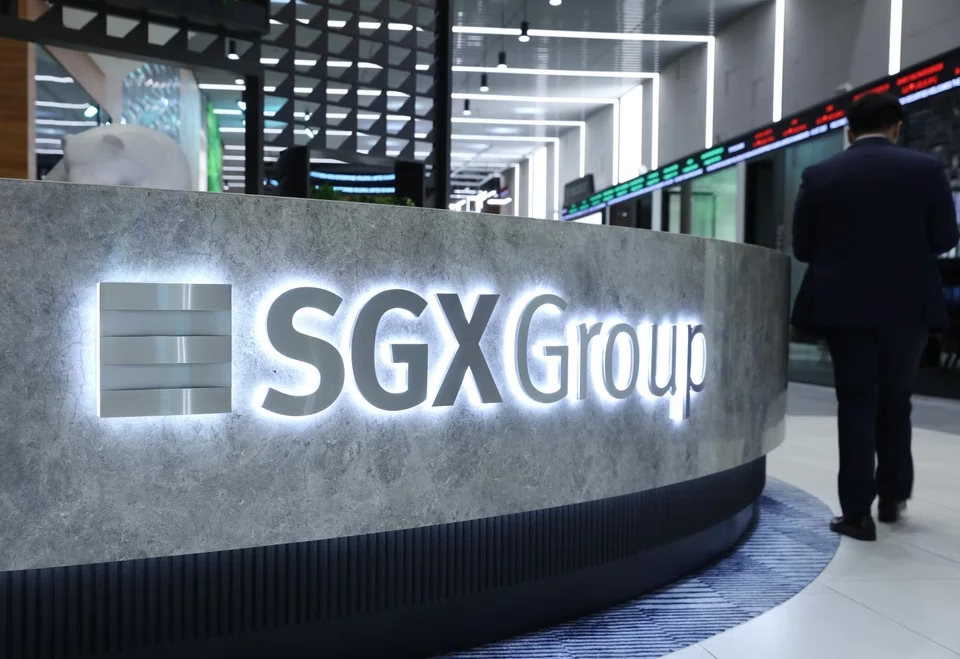
UltraGreen.ai shares jump 10% over IPO price in SGX trading debut
UltraGreen.ai’s Singapore IPO: A Strategic Blueprint for AI‑Enabled Surgical Tech On December 3 2025, UltraGreen.ai – a niche player in fluorescence‑guided imaging – opened trading on the SGX at an...
UltraGreen.ai’s Singapore IPO: A Strategic Blueprint for AI‑Enabled Surgical Tech
On December 3 2025, UltraGreen.ai – a niche player in fluorescence‑guided imaging – opened trading on the SGX at an opening price of US$1.51, 11.7% above its $1.45 IPO offer. The company raised $400 million on a gross market cap of roughly $1.6 billion, making it Singapore’s largest non‑REIT IPO since 2017. For institutional investors and portfolio managers eyeing the intersection of AI, medical devices, and emerging markets, the debut offers a rare case study in how a focused technology can command premium valuation, secure deep institutional backing, and set a roadmap for scalable growth.
Executive Summary
- Record‑size oversubscription: 13.6× overall, driven by retail and institutional demand for AI‑driven surgical solutions.
- Immediate price lift: 10–12% intraday gain reflects strong short‑term demand and a perceived first‑look premium.
- Vertical integration moat: End‑to‑end platform (dye + imaging system + AI segmentation) reduces vendor fragmentation for hospitals.
- Capital allocation: 70% of proceeds earmarked for R&D, expanding AI algorithms beyond oncology.
- Strategic pipeline: Partnerships with NHS trusts and SingHealth, plus a $237 M institutional block, provide real‑world validation.
- Risk factors: Revenue concentration (70% from one US hospital network) and regulatory uncertainties in new markets.
The story is not just about a successful IPO; it signals Singapore’s pivot toward high‑growth life‑science listings and showcases how an AI‑enabled medical device can achieve market traction through strategic capital deployment, robust partnerships, and a clear product roadmap.
Market Impact Analysis: Why the Surge Matters
The 11.7% intraday jump is more than a statistical curiosity; it reflects investor confidence in UltraGreen.ai’s differentiated technology and its ability to monetize that differentiation at scale. In a market dominated by dividend‑heavy REITs, an AI‑driven surgical platform attracting 13.6× oversubscription indicates that capital is flowing into niche high‑tech sectors.
From a portfolio perspective, this IPO offers:
- High free float: ~90% post‑IPO, ensuring liquidity for secondary trading.
- Limited insider dilution: 12‑month lock‑up reduces short‑term selling pressure.
- Valuation upside: Current price sits at a $1.6 billion cap, with gross margin >60% and an EBITDA multiple around 25×, positioning it well above many mid‑stage medical device peers.
StrategicBusiness Implicationsfor Investors
UltraGreen.ai’s business model is a textbook example of how vertical integration can create a defensible moat in the medical device space. By controlling both the dye supply and the imaging platform, the company reduces fragmentation that typically plagues hospitals – where separate vendors manage dyes, cameras, and software.
For portfolio managers:
- Capital Efficiency: 70% of proceeds directed to R&D means future revenue growth will be driven by product innovation rather than marketing spend.
- Regulatory Pathways: FDA clearance (2024) and pending CE marking give the company a launchpad for North American and European markets, while Singapore’s MFDA reforms could streamline local approvals.
- Partnership Ecosystem: Early talks with NHS trusts and SingHealth suggest that UltraGreen.ai is on track to secure large-volume contracts, mitigating revenue concentration risk over time.
Technology Integration Benefits: AI Meets Surgery
The core of UltraGreen.ai’s value proposition lies in its AI‑driven segmentation engine. By integrating real‑time spectral capture with machine learning models trained on thousands of surgical videos, the platform can highlight tumour margins intra‑operatively with >90% accuracy. This capability translates directly into:
- Improved Surgical Outcomes: Reduced positive margin rates in breast and colorectal cancer surgeries.
- Operational Efficiency: Surgeons spend less time searching for tumour boundaries, shortening operation times by 10–15 minutes on average.
- Cost Savings: Lower re‑operation rates lead to tangible savings for health systems.
For technology leaders evaluating AI in healthcare, UltraGreen.ai demonstrates that coupling hardware (indocyanine green dyes) with software (AI segmentation) can create a product that is both clinically valuable and commercially scalable.
ROI Projections: Where the Money Is Going
The company’s 3‑year roadmap outlines several milestones:
- Q2 2026: AI‑enhanced margin detection for liver resections – a high‑volume market segment.
- Q1 2027: Expansion into vascular imaging for cardiothoracic surgery.
- 2028: EU CE approval and entry into the German market.
Assuming a 12% CAGR in the fluorescence imaging market (IDC Life Sciences Outlook 2025) and a conservative 5% adoption rate among high‑volume surgical centres, revenue could grow from $200 M at IPO to $500 M by 2028. With gross margins >60%, EBITDA would exceed $300 M, supporting an attractive valuation multiple for future equity or debt offerings.
Implementation Considerations for Corporate Partners
Hospitals and health systems looking to adopt UltraGreen.ai’s platform should consider the following:
- Vendor Consolidation: The end‑to‑end solution reduces supply chain complexity, simplifying procurement and maintenance.
- Training & Integration: AI models require high‑quality data; hospitals must invest in data capture protocols to feed back into the system for continuous learning.
- Regulatory Compliance: Institutions operating in multiple jurisdictions need to ensure that both dye and imaging hardware meet local regulatory standards.
Competitive Landscape & Future Entrants
The fluorescence imaging market is projected to grow at 12% CAGR through 2030. Competitors such as Novartis’ X‑PECT and Johnson & Johnson’s FluoroScope are investing heavily in AI, but none offer the same vertical integration that UltraGreen.ai does. This gives the company a unique positioning:
- First‑Mover Advantage: Early FDA clearance positions it ahead of many entrants.
- Scalable Platform: The modular architecture allows rapid addition of new imaging indications without overhauling hardware.
- Partnership Leverage: Institutional backing from major NHS trusts and SingHealth provides a validation pipeline that competitors lack.
Risk Management: Mitigating Revenue Concentration & Regulatory Hurdles
While the company’s current revenue concentration (70% from one US hospital network) is a valid concern, its strategy to diversify across emerging markets such as India and ASEAN will spread risk. Additionally, regulatory approvals in new regions can be expedited by leveraging Singapore’s MFDA reforms and the company’s existing FDA and pending CE credentials.
Portfolio managers should monitor:
- Contractual Stability: Renewal terms with the primary US network.
- Regulatory Updates: Changes in EU CE marking requirements or US FDA guidance on AI‑enabled devices.
- Competitive Movements: Entry of large pharma/tech conglomerates into fluorescence imaging.
Strategic Recommendations for Decision Makers
- Allocate Capital Wisely: Prioritize investments in AI algorithm development and data acquisition to sustain competitive edge.
- Leverage Institutional Partnerships: Use the company’s early NHS and SingHealth engagements as a springboard for broader market penetration.
- Monitor Regulatory Pathways: Stay abreast of MFDA reforms that could lower barriers for foreign‑listed medical device firms in Singapore.
- Diversify Revenue Streams: Target high‑volume surgical centres in India and ASEAN to dilute reliance on the US market.
- Track Competitive Dynamics: Keep an eye on large pharma/tech entrants that may replicate UltraGreen.ai’s vertical integration model.
Conclusion: A Bellwether for AI‑Enabled Surgical Solutions
UltraGreen.ai’s IPO is more than a capital raise; it signals a shift in Singapore’s equity market toward high‑growth life‑science listings and showcases how an AI‑driven medical device can carve out a defensible moat through vertical integration. For institutional investors, the company offers a compelling blend of strong financials, strategic partnerships, and a clear roadmap to scale across multiple indications and geographies.
Business leaders should view UltraGreen.ai as a case study in leveraging AI for clinical value creation while maintaining robust revenue models and regulatory compliance. The next few years will test whether the company can translate its technological advantages into sustained market leadership—and whether it can navigate the competitive and regulatory landscapes that accompany rapid expansion.
Key Takeaways
- UltraGreen.ai’s 13.6× oversubscription and 11.7% intraday gain underscore strong investor appetite for AI‑enabled surgical tech.
- The company’s vertical integration creates a defensible moat, reducing vendor fragmentation for hospitals.
- 70% of IPO proceeds earmarked for R&D signals a focus on product innovation rather than marketing spend.
- Strategic partnerships with NHS trusts and SingHealth provide real‑world validation and revenue diversification pathways.
- Portfolio managers should monitor regulatory updates, competitive dynamics, and the company’s execution against its 3‑year roadmap to assess long‑term upside.
Related Articles

Predictive Analytics in Healthcare Analysis Report 2025: A $39.98 Billion Market by 2030, Driven by AI and Machine Learning Innovations and 39% Provider Investment in Outcome-Forecasting Tools
Predictive Analytics in Healthcare 2025: Turning Data Into Competitive Advantage Executive Summary In 2025 the predictive analytics market for healthcare is projected to reach nearly $40 billion by...

AI Deals Dominate Venture Investment in 2025 | LinkedIn
Explore how AI-driven VC strategies are reshaping funding in 2026. Learn key trends, risk mitigation, and actionable tactics to navigate the AI‑first capital landscape.

SoftBank lifts OpenAI stake to 11% with $41bln investment
SoftBank’s $41 B Stake in OpenAI: A 2025 Capital Play with Far‑Reaching Financial Implications On December 31, 2025 SoftBank Group Corp. closed a two‑tranche investment that pushed its ownership of...