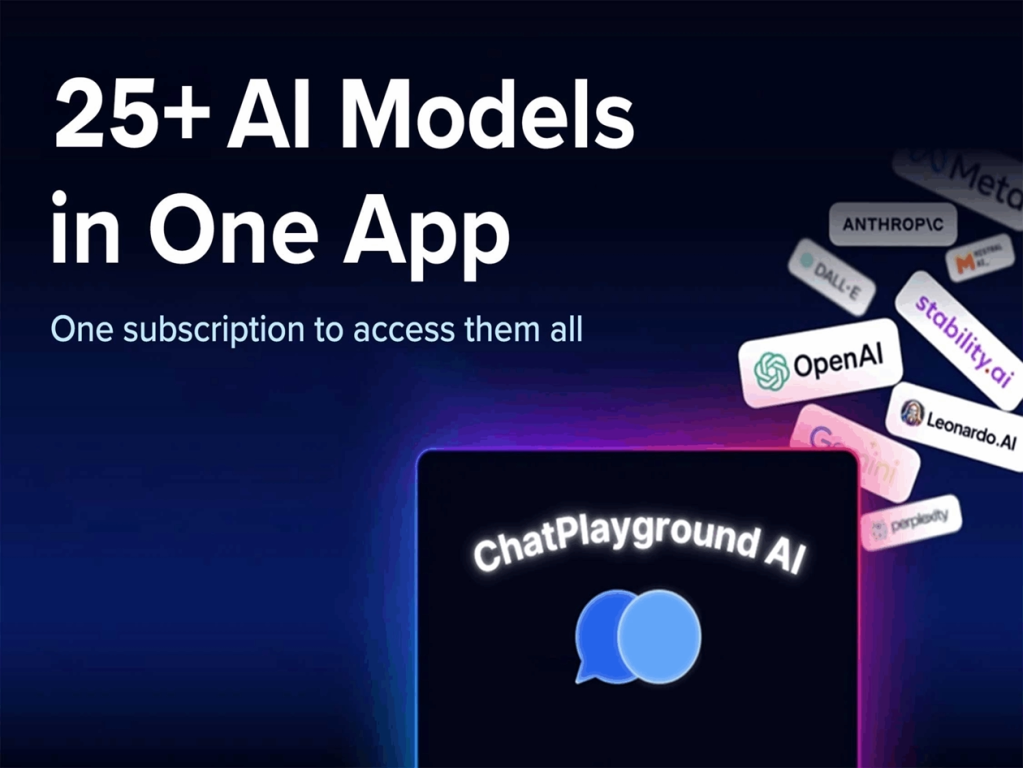
This lifetime AI platform lets you use every major model in one place — 87% Off
Lifetime AI Platform in 2025: A Strategic Guide for Enterprise Adoption Executive Summary ChatPlayground offers a one‑time $79.97 license that unlocks lifetime access to 25+ leading models (GPT‑4o,...
Lifetime AI Platform in 2025: A Strategic Guide for Enterprise Adoption
Executive Summary
- ChatPlayground offers a one‑time $79.97 license that unlocks lifetime access to 25+ leading models (GPT‑4o, Gemini 3 Pro, Claude 4.5, Llama, etc.) with side‑by‑side benchmark data.
- The platform’s unified dashboard eliminates API key juggling, reduces subscription churn risk, and provides granular performance & cost metrics that enable precise workload mapping.
- For SMBs and mid‑market firms, the upfront model provides predictable budgeting; for enterprises, it offers a sandbox to validate multimodal capabilities before committing to vendor contracts.
- Key risks include lack of latency SLAs, unclear fine‑tuning support, and potential regulatory exposure when sending proprietary data to third‑party models.
- Bottom line: If your organization needs rapid experimentation across the 2025 model ecosystem with transparent metrics and a low upfront cost, ChatPlayground is a compelling platform. Align its use with a staged rollout that begins with proof‑of‑concept workloads before scaling to production.
StrategicBusiness Implicationsof Lifetime Licensing in 2025
The shift from subscription‑based revenue models to lifetime licensing is a bold move that reshapes the economics of AI tooling. In 2025, most vendors (OpenAI, Anthropic, Google) continue to charge per‑token usage or maintain tiered monthly plans. ChatPlayground’s approach offers:
- Capital Expenditure Predictability : A single upfront fee eliminates recurring costs, simplifying budget approvals for CFOs and enabling more accurate capital budgeting.
- Vendor Lock‑In Mitigation : By aggregating multiple models under one UI, the platform reduces dependency on any single vendor’s pricing changes or policy shifts. This is especially valuable in regulated industries where data residency requirements may force a switch to a local model provider.
- Competitive Positioning for SMBs : Many small firms lack the scale to negotiate enterprise contracts with OpenAI or Google. A lifetime license democratizes access to cutting‑edge models, leveling the playing field and accelerating digital transformation.
- Risk of Rapid Obsolescence : The AI model lifecycle is fast; a 2025 platform may need frequent updates to stay current. Without a clear upgrade path, customers risk being left behind if new models (e.g., Gemini 4) are released.
Technical Implementation Guide: From Sandbox to Production
The platform’s interface is designed for rapid experimentation, but moving workloads into production requires disciplined engineering practices. Below is a step‑by‑step workflow that aligns with DevOps and MLOps principles.
1. Model Selection via Benchmark Dashboards
- Large‑Context Research : Gemini 3 Pro’s 1 M‑token window at ~81–142 t/s outperforms GPT‑5.1 in reasoning benchmarks.
- Conversational Agents with External Data : GPT‑5.1’s 196k token limit and tight plugin ecosystem (OpenAI Studio) make it ideal for customer support bots that need real‑time API calls.
- Code Generation & Safety : Claude 4.5 offers robust safety mitigations and a 200k token context window, suitable for developer assistants.
2. Latency and Throughput Profiling
- Run synthetic workloads (e.g., 10 000 concurrent requests with 512‑token prompts) to capture real latency under load. The platform does not publish SLA guarantees, so internal profiling is critical.
- Compare per‑token pricing: GPT‑5.1 ($15 input / $60 output), Gemini 3 Pro ($2 / $12), Claude 4.5 ($3 / $15). For high‑volume text generation (e.g., content marketing), the cost differential can be significant.
3. Data Governance and Compliance Checks
- Verify that data sent to third‑party models complies with GDPR, CCPA, and industry‑specific regulations (HIPAA for healthcare). The platform’s documentation does not disclose token‑counting heuristics for video or audio; perform a privacy impact assessment before uploading sensitive media.
- Consider on‑prem fine‑tuning options. While the current release lacks explicit support, monitor the roadmap for future capabilities that allow custom embeddings or model personalization without external data exposure.
4. Integration Layer Development
- Build a lightweight wrapper around the platform’s API endpoints to standardize request/response handling across models.
- Implement token‑budget monitoring to enforce cost caps per application (e.g., cap GPT‑5.1 usage at $100/month for a chatbot).
- Use feature flags to toggle between models in production, enabling A/B testing of performance and cost metrics.
5. Continuous Monitoring and Optimization
- Set up dashboards that track latency, throughput, error rates, and spend per model.
- Automate alerts for SLA breaches or budget overruns.
- Periodically re‑benchmark against new releases (e.g., Gemini 4) to ensure the platform remains cost‑effective.
ROI Projections: Quantifying Value Beyond Benchmarks
To translate technical metrics into business value, consider the following scenarios:
- Assume 512 tokens per article. Using Gemini 3 Pro at $12 output per million tokens, total monthly cost ≈ $600.
- With GPT‑5.1 at $60 output per million tokens, the same workload costs ≈ $3,000.
- Cost savings: ~80% reduction in spend, freeing budget for creative assets.
- Each interaction averages 200 tokens. Using GPT‑5.1’s plugin ecosystem reduces response time by 30%, improving CSAT scores.
- Estimated incremental revenue from higher satisfaction: $0.50 per interaction → $10,000/month.
- Net benefit after accounting for token costs (~$2,400) is ~$7,600/month.
- Claude 4.5’s safety mitigations reduce hallucinations by 25%, cutting code review time by 15%.
- Assuming a team of 10 developers saves 2 hours/day, the annual labor cost savings are ~ $200,000.
These examples illustrate how choosing the right model based on benchmark data can yield tangible financial gains. The lifetime license removes recurring overhead, making ROI calculations cleaner and more predictable.
Market Analysis: Where ChatPlayground Fits in 2025’s AI Ecosystem
The competitive landscape in late 2025 is dominated by three pillars:
- Scale Monsters : Gemini 3 Pro offers unmatched context windows and low per‑token cost, appealing to data‑heavy research labs.
- Ecosystem Hubs : GPT‑5.1 integrates tightly with OpenAI’s plugin system, making it the default choice for enterprises that need real‑time API calls and code execution.
- Safety Craftsmen : Claude 4.5 prioritizes content filtering and safe completion, ideal for regulated industries.
ChatPlayground’s value proposition is its
model marketplace
model: a single dashboard that brings all three pillars together. This reduces the friction of maintaining multiple vendor accounts, streamlines credential management, and enables cross‑model experimentation without code rewrites.
However, the platform faces challenges:
- Update Cadence : Without a transparent upgrade policy, users may need to purchase additional licenses for new models or rely on community forks.
- Compliance Visibility : The lack of detailed data residency and audit logs could deter highly regulated sectors.
- Fine‑Tuning Limitations : Many enterprises require custom model training; the current platform does not expose fine‑tuning APIs, limiting adoption for niche workloads.
Future Outlook: Trends Shaping AI Platforms in 2026 and Beyond
1.
Model-as-a-Service (MaaS) Ecosystems
: OpenRouter‑style integrations will become mainstream, allowing users to plug in open‑source or niche models directly into unified dashboards.
2.
Hybrid On‑Prem/Cloud Deployments
: Regulatory pressure will drive demand for hybrid solutions that keep sensitive data on premises while leveraging cloud inference for scalability.
3.
Standardized Latency SLAs
: As AI moves into latency‑critical domains (autonomous vehicles, real‑time trading), vendors will offer SLA guarantees tied to token throughput and response times.
4.
Fine‑Tuning APIs for Multi‑Model Platforms
: Unified platforms will expose fine‑tuning endpoints that respect each model’s underlying architecture, enabling truly customized deployments without leaving the ecosystem.
Strategic Recommendations for Decision Makers
- Start with a Pilot : Use ChatPlayground to run proof‑of‑concepts on low‑risk workloads (e.g., internal documentation generation) before committing to production pipelines.
- Implement Governance Controls : Enforce token budgets, data residency checks, and audit logs at the wrapper layer to mitigate compliance risks.
- Leverage Benchmark Data for Model Selection : Match workloads to model strengths—use Gemini 3 Pro for large‑context reasoning, GPT‑5.1 for plugin‑heavy conversations, Claude 4.5 for safety‑critical code generation.
- Negotiate Upgrade Paths : Clarify with the vendor whether future models will be included in the lifetime license or require additional purchases; consider a multi‑year renewal strategy if available.
- Plan for Fine‑Tuning Needs : If custom training is essential, evaluate whether the platform’s roadmap includes fine‑tuning APIs or if you need to maintain separate on‑prem models.
- Monitor Cost vs. Performance Continuously : Set up automated dashboards that track token usage, latency, and spend per model to ensure ongoing ROI.
Conclusion: Harnessing a Unified Lifetime Platform in 2025
The ChatPlayground lifetime license is more than an inexpensive bundle; it represents a strategic shift toward unified AI experimentation and cost transparency. For organizations that value rapid iteration across the full spectrum of 2025’s leading models, the platform offers:
- Immediate access to high‑performance multimodal capabilities.
- Granular benchmark data that informs precise workload mapping.
- A predictable financial model that aligns with capital budgeting cycles.
Adopting this platform requires disciplined governance, continuous monitoring, and a clear upgrade strategy. When executed thoughtfully, it can accelerate digital transformation, unlock cost efficiencies, and position your organization at the forefront of AI innovation in 2025 and beyond.
Related Articles

Artificial Intelligence News -- ScienceDaily
Enterprise leaders learn how agentic language models with persistent memory, cloud‑scale multimodal capabilities, and edge‑friendly silicon are reshaping product strategy, cost structures, and risk ma
Raaju Bonagaani’s Raasra Entertainment set to launch Raasra OTT platform in June for new Indian creators
Enterprise AI in 2026: how GPT‑4o, Claude 3.5, Gemini 1.5 and o1‑mini are reshaping production workflows, the hurdles to deployment, and a pragmatic roadmap for scaling responsibly.
Meta’s new AI infrastructure division brings software, hardware , and...
Discover how Meta’s gigawatt‑scale Compute initiative is reshaping enterprise AI strategy in 2026.