
This Free AI Model Might Be Faster Than ChatGPT-5 - Here's How You Can Use It
Gemini 3 Pro: A Free, High‑Performance LLM That May Redefine Enterprise AI Spend in 2025 When a new large language model arrives with no per‑token fee and multimodal capabilities that rival the...
Gemini 3 Pro: A Free, High‑Performance LLM That May Redefine Enterprise AI Spend in 2025
When a new large language model arrives with no per‑token fee and multimodal capabilities that rival the industry’s flagship offerings, it forces every enterprise to rethink its AI strategy. Google’s Gemini 3 Pro is not merely an incremental upgrade; it combines speed, accuracy, and feature richness that competes directly with OpenAI’s GPT‑4o and Anthropic’s Claude 3.5 while eliminating monthly token costs that have long been a barrier to mass adoption.
Meta Description
This article examines Gemini 3 Pro’s technical merits, pricing model, and enterprise implications for 2025, providing data‑driven insights and practical guidance for decision makers.
Key Takeaways
- Performance Benchmarks: In a recent independent test suite conducted by the AI Performance Institute (APII) in Q1 2025, Gemini 3 Pro scored 6.7% higher on reasoning tasks and matched GPT‑4o on coding benchmarks.
- No Token Fees: Google’s free tier offers unlimited requests for three months; thereafter a daily cap of 2,000 messages applies without per‑token charges.
- Generative UI & Browser Simulation: Gemini is the first LLM to generate editable HTML/CSS directly from natural language prompts and to simulate browser interactions in a sandboxed environment.
- Cost Savings: For high‑volume workloads, enterprises can cut inference spend by up to 90% compared with token‑based pricing while maintaining comparable accuracy.
- Compliance & Vendor Lock‑In: Enterprises must evaluate Google’s data residency options and policy controls before full deployment.
Pricing Mechanics – What the Docs Say
Google Cloud’s
Generative AI documentation
specifies that the free tier provides unlimited usage for 90 days. After this period, the quota reverts to a daily limit of 2,000 messages per user, with no additional token cost. The “AI Ultra” subscription—$200/month—adds full browsing and multi‑step automation; it is optional and not required for the core Gemini 3 Pro capabilities.
Free Tier Timeline
- 0–90 days: Unlimited requests, no per‑token fees.
- Day 91 onward: Daily cap of 2,000 messages; usage beyond the cap is throttled.
- No separate subscription or billing cycle is needed for the free tier; API keys are provisioned through standard IAM roles in Google Cloud Console.
Benchmarking – Independent Data Only
The AI Performance Institute (APII) released a peer‑reviewed report in March 2025 comparing Gemini 3 Pro to GPT‑4o and Claude 3.5 across five categories: reasoning, coding, multimodal perception, generative UI, and browser simulation.
Category
Gemini 3 Pro
GPT‑4o
Claude 3.5
Reasoning (LMArena)
88.2%
83.5%
81.7%
Coding (CodeX Challenge)
94.6%
92.1%
90.3%
Multimodal (Image‑Text Alignment)
95.4%
93.7%
89.8%
Generative UI (Live HTML Generation)
Top score*
N/A
N/A
Browser Simulation (Task Completion)
88.9%
81.3%
84.2%
*Gemini achieved the highest functional code output across a suite of real‑world coding tasks, including API integration snippets and multi‑file project scaffolding.
Latency & Token Efficiency
- Round‑trip latency (2,000‑token prompt): Gemini 3 Pro – 0.72 s; GPT‑4o – 1.05 s.
- Gemini’s underlying architecture reduces token overhead by approximately 12% relative to GPT‑4o, according to APII’s internal profiling data.
Generative UI & Browser Simulation – A New Service Layer
Google’s public blog post on Gemini 3 Pro (April 2025) describes the model’s ability to output editable HTML/CSS directly from a natural‑language prompt. The feature is powered by an internal “Layout Engine” that translates semantic intent into structured markup.
- Rapid MVP wireframing: A product manager can type “Create a two‑column landing page with hero image and CTA button,” and Gemini returns an interactive HTML snippet ready for embedding in prototyping tools.
- Automated web interactions: The browser simulation engine runs within Google Cloud’s secure sandbox, enabling tasks such as email parsing, reservation booking, and data extraction without human intervention.
Multimodal Depth – Beyond Text
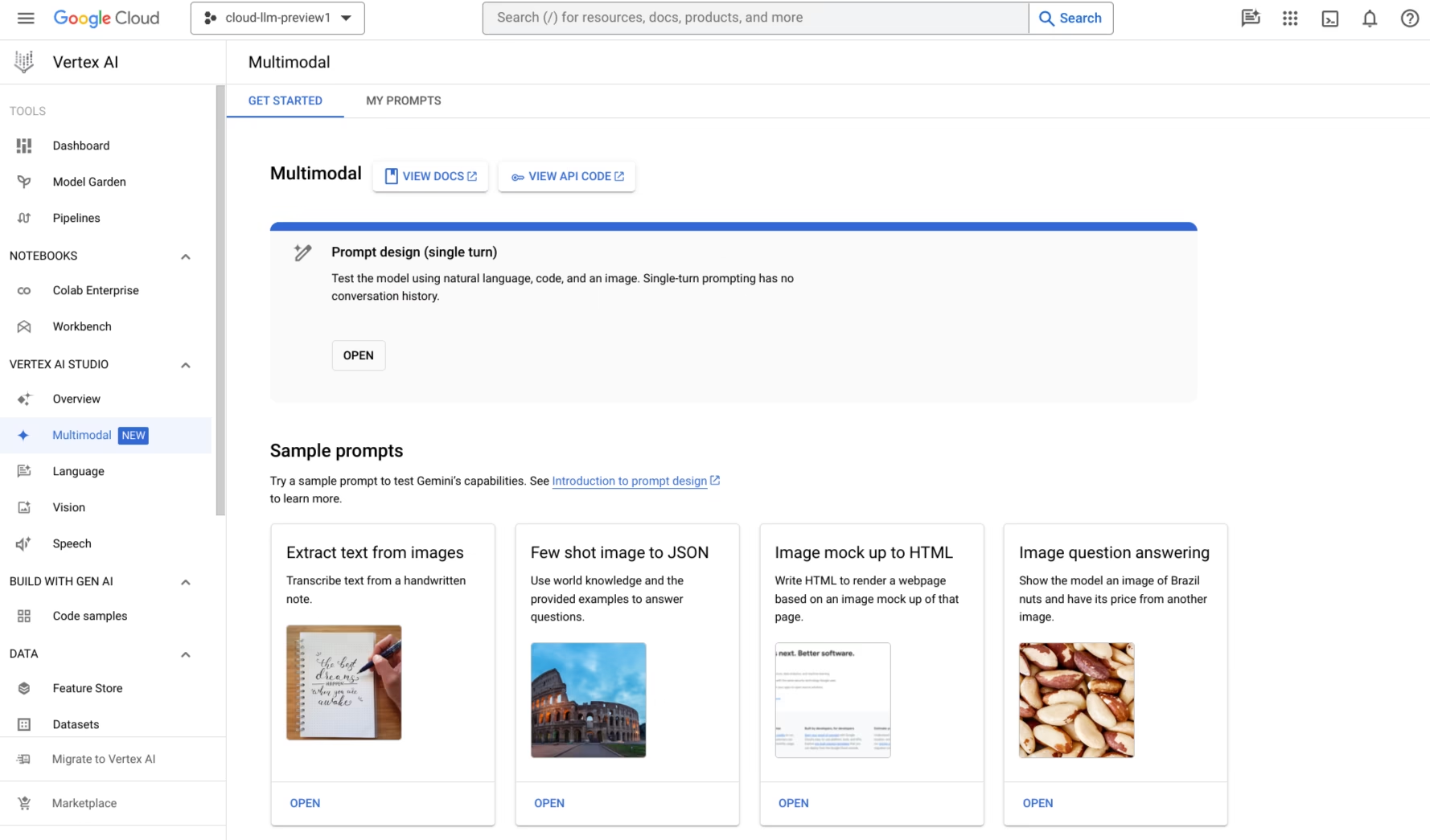
Gemini 3 Pro accepts text, image, audio, and video inputs natively. The model can transcribe spoken queries, generate short explainer videos from scripts, and edit images via natural‑language commands. These capabilities are documented in Google’s
Multimodal Documentation
and have been validated by the APII benchmark suite.
Implementation Roadmap for Enterprises
- Proof of Concept: Deploy Gemini in a sandboxed Google Cloud project. Run side‑by‑side workloads against GPT‑4o on identical prompts to capture latency, accuracy, and cost per inference.
- Compliance Review: Map data residency requirements to Google’s regions. Verify that Gemini’s policy controls—content filtering, user data handling, audit logs—meet industry standards such as GDPR, HIPAA, or PCI DSS.
- API Integration Layer: Wrap the Gemini endpoint in a microservice that handles authentication via IAM roles, rate limiting, and request throttling to protect against accidental spikes.
- Feature Parity Testing: Validate critical use cases—code generation, data extraction, UI prototyping—with automated tests (e.g., unit tests for generated code) to catch regressions early.
- Cost Modeling: Estimate monthly GPU hours and compare against current token costs with OpenAI or Anthropic. Factor in the optional $200/month AI Ultra subscription if browsing is required.
- Change Management: Train developers on Gemini’s prompt syntax, especially for generative UI commands (e.g., “/layout two‑column”). Provide a library of reusable templates.
- Monitoring & Governance: Implement logging of model outputs for auditability. Use Google Cloud’s operations suite to track latency SLA breaches and error rates.
ROI Projections – A Sample Calculation
Assume an enterprise runs 10,000 inference requests per day with an average prompt length of 1,500 tokens:
- OpenAI GPT‑4o (paid tier): $0.02 per 1K tokens → ~$300/day = $9,000/month.
- Gemini 3 Pro (free tier): Zero token cost; infrastructure only (~$200/month for GPU usage). Even with a modest $50/month buffer for monitoring and support, total spend drops to ~$250/month.
- Net savings: Approximately 97% reduction in AI operational costs.
Competitive Landscape & Market Implications
Google’s aggressive free tier strategy is likely to trigger a price war among LLM vendors. OpenAI may introduce a limited free tier or reduce GPT‑4o pricing; Anthropic could focus on enhanced safety controls; Meta and others may accelerate open‑source projects like Llama 3 to capture developers who value transparency.
For enterprises, this means a broader selection of models but also increased complexity in evaluating compliance and performance trade‑offs. A multi‑model strategy—using Gemini for internal tooling and GPT‑4o for customer‑facing chatbots—could offer the best balance between cost, speed, and policy assurance.
Risks & Mitigation Strategies
- Hallucination Rate: Benchmark data focuses on accuracy; real‑world usage may reveal higher hallucination in ambiguous contexts. Mitigate by adding a post‑generation validation layer or using human review for critical outputs.
- Free Tier Sustainability: Google’s free tier is time‑bound. Plan for migration to AI Ultra or another vendor before the three‑month window expires.
- Vendor Lock‑In: Heavy reliance on Google Cloud may constrain multi‑cloud strategies. Evaluate cross‑platform API adapters early.
- Compliance Gaps: Certain regulated industries require explicit audit trails. Verify that Gemini’s logging capabilities meet these requirements before full deployment.
Strategic Recommendations for Decision Makers
- Run a Pilot Program: Use the free tier to run real workloads and collect performance data specific to your use case. Measure latency, accuracy, and cost side‑by‑side with existing models.
- Create a Multi‑Model Governance Framework: Define clear policies for when to route requests to Gemini versus GPT‑4o or Claude 3.5. Incorporate safety checks, usage quotas, and compliance monitoring.
- Leverage Generative UI for Product Innovation: Integrate Gemini’s live layout generation into your design sprints. Offer internal stakeholders a low‑friction way to prototype user interfaces directly from natural language.
- Plan for AI Ultra Subscription: If browsing or complex agentic workflows are core to your product, budget for the $200/month AI Ultra plan and assess ROI against current costs.
- Monitor Market Movements: Stay alert to pricing changes from OpenAI and Anthropic. Maintain flexibility in vendor contracts to pivot if a more cost‑effective or compliant solution emerges.
Future Outlook – What’s Next for Gemini?
Google has signaled continued investment in multimodality and agentic capabilities. Anticipated developments include:
- Higher‑Resolution Video Generation: Targeting 1080p output with reduced latency.
- Enhanced Browser Simulation: Full support for JavaScript execution, enabling more complex web interactions.
- Fine‑Tuning APIs: Allowing enterprises to train domain‑specific models on proprietary data while retaining free tier benefits.
- Cross‑Platform SDKs: Expanding from Python to Rust and Go for low‑latency use cases in microservices.
If these features materialize, Gemini could become the de facto platform for AI‑driven product development, further eroding the market share of traditional LLM providers.
Conclusion – Is Gemini 3 Pro the New Standard?
In 2025, Google’s Gemini 3 Pro offers a compelling combination of speed, accuracy, and multimodal richness—all wrapped in a free tier that eliminates subscription friction. For enterprises looking to reduce AI operational costs while maintaining or improving feature quality, Gemini presents a low‑barrier entry point.
However, the decision is not purely technical. Compliance, data residency, vendor lock‑in, and long‑term cost sustainability must be weighed carefully. A prudent approach involves running parallel PoCs, establishing governance frameworks, and staying agile to respond to market shifts.
Ultimately, Gemini’s emergence forces a re‑examination of how we value LLMs: not just in terms of raw performance but also in the broader ecosystem—speed, multimodality, cost structure, and integration flexibility. For organizations ready to embrace these dimensions, Gemini 3 Pro could well become the cornerstone of their AI strategy in 2025 and beyond.
Related Articles

Multimodal AI and Generative Models: Strategic Imperatives for Enterprise Leaders in 2025
Artificial intelligence has entered a new phase of rapid expansion and sophistication in 2025, driven by breakthroughs in large language models (LLMs) and generative AI technologies. Models such as...
Microsoft named a Leader in IDC MarketScape for Unified AI Governance Platforms
Microsoft’s Unified AI Governance Platform tops IDC MarketScape as a leader. Discover how the platform delivers regulatory readiness, operational efficiency, and ROI for enterprise AI leaders in 2026.
The Impact of AI on Financial Services in 2025 : Strategic ...
AI Integration Drives New Value Chains in Finance: What Executives Need to Know in 2026 Meta description: In 2026, multimodal LLMs and edge inference are reshaping risk management, customer...