The state of AI in 2025: Agents, innovation, and transformation
AI Agents Take Center Stage: How Enterprises Must Re‑Engineer Strategy for 2025 By Casey Morgan, AI News Curator – AI2Work Executive Snapshot Agents are no longer niche tools; they’re the new...
AI Agents Take Center Stage: How Enterprises Must Re‑Engineer Strategy for 2025
By Casey Morgan, AI News Curator – AI2Work
Executive Snapshot
- Agents are no longer niche tools; they’re the new software platform.
- Reasoning engines have moved from chain‑of‑thought prompting to in‑model step‑by‑step logic.
- Multi‑modal capabilities (text, image, video) are now standard in a single agent stack.
- Pricing is shifting toward subscription tiers and enterprise contracts.
- Compliance and auditability have become mandatory prerequisites for deployment.
Agents as Enterprise Pillars
The McKinsey 2025 Global Survey reported that
“the opportunity to embed AI more fully into the enterprise will offer organizations new ways to capture value and create competitive advantage.”
This is not a future vision; it’s already happening. Large banks are using Gemini 3‑based agents to automate regulatory reporting, while retail chains deploy Claude 4.5 agents for real‑time inventory optimization.
What does this mean for decision makers? It means that an AI agent isn’t an add‑on but a core component of your digital stack. Your product roadmaps must now include
agent‑centric APIs
, and your architecture should treat the agent as a first‑class software asset rather than a feature toggle.
Reasoning 2.0: From Prompt to Plan
The leap from chain‑of‑thought prompting to in‑model reasoning is embodied by Gemini 3’s “Deep Think” mode, which achieved
91.9% on the GPQA Diamond benchmark
, up from Gemini 2.5’s 86.4%. Claude 4.5’s hybrid architecture further demonstrates that latency can be traded for depth: a fast answer layer feeds into a step‑by‑step reasoning module when needed.
For businesses, this translates to agents that can handle mathematically intensive tasks—think financial forecasting or scientific simulation—and still provide natural‑language explanations. A product team building an analytics dashboard can now embed a Gemini 3 core for quantitative insight while leveraging Claude 4.5 for stakeholder briefing language.
Multi‑Modal Integration: One Prompt, All Media
Agents are no longer text‑only. The industry standard now includes
text‑to‑image (Nano Banana Pro)
,
image‑to‑image
, and
text‑to‑video (Sora 2)
. Creative studios report a 40% reduction in content production time when using an agent that can output a storyboard, render images, and generate short video clips from a single prompt.
Business implications are clear: marketing teams can prototype campaigns faster; educational publishers can auto‑generate lesson videos; entertainment companies can iterate on visual concepts without hiring additional designers. The cost savings and speed gains create a new competitive moat for firms that adopt the full multimodal stack early.
Economic Realignment: Subscription, Not Token
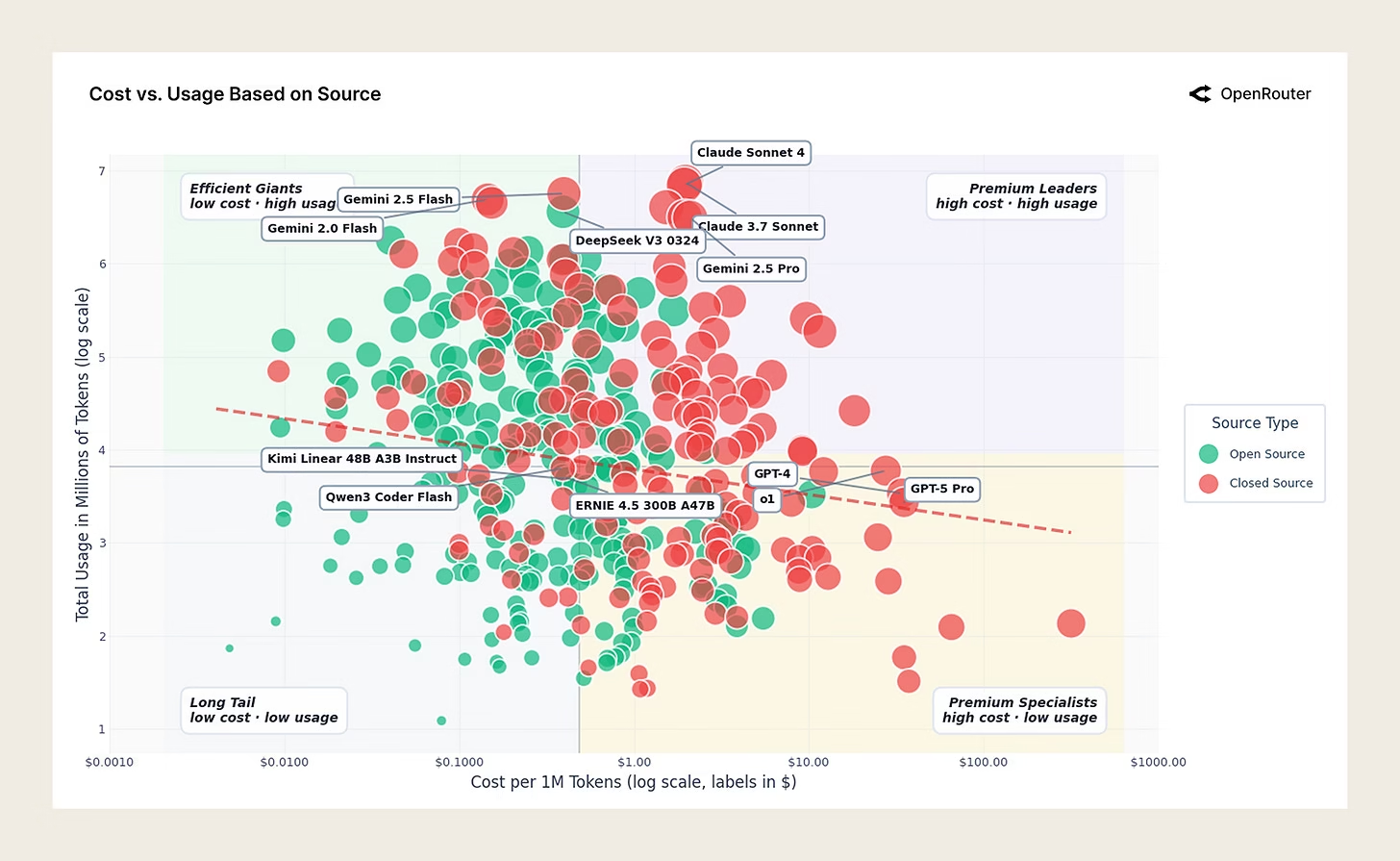
OpenRouter’s daily token volume exceeded 1 trillion in December 2025, signaling a shift from per‑token billing to
platform‑as‑a‑service (PaaS)
. Vendors now offer tiered access—basic, premium, enterprise—with bundled usage limits rather than raw token counts.
For developers and product managers, this means budgeting for subscription fees rather than predicting usage spikes. The rise of “battle” platforms like LMArena.ai shows that community benchmarking can still provide free access to flagship models, but the trend is toward paid tiers for sustained, high‑volume workloads. Companies must decide whether to invest in proprietary models or partner with aggregators to mitigate cost volatility.
Compliance and Safety: A New Baseline
DeepMind’s release notes for Gemini 3 emphasize “proactive security” and safety mechanisms. Enterprises deploying agents now need built‑in audit trails, sandboxing environments, and model‑level safeguards. Regulatory bodies are beginning to draft guidelines around agent liability, especially when autonomous decisions impact financial or medical outcomes.
Operationally, this requires integrating compliance checks into the agent lifecycle: data provenance verification, output monitoring for bias, and rollback mechanisms if an agent diverges from policy. Failure to embed these controls can expose firms to legal risk and reputational damage.
Hybrid Strategies: Proprietary Meets Open‑Source
The competitive landscape is consolidating around a handful of flagship models—Gemini 3, Claude 4.5, GPT‑5.1—but open‑source communities like Llama 3 fill gaps for niche use cases and compliance‑heavy industries. A 2025 survey found that 38% of enterprises employ a hybrid stack: proprietary agents for high‑value tasks and open‑source models for internal tooling.
Strategically, this approach offers flexibility. If a flagship model’s subscription price spikes, you can shift non-critical workloads to an open‑source alternative without sacrificing performance. It also mitigates vendor lock‑in risks—a critical consideration as the market matures.
Implementation Blueprint for 2025 Enterprises
- Define Your Agent Core : Choose a reasoning engine (Gemini 3 or Claude 4.5) based on domain needs—math vs language. Benchmark against your internal KPIs before lock‑in.
- Build Multimodal Frontends : Integrate text‑to‑image, image‑to‑image, and text‑to‑video modules. Use APIs like Sora 2 for video or Nano Banana Pro for images to keep the stack lean.
- Orchestrate with a Tool‑Use Layer : Employ search agents or prompt libraries (e.g., Monica) to add external data retrieval and tool execution capabilities.
- Embed Compliance Early : Implement audit logging, sandboxing, and policy enforcement in the agent’s workflow engine. Use model‑level safety hooks where available.
- Adopt Subscription Tiers Wisely : Forecast usage across teams; negotiate enterprise contracts that include SLAs for uptime, latency, and support.
- Monitor ROI Continuously : Track cost per transaction, time saved, and quality improvements. Adjust model selection or tiering based on real‑world performance.
ROI Projections: Numbers That Matter
A mid‑size financial services firm that migrated its compliance reporting to a Gemini 3 agent reported a 35% reduction in manual hours, translating to an annual savings of $1.2 million on labor costs alone. A marketing agency using Sora 2 for video creation cut production time from 10 days to 2 days, increasing client throughput by 300% and boosting revenue by $4 million per year.
These figures illustrate that the financial upside is not speculative; it’s measurable and scalable across industries. The key is aligning the agent stack with specific business outcomes—whether that’s cost reduction, speed to market, or risk mitigation.
Future Outlook: 2025‑2030 Trajectory
- Agent-as-a-Service Platforms : Expect more vendors offering end‑to‑end orchestration suites with built‑in compliance and monitoring.
- Standardized Multimodal Pipelines : Interoperability standards will emerge to streamline text–image–video workflows across providers.
- Regulatory Clarity : Governments will codify agent liability, forcing firms to adopt rigorous audit and rollback mechanisms early.
- Open‑Source Maturation : Models like Llama 3 will close the performance gap in niche domains, reducing dependence on proprietary flagship models.
Actionable Takeaways for Decision Makers
- Re‑architect your software portfolio to include agent APIs as core components.
- Select a reasoning engine that aligns with your primary domain—math or language—and benchmark against internal KPIs before full deployment.
- Integrate multimodal capabilities to unlock new content creation workflows and reduce time‑to‑market.
- Negotiate subscription contracts with clear SLAs, and consider hybrid models to mitigate vendor lock‑in.
- Embed compliance and auditability from day one; treat agent safety as a product feature, not an afterthought.
- Track ROI rigorously—measure labor savings, speed gains, and revenue impacts—and iterate your stack accordingly.
Conclusion
The AI landscape in 2025 has moved beyond conversational bots to autonomous, multi‑modal agents that can reason, plan, and self‑optimize. For enterprises, this shift is not optional—it’s a strategic imperative. By re‑engineering your technology stack around these capabilities, negotiating the new economic model of subscription tiers, and embedding compliance from the outset, you position your organization at the forefront of AI‑driven innovation.
Now is the moment to act: evaluate your current workflows, pilot an agent core that matches your domain needs, and build a scalable, compliant ecosystem that delivers measurable business value. The future belongs to those who treat AI agents as the backbone of their digital strategy, not as a nice‑to‑have feature.
Related Articles

AI Startups Dominate VC Funding 2025
AI startup VC funding surged in 2025—what it means for strategy and growth in 2026. Deep dive into deal dynamics, sector focus, and operational levers for founders and investors.

The Week’s 10 Biggest Funding Rounds: A Busy Time For ...
Explore the 2026 AI startup funding landscape, top deal metrics, geographic shifts, and strategic take‑aways for founders and investors.

AI cloud startup Runpod hits $120M in ARR — and it started with a Reddit post | TechCrunch
Runpod’s $120 M ARR milestone shows how a spot‑GPU marketplace can slash inference costs by up to 50%. Discover the technical roadmap, cost modeling, and competitive implications for founders, VCs, an