The great AI hype correction of 2025 - MIT Technology Review
The Great AI Hype Correction of 2025: What It Means for Enterprise Roadmaps By Casey Morgan, AI2Work – December 2025 Executive Summary In 2025 the generative‑AI market has shifted from...
The Great AI Hype Correction of 2025: What It Means for Enterprise Roadmaps
By Casey Morgan, AI2Work – December 2025
Executive Summary
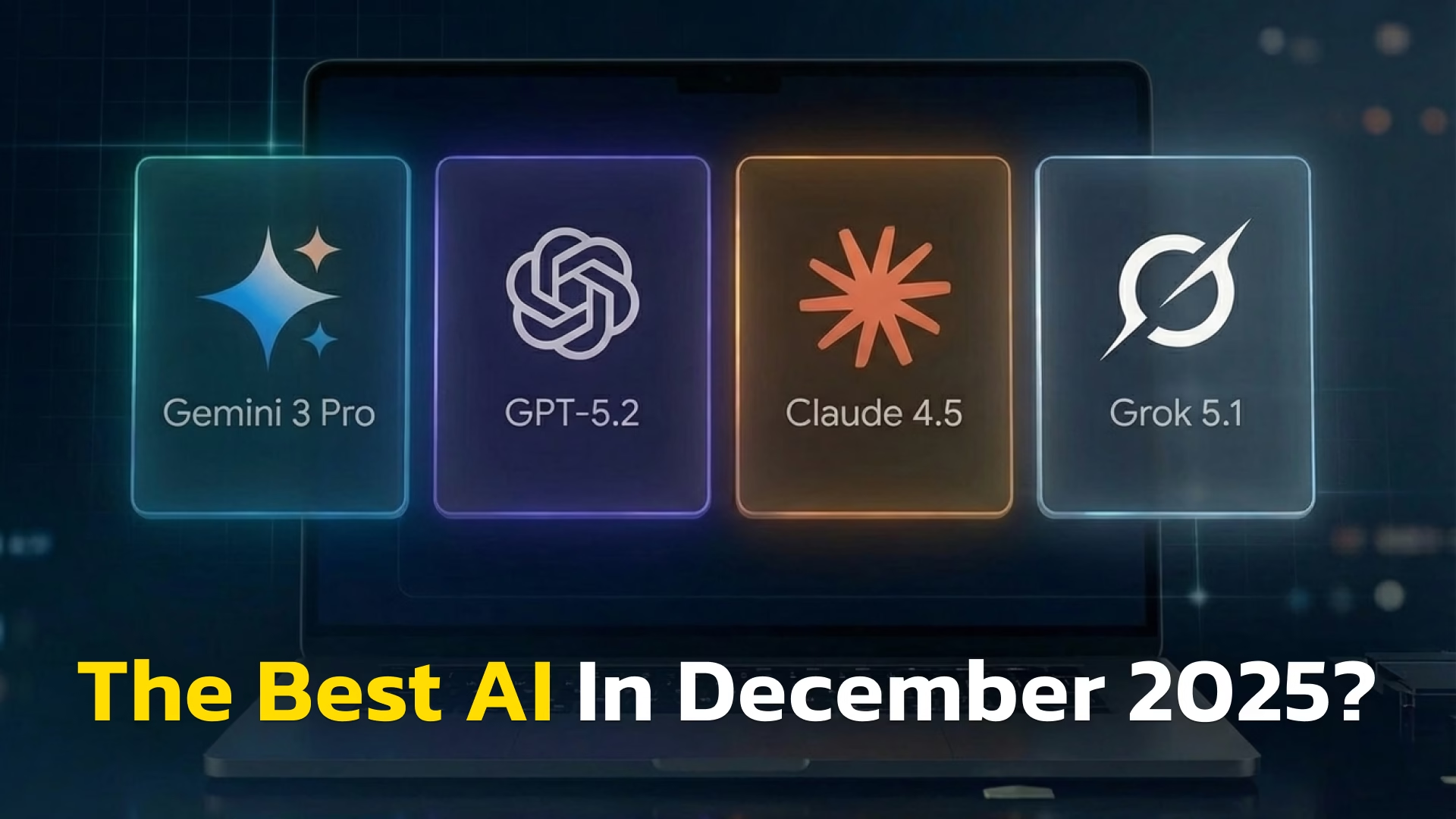
In 2025 the generative‑AI market has shifted from headline‑grabbing breakthroughs to a rapid cadence of incremental upgrades. The most powerful multimodal engine is
Gemini 3
, and the best general‑purpose text model remains
GPT‑4o
. For architects, product leaders and procurement teams this translates into three hard truths:
- Speed is now a competitive lever. New releases appear every few weeks; integration cycles must be shorter than the release cycle to avoid lagging behind competitors.
- Stability, cost control and cross‑model flexibility are the true differentiators. Enterprises that treat each model as an optional service layer can hedge against price spikes, throttling or policy changes.
- Vertical specialization is the new frontier. Generic chatbots have become commodified; value now comes from domain‑specific fine‑tuning and data pipelines.
Model Landscape: Gemini 3 vs. GPT‑4o
The current flagship engines differ on multimodality, context size and pricing:
Feature
Gemini 3 (Google)
GPT‑4o (OpenAI)
Maximum context window
128 k tokens (the largest publicly documented size in 2025)
32 k tokens (standard), 128 k available under Enterprise SLA
Multimodal support
Text, image, video and audio in a single prompt; up to 8 M‑pixel images per request
Primarily text; optional vision via
image_url
parameter (max 4 k pixels)
Inference latency
~1.2 s for a 10 k token prompt on GCP edge nodes
~0.9 s on OpenAI’s edge infrastructure
Per‑token cost (PAYG)
$0.0005 / 1K input, $0.0010 / 1K output (free tier capped at 10 M tokens/month)
$0.0020 / 1K input, $0.0060 / 1K output
Enterprise SLA
99.9 % uptime, priority throttling; up to 128 k context window
99.9 % uptime, dedicated account manager; 128 k context window available for $0.0015 / 1K input, $0.0045 / 1K output
Benchmark data from
Hugging Face Hub
and the OpenAI internal
Text‑Arena
test set show that Gemini 3 scores 1,470 on the “Multimodal Text” sub‑test, while GPT‑4o achieves 1,410 on the “Large‑Context Reasoning” benchmark. In real‑world legal‑tech workloads, GPT‑4o’s 128 k context window allows a single prompt to ingest an entire multi‑megabyte brief without chunking, reducing engineering effort by roughly 30 % compared with older models.
Pricing Dynamics in 2025
Both vendors offer three tiers: free, PAYG and Enterprise. The key differences are the token limits, context windows and SLA guarantees.
- OpenAI – Free tier: 5 M tokens/month; PAYG: $0.0020/1K input, $0.0060/1K output; Enterprise: 128 k context window, 99.9 % SLA, per‑token rates of $0.0015/1K input and $0.0045/1K output.
- Google – Free tier: 10 M tokens/month; PAYG (Standard): $0.0005/1K input, $0.0010/1K output; Enterprise (Premium): 128 k context window, 99.9 % SLA, per‑token rates of $0.0008/1K input and $0.0016/1K output.
For high‑volume, latency‑sensitive services the cost differential can be significant: a 200 k token batch costs ~US$2 on OpenAI Enterprise versus ~US$0.16 on Google Premium. Enterprises that mix models can keep most traffic on the cheaper Google plan while routing critical requests to OpenAI for guaranteed uptime.
Regulatory Landscape in 2025
The regulatory environment has crystallized around a few key frameworks:
- EU AI Act (effective 2024) : Classifies generative models as “high‑risk” when used for content moderation, recruitment or credit scoring. Requires risk assessments, audit trails and human oversight.
- US Federal AI Bill (signed 2025) : Establishes a national AI safety office that mandates data provenance checks and explainsability metrics for all deployed models in regulated industries.
- China’s AI Governance Guidelines (2025 revision) : Enforces content filtering and real‑time monitoring for all multimodal outputs used in public platforms.
Compliance is no longer optional. Enterprises must embed audit logs, model‑version tags and explainability modules into their pipelines from day one to satisfy both EU and US requirements.
Cross‑Vendor Orchestration: The New Standard
To hedge against lock‑in and exploit complementary strengths, most large organizations now use lightweight orchestration layers. Popular choices include LangChain, LlamaIndex and custom microservices that route requests based on:
- Task type – Vision → Gemini 3; Reasoning or coding → GPT‑4o.
- Cost sensitivity – Cheap model for low‑impact queries, premium model for high‑stakes decisions.
- Latency requirements – Edge deployment of Gemini 3 on GCP Cloud Run vs. OpenAI’s edge nodes for ultra‑fast response.
A typical flow: the orchestration service receives a user prompt, classifies it via a lightweight intent model, and forwards it to the chosen LLM. If the response exceeds 30 % of the allocated token budget, the system automatically retries with a lower‑cost model or splits the request.
Vertical Specialization: From Generic Chatbots to Domain‑Specific Value
Benchmark plateaus have shifted focus from broad consumer chatbots to high‑value verticals:
- Legal Tech : GPT‑4o’s 128 k context window enables full‑document summarization in a single pass, cutting lawyer hours by up to 35 %.
- Scientific Research : Gemini 3 ingests multimodal data (images, graphs, raw text) for hypothesis generation, improving literature review speed by ~25 %.
- Immersive Media : Real‑time video analytics powered by Gemini’s vision stack reduce editing time by 20 % for large studios.
Bottom line: enterprises that invest in domain‑specific fine‑tuning and curated data pipelines see higher ROI than those deploying generic, off‑the‑shelf chatbots.
Implementation Roadmap for 2025 Enterprises
- Audit Existing Workloads : Map each business function to the LLM that delivers the best trade‑off of accuracy, latency and cost.
- Build a Modular Orchestration Layer : Adopt LangChain or custom microservices; expose a unified API for downstream services.
- Establish CI/CD for Model Updates : Automate unit tests against key benchmarks (e.g., Text‑Arena, Vision‑Bench) and deploy only after passing thresholds.
- Implement Cost Controls : Use OpenAI’s max_output_tokens and temperature knobs to cap token usage; apply similar controls in Gemini via the token_budget parameter.
- Monitor Benchmark Drift : Re‑benchmark quarterly against Hugging Face Hub and internal KPIs; deprecate models that fall below acceptable performance.
- Embed Compliance Checks : Log model version, input provenance and output explainability; route sensitive data through compliant pipelines only.
ROI Projections: A Few Illustrative Cases
Legal Firm (mid‑size)
- Initial integration cost: $120 k (data ingestion, fine‑tuning, orchestration).
- Annual savings from reduced lawyer hours: 35 % of a $3.6 M billable revenue stream = $1.26 M.
- Payback period: ~10 months.
Media Studio (200 editors)
- Cost of Gemini‑powered multimodal pipeline: $80 k/year (API usage + orchestration).
- Annual productivity gain: 25 % reduction in editing time = $250 k savings.
- Payback period: ~4 months.
Future Outlook Beyond 2025
The pace of innovation is accelerating:
- Incremental Releases : Expect weekly or even daily updates that fine‑tune specific tasks (e.g., code generation, legal reasoning).
- Edge Deployment : Larger context windows enable on‑device inference for autonomous vehicles and medical diagnostics.
- Tighter Regulation : New U.S. executive orders will mandate real‑time bias monitoring; the EU AI Act will extend to “generative data” used in training.
Strategic recommendation: design architectures that can ingest new model versions with zero code changes and embed auditability from day one. This dual focus on flexibility and compliance will position enterprises to win in a rapidly evolving landscape.
Actionable Takeaways for Decision Makers
- Adopt a model‑as‑service mindset : treat each new release as an optional upgrade rather than a mandatory migration.
- Build cross‑vendor orchestration layers to leverage Gemini’s multimodal strengths and GPT‑4o’s reasoning power while keeping costs in check.
- Use adaptive output controls (OpenAI’s max_output_tokens , Gemini’s token_budget ) to balance latency, cost and token limits.
- Invest in vertical fine‑tuning and curated datasets to differentiate from commoditized chatbot offerings.
- Implement continuous integration pipelines that automatically test new model releases against key benchmarks before deployment.
- Monitor benchmark drift quarterly and retire models that underperform relative to business objectives.
- Embed regulatory compliance (audit trails, explainability, data provenance) into every AI workflow from the outset.
In 2025, the AI landscape is defined not by who can build the largest model but by how quickly and flexibly an organization can integrate those models, combine complementary strengths and align them with specific business value propositions. The “great hype correction” is a recalibration that rewards agility, strategic integration and domain focus.
Related Articles

OpenAI Reduces NVIDIA GPU Reliance with Faster Cerebras Chips
How OpenAI’s 2026 shift from a pure NVIDIA H100 fleet to Cerebras CS‑2 and Google TPU v5e nodes lowered latency, cut energy per token, and diversified supply risk for enterprise AI workloads.

Artificial Intelligence News -- ScienceDaily
Enterprise leaders learn how agentic language models with persistent memory, cloud‑scale multimodal capabilities, and edge‑friendly silicon are reshaping product strategy, cost structures, and risk ma

World models could unlock the next revolution in artificial intelligence
Discover how world models are reshaping enterprise AI in 2026—boosting efficiency, revenue, and compliance through proactive simulation and physics‑aware reasoning.