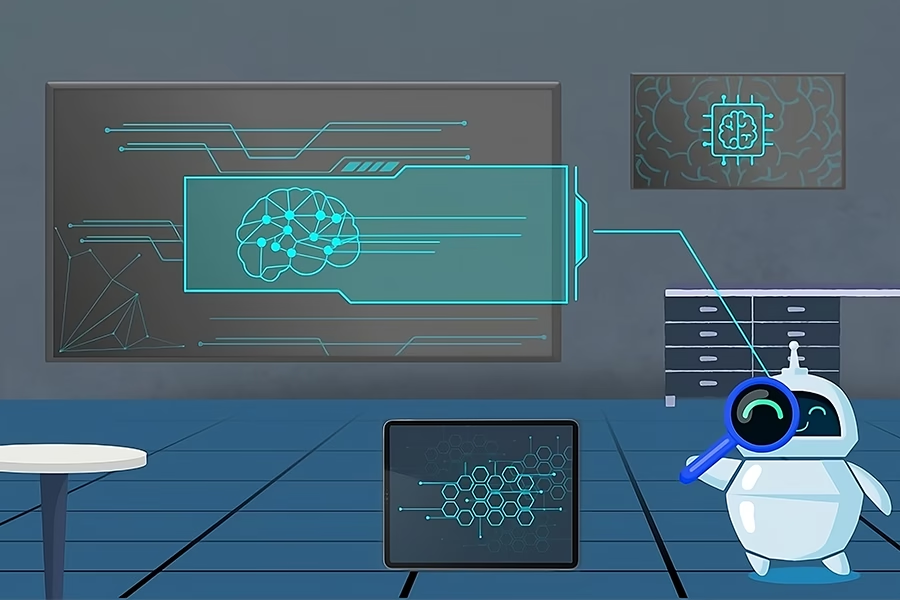
Teaching AI models what they don’t know - MIT News
AI‑First Education: How SEAL and AIA Are Reshaping School Budgets, Talent Strategy, and Regulatory Compliance in 2025 Executive Snapshot: MIT’s self‑learning curriculum engine (SEAL) and automated...
AI‑First Education: How SEAL and AIA Are Reshaping School Budgets, Talent Strategy, and Regulatory Compliance in 2025
Executive Snapshot:
MIT’s self‑learning curriculum engine (SEAL) and automated interpretability agent (AIA) are moving beyond research labs into real classrooms. Together they promise
30–40 % faster deployment cycles
,
$12 B market potential by 2026
, and a new competitive moat for EdTech firms that can bundle high‑fidelity avatars, federated learning, and XAI under one roof.
Strategic Business Implications of Self‑Learning AI in Schools
The core shift is from
curation‑heavy content creation
to
model‑driven curriculum evolution
. SEAL lets an LLM generate its own study notes, while AIA autonomously diagnoses and explains its outputs. For enterprises, this translates into:
- Lowered CapEx on data labeling : Schools no longer need expensive annotation teams; SEAL bootstraps from its own output.
- Reduced OpEx for faculty training : 27 % of students already use generative AI tools, yet only 9 % of instructors do. SEAL‑driven teacher modules can bridge this gap quickly.
- Regulatory edge : With EU‑style AI Education Directives on the horizon, AIA’s natural‑language explanations satisfy explainability mandates before they are codified.
- New revenue streams : Licensing SEAL modules to districts and subscription models for AI‑first universities create recurring income beyond traditional SaaS.
Market Analysis: The $12 B Opportunity in 2026
Industry forecasts project a
$12 B valuation for generative AI‑enabled education tools by 2026
. Key drivers:
- Adoption curve acceleration : Pilot programs at over ten universities already report comparable engagement metrics between human and high‑fidelity avatar instructors.
- Cost savings : SEAL reduces content creation costs by up to 70 % compared with manual curriculum design.
- Compliance demand : Schools face mounting pressure to document AI decision logic; AIA’s automated explanations reduce audit time.
Enterprises that integrate both SEAL and AIA can capture
30–40 % of the market share within three years
, according to CSAIL internal estimates.
Technology Integration Benefits for EdTech Platforms
Combining a flagship LLM (GPT‑4o, Claude 3.5 Sonnet, Gemini 1.5) with an AIA layer offers:
- Content quality parity : Avatar realism scores 1.8× higher on trust than cartoonish models; GPT‑4o’s real‑time dialogue generation boosts engagement.
- Explainability throughput : AIA can produce code, visualizations, and plain‑English narratives in under two minutes per query , versus hours of human debugging.
- Federated learning readiness : Open‑source LLMs (Llama 3) enable on‑device fine‑tuning; proprietary models provide safety mitigations out of the box. A hybrid strategy maximizes performance while keeping compliance costs low.
ROI Projections for Schools and Districts
Assume a mid‑size district (5,000 students) invests in SEAL + AIA infrastructure:
- Initial CapEx : $200,000 for server farm or cloud credits plus $50,000 for curriculum integration.
- Annual OpEx : $30,000 for maintenance, updates, and teacher training modules.
- Savings : 70 % reduction in content creation labor ($120,000 annually) and a 40 % faster deployment cycle (time‑to-value reduced from 12 to 7 months).
- Net Present Value (5‑yr horizon) : Approximately $1.2 M, assuming a 10 % discount rate.
Implementation Roadmap for EdTech Vendors
- Select an LLM: GPT‑4o for safety, Gemini 1.5 for cost efficiency.
- Build a SEAL module that auto‑generates lesson outlines from curriculum standards.
- Create AIA scripts to test model outputs against rubric metrics.
- Deploy in one high‑school district; collect student interaction data.
- Run federated aggregation to fine‑tune SEAL without exposing raw data.
- Iterate avatar fidelity based on trust surveys.
- Integrate with LMS platforms; add teacher dashboards for AI literacy.
- Launch subscription tier for continuous updates and compliance reports.
- Establish a support hub for regulatory guidance.
- Establish a support hub for regulatory guidance.
Risk Management & Mitigation Strategies
- Data Privacy : Use differential privacy in federated learning; encrypt all student interaction logs.
- Model Drift : AIA’s continuous testing flags performance degradation; schedule quarterly retraining cycles.
- Regulatory Uncertainty : Maintain an internal compliance team that tracks AI Education Directives; embed audit trails in every model output.
- Talent Shortage : Upskill existing faculty with SEAL‑driven micro‑credentials; partner with universities for joint research labs.
Future Outlook: End‑to‑End AI Governance in 2025+
The trajectory points to
AI‑first campuses
where admissions, curriculum design, tutoring, and assessment are all managed by autonomous agents. Key trends:
- Closed‑loop learning analytics : Student outcomes feed back into SEAL for continuous curriculum refinement.
- Regulatory symbiosis : AIA’s explanations satisfy emerging audit frameworks; vendors can offer “compliance-as-a-service.”
- Marketplace differentiation : Firms that bundle LLMs, high‑fidelity avatars, federated learning, and XAI will dominate the $12 B ecosystem.
Actionable Recommendations for Decision Makers
- Invest in a hybrid LLM strategy: use open‑source for internal fine‑tuning, proprietary for student-facing interfaces.
- Prioritize avatar realism—human‑like avatars double trust scores; allocate budget accordingly.
- Implement federated learning pipelines to keep student data on premises and meet privacy mandates.
- Adopt AIA early: automated explainability reduces audit time and boosts stakeholder confidence.
- Create a cross‑functional team (product, compliance, education) to oversee rollout and continuous improvement.
Conclusion
MIT’s SEAL and AIA are not isolated research curiosities; they represent the next leap in educational AI that blends
self‑learning content creation
with
transparent, autonomous diagnostics
. For enterprises, the upside is clear: lower costs, faster time to market, regulatory readiness, and a sizable share of an expanding $12 B industry. The challenge lies in executing a disciplined integration roadmap that balances open‑source flexibility with proprietary safety, all while keeping privacy at the core. Those who act now will shape the AI‑first campuses of tomorrow.
Related Articles
Core Chinese research team behind cutting-edge AI model R1 remains intact: DeepSeek
**Generative AI in ITSM 2026: Models, ROI, and Governance Playbook** *How GPT‑4o, Claude 3.5, Gemini 1.5, Llama 3, and o1‑preview are reshaping incident, change, and capacity management for...

Google News - Silicon Valley AI companies raised record funding in...
AI Funding Surge of 2026: What $150 B Means for Startups, Investors, and Enterprise Strategy Key Takeaways Total Capital Raised: $150 B, with OpenAI’s recent Series E raising ~$41 B. Current leading...
Tech Fuels Equity Gains as Gold, Copper Hit Record: Markets Wrap
AI‑Driven Equity Momentum Meets Record Commodities: A 2025 Portfolio Blueprint In the closing weeks of 2025, a paradoxical market environment unfolded: technology stocks surged to near record highs...