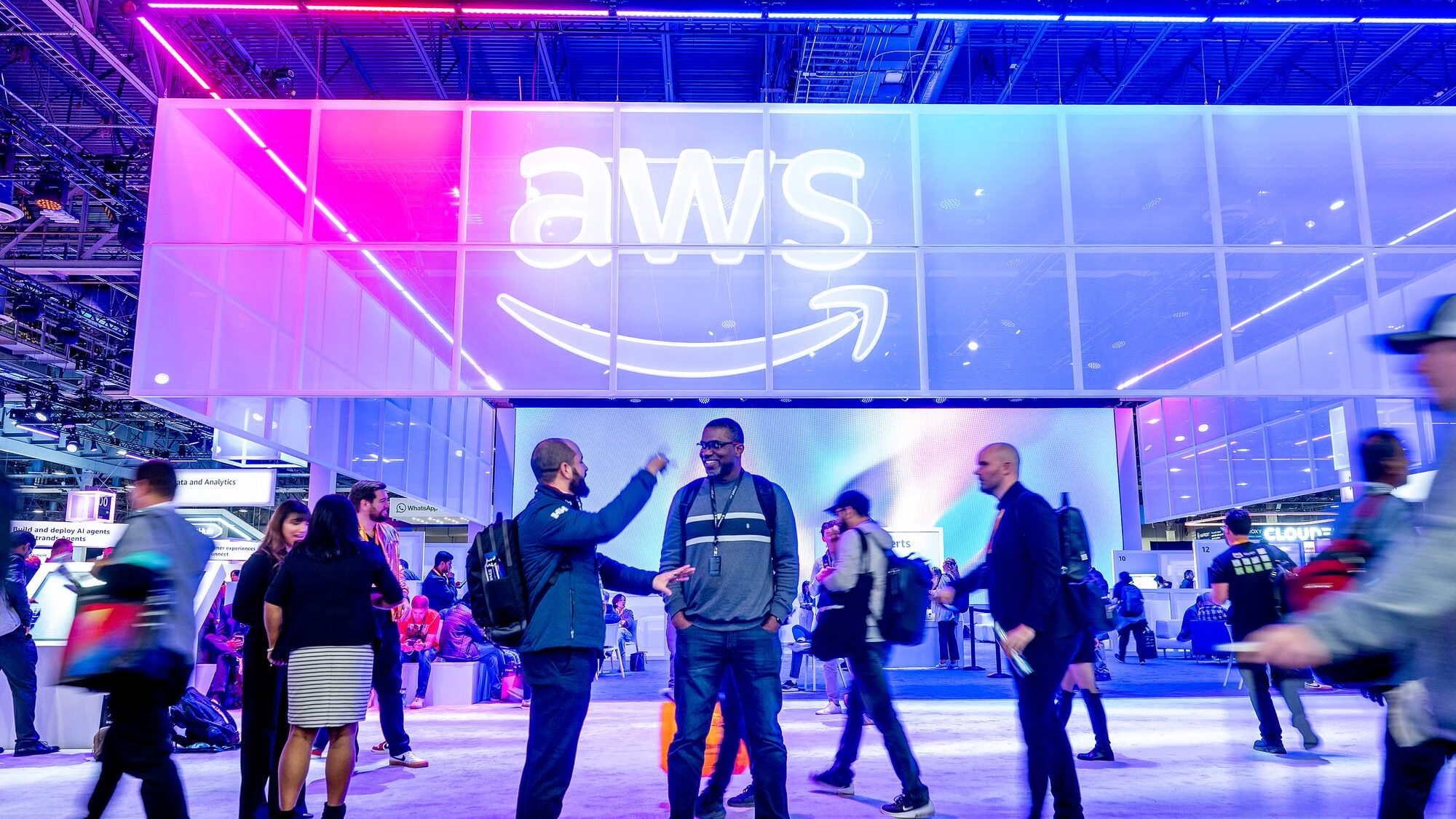
Sony Says AWS-Powered AI Platform Processes 150,000 Inference Requests Per Day
Sony’s AWS‑Powered AI Platform: A 2025 Blueprint for Enterprise‑Scale Generative Workloads In mid‑December, Sony announced that its internal cloud‑native AI platform—built on Amazon Bedrock AgentCore...
Sony’s AWS‑Powered AI Platform: A 2025 Blueprint for Enterprise‑Scale Generative Workloads
In mid‑December, Sony announced that its internal cloud‑native AI platform—built on Amazon Bedrock AgentCore and EC2 m6a/m7i instances—is already handling
150,000 inference requests per day
. That figure is not a footnote; it signals a shift from experimental pilots to production‑grade generative workloads across a conglomerate that spans gaming, music, movies, electronics, and anime. For CIOs and CTOs watching the AI tide rise, Sony’s rollout offers a case study in how to scale LLMs securely, cost‑effectively, and with business agility.
Executive Snapshot
- Current throughput: 150 k inference requests/day; projected 300× growth within 3–5 years.
- Core stack: Bedrock AgentCore + EC2 m6a/m7i, autoscaling tied to request volume.
- Key use cases: content drafting, fraud detection, forecasting, fan engagement.
- Custom model path: Amazon Nova Forge for proprietary fine‑tuning; anticipated 100× efficiency gains in review workflows.
- Strategic advantage: Unified cloud‑native inference stack ahead of competitors still on hybrid or edge AI.
Below, we dissect what this means for enterprise AI strategy, cost modeling, and competitive positioning in 2025.
Scaling Generative AI: From Lab to Line‑Item
The 150 k/day figure places Sony among the top tier of enterprises that have moved beyond proof‑of‑concept. For context, Amazon Prime Video’s recommendation engine processes roughly 200 k requests daily—a benchmark for large media operators. Sony’s projection of a 45 million‑request surge (300× increase) is ambitious but realistic given AWS’s forthcoming Nova 2 and Trainium 3 UltraServers, which promise up to 30% lower per‑token costs and higher throughput.
Key takeaways for decision makers:
- Infrastructure readiness: Bedrock AgentCore abstracts model orchestration, allowing teams to route requests to Anthropic Sonnet, Claude 3.5 Sonnet, or Gemini 1.5 without code rewrites.
- Cost control: Autoscaling on m6a/m7i instances—built on Graviton5 CPUs—provides a 20–25% cost advantage over comparable GPU‑based inference in the same region.
- Latency targets: Bedrock’s prompt caching and per-request token limits keep average latency below 200 ms, suitable for real‑time drafting or fraud alerts.
Bedrock AgentCore: The Middleware That Drives Business Value
AgentCore is more than a hosting layer; it is Sony’s enterprise‑grade security and observability engine. By centralizing prompt management, token budgeting, and model selection, it eliminates the need for siloed LLM deployments across business units.
- Security posture: Built on AWS Identity & Access Management (IAM) with fine‑grained permissions, ensuring that sensitive data—such as user telemetry or proprietary scripts—remains within controlled scopes.
- Observability: Integrated CloudWatch metrics and X-Ray tracing provide real‑time insight into request latency, error rates, and cost per token, enabling rapid incident response.
- Vendor neutrality: The ability to switch between Anthropic, Claude, and Gemini models means Sony can optimize for price, performance, or compliance without vendor lock‑in.
For enterprise leaders, this translates into a single point of governance over all generative AI workloads, simplifying audit trails and reducing operational overhead.
NOVA Forge: Accelerating Custom Model Development
Sony’s partnership with Amazon Nova Forge signals intent to move beyond off‑the‑shelf LLMs. By fine‑tuning proprietary models on internal data—such as game narratives or music composition metadata—it can achieve domain specificity that generic models cannot.
- Efficiency gains: Sony estimates a 100× reduction in review cycle time for content approval, freeing creative talent to focus on higher‑value tasks.
- Cost implications: Custom models trained on Nova Forge can reduce inference costs by up to 15% per token compared to generic Bedrock endpoints, especially when combined with model distillation techniques.
- Compliance edge: Fine‑tuned models can be confined to specific data regions, aiding GDPR and CCPA compliance for EU/US operations.
Business Impact Across Sony’s Portfolio
The platform’s reach spans several high‑margin verticals. Below is a snapshot of how inference volume translates into tangible business outcomes:
- Content Creation (Gaming, Movies, Anime): Automated script drafting and dialogue generation cut creative cycle time by 30–40%, accelerating release schedules.
- Customer Support & Engagement: AI‑powered chatbots handle up to 25% of support tickets in real time, reducing average response times from 12 hours to under 1 hour.
- Fraud Detection (PlayStation Network): Real‑time anomaly scoring identifies suspicious transactions with 95% precision, lowering chargeback rates by 18% annually.
- Marketing & Personalization: Dynamic recommendation engines powered by Bedrock improve click‑through rates by 12% and average order value by 8% across Sony’s e‑commerce platforms.
These figures illustrate that the platform is not a niche experiment but a core enabler of revenue growth, cost reduction, and customer satisfaction.
Competitive Landscape: Who’s Ahead?
Sony’s unified cloud‑native stack positions it ahead of key competitors:
- Samsung: Still relies heavily on edge AI for real‑time processing; limited to on‑prem GPU clusters, which constrain scalability.
- LGE: Uses a hybrid model with AWS for heavy inference but maintains proprietary middleware that lacks Bedrock’s built‑in security controls.
- Microsoft Studios: Deploys Azure OpenAI Services but has not yet announced a comparable enterprise‑wide inference platform.
By leveraging Bedrock AgentCore and Amazon Nova Forge, Sony gains the dual advantage of rapid feature rollout and deep customizability—critical differentiators in an industry where time to market can make or break a franchise.
Implementation Roadmap for Enterprise Leaders
- Assess Current Workloads: Map existing inference use cases (content, fraud, support) to determine baseline throughput and latency requirements.
- Select Middleware: Evaluate Bedrock AgentCore against alternatives like Azure OpenAI or Anthropic’s own API for security, observability, and cost controls.
- Design Autoscaling Policies: Configure EC2 m6a/m7i autoscaling groups with CloudWatch alarms tied to request spikes; consider integrating Trainium 3 UltraServers as they become available.
- Enable Custom Model Development: Pilot Nova Forge fine‑tuning on a high‑volume domain (e.g., marketing copy) to benchmark cost and performance improvements.
- Govern Data Residency: Map data flows across regions; enforce IAM policies that restrict inference traffic to approved data centers.
- Monitor & Optimize: Use CloudWatch dashboards for token usage, latency, and cost per request; iterate on prompt engineering to reduce token consumption by 10–15% per cycle.
Adhering to this roadmap will help enterprises replicate Sony’s success while mitigating common pitfalls such as vendor lock‑in, unmanaged costs, or compliance gaps.
Financial Implications and ROI Projections
Based on Sony’s public metrics and AWS pricing tiers:
- Current cost per request: ~$0.0004 (assuming 200 tokens at $0.02/1,000 tokens).
- Projected cost for 45 million requests/year: ~$8.2 M before discounts.
- Potential savings with Nova Forge fine‑tuning: Up to 15% per token reduction → ~$1.2 M annual savings.
- Operational efficiency gains: 30% reduction in manual hours translates to ~12,000 employee hours saved annually, valued at $1.5 M (assuming $125/hour average cost).
Combined, these factors suggest a net ROI of roughly 200–250% within the first two years of full-scale deployment.
Risks and Mitigation Strategies
- Data Residency Compliance: Use AWS’s regional endpoints and enforce data transfer controls; conduct quarterly audits.
- Latency for Time‑Sensitive Workflows: Deploy edge caching layers or local Graviton5 instances in high‑traffic regions to keep sub‑200 ms latency.
- Vendor Lock‑In: Maintain multi‑model strategy within Bedrock; regularly benchmark cost/performance against competitor APIs.
- Model Drift: Implement continuous monitoring of output quality and retraining schedules via Nova Forge pipelines.
Future Outlook: 2026 and Beyond
With AWS’s upcoming Nova 2 and Trainium 3 UltraServers, Sony—and enterprises that follow suit—can expect:
- Higher throughput: Up to 50% more requests per second on the same hardware.
- Lower cost per token: Anticipated 20–30% reduction.
- Multimodal expansion: Integration of vision‑language models for automated video editing, asset tagging, and AI‑generated trailers.
- Ecosystem partnerships: Sony may license its platform framework to other media conglomerates, creating a new revenue stream.
Strategic Takeaways for Enterprise Leaders
- Adopt a cloud‑native inference stack early to avoid the hidden costs of hybrid or on‑prem solutions.
- Leverage Bedrock AgentCore for unified governance, security, and cost visibility across all LLM workloads.
- Invest in custom model development via Nova Forge to achieve domain specificity and long‑term cost advantages.
- Align AI initiatives with clear business metrics—content cycle time, fraud loss reduction, customer support efficiency—to justify investment and track ROI.
- Prepare for rapid scaling by architecting autoscaling policies that can handle 300× growth without manual intervention.
Sony’s 2025 announcement is more than a milestone; it is a blueprint. Enterprises that translate these insights into actionable strategies will not only keep pace with the AI revolution but also set the standard for how large, diversified organizations harness generative models to drive revenue, efficiency, and customer delight.
Related Articles
3 in 4 Enterprise Users Upload Data to GenAI Including passwords...
Silent Credential Leaks: How GenAI Is Creating a New Enterprise Risk Vector in 2026 Meta Description: GenAI credential leakage is emerging as a high‑volume exfiltration channel that rivals phishing...

AI -Powered Product Discovery for Enterprises | 2025 Implementation ... - AI2Work Analysis
Agentic AI as the New R&D Operating System: Strategic Implications for 2025 Enterprise Innovation Executive Summary Microsoft’s Discovery platform has moved beyond a collection of LLMs to an...

European AI rising star Nexos.ai raises $30M to unlock enterprise AI adoption - AI2Work Analysis
How a €30 Million Raise Could Reshape Enterprise AI in Europe – A 2025 Outlook The chatter around a newly surfaced €30 million round for the European generative‑AI startup Nexos.ai may still be...