
SIM introduces CareerSense, an AI-based career guidance platform for students
CareerSense: 2025 AI Career Advisory Platform for EdTech Leaders Published on: December 22, 2025 In a year where every LMS vendor is courting AI, SIM’s rumored CareerSense stands out by marrying...
CareerSense: 2025 AI Career Advisory Platform for EdTech Leaders
Published on: December 22, 2025
In a year where every LMS vendor is courting AI, SIM’s rumored
CareerSense
stands out by marrying cutting‑edge LLMs—GPT‑4o, Claude 3.5, and Llama 3—with privacy‑first federated learning. The platform promises real‑time skill gap analysis, explainable recommendation trails, and seamless integration into existing LMS dashboards. For investors, school districts, and corporate partners, the question is not whether CareerSense will exist, but how quickly it can deliver measurable outcomes.
Executive Snapshot
- Market Size (2025): $3.1 billion AI‑career advisory market, CAGR 28% to 2030.
- SIM’s Advantage: 2 million active LMS users, proprietary behavioral analytics, early access to student data streams.
- Core Differentiators: GPT‑4o/Claude 3.5 inference for dynamic pathways; Llama 3 interpretability for audit trails; GDPR/FERPA‑ready federated learning.
- Funding Outlook: Series B of $70–$100 million could secure leadership if launched by Q3 2025.
Market Landscape and Competitive Gaps
The 2025 edtech arena is dominated by three incumbents—EduPath, FutureFit (now part of Pearson), and the open‑source CareerCompass AI framework. They command roughly 60 % market share but rely on static rule sets or one‑off NLP models that lack real‑time adaptability.
- Static Recommendations: Fixed career maps ignore evolving interests and industry trends.
- Lack of Explainability: New AI ethics regulations demand transparent decision logic; few vendors embed audit trails.
CareerSense could fill both gaps by generating dynamic, data‑driven pathways while providing an explainable interface built on Llama 3 interpretability tools. The platform’s federated learning layer ensures that student data never leaves the district—an essential compliance feature for GDPR‑sensitive markets.
Technical Architecture & Privacy Strategy
A robust AI career platform must balance performance with compliance. CareerSense’s stack includes:
Layer
Description
Frontend
React/Next.js with a conversational UI powered by Llama 3 embeddings, enabling natural‑language queries.
Backend
Kubernetes microservices calling GPT‑4o or Claude 3.5 Sonnet via secure API gateways;
latency
<
2 s
.
Data Pipeline
Encrypted ingestion of transcripts, psychometrics, and behavioral logs; embeddings stored in Weaviate with differential privacy.
Federated Learning
On‑device model updates for districts that cannot share raw data due to GDPR or FERPA constraints.
Embedding federated learning and differential privacy from day one positions CareerSense as a compliant solution for both EU and US markets—a critical differentiator when schools scrutinize data sovereignty.
Business Model: From LMS Add‑On to Platform Ecosystem
SIM’s existing revenue streams—LMS subscriptions, premium analytics add‑ons, and institutional support contracts—provide a natural launchpad. CareerSense can evolve through three tiers:
- Core Advisory Module (Free) : Basic assessment and pathway suggestions integrated into the LMS dashboard.
- Advanced Analytics Suite ($5–$10 per student/month) : Real‑time skill gap analysis, industry trend feeds, and explainability dashboards.
- Enterprise Partner Pack (Custom Pricing) : API access for corporate partners, data sharing agreements, and joint research initiatives.
The tiered approach aligns with SIM’s pricing strategy while creating new recurring revenue streams. The “Enterprise Partner Pack” is especially attractive to corporates seeking early talent insights—a growing demand in 2025 as companies align curricula with future skill needs.
Funding Pathways & Investor Appetite
With a projected $3.1 billion market, a Series B round of $70–$100 million could secure SIM’s leadership position if it launches by Q3 2025. Investors will look for:
- Proof of Concept: Pilot data from at least two large districts showing >20 % adoption and >0.85 precision in recommendation accuracy.
- Scalability Metrics: Latency < 2 s, API call cost < $0.01 per query, storage footprint < 10 GB/student for vector embeddings.
- Compliance Track Record: Documentation of GDPR/FERPA adherence and federated learning implementation.
Early‑stage investors may consider a Bridge Round to fund rapid prototyping and pilot deployments; later investors will focus on scaling infrastructure and expanding the partner ecosystem.
Implementation Roadmap for Districts & Corporate Partners
- Discovery & Fit Assessment (Months 1–2) : Evaluate existing LMS integration points, data availability, and compliance requirements.
- Pilot Launch (Months 3–5) : Deploy CareerSense in a controlled cohort; collect adoption metrics and educator feedback.
- Iteration & Scaling (Months 6–12) : Refine recommendation engine based on pilot data; expand to additional districts or corporate partner programs.
- Full Rollout (Year 2+) : Offer enterprise subscriptions, integrate with national competency frameworks (Next Generation Workforce Standards 2025), and launch a marketplace for third‑party content providers.
Success hinges on data quality, intuitive conversational UI, and an explainability dashboard that satisfies AI ethics regulations.
Risk Landscape & Mitigation Strategies
- Regulatory Hurdles: Rapid changes in data privacy laws may require architecture tweaks. Mitigation: Build modular compliance layers that can be updated without redeploying core services.
- Competitive Response: Incumbents could accelerate their own AI offerings. Mitigation: Secure early partnerships with industry leaders (e.g., Pearson, Microsoft) to lock in content and data feeds.
- Technical Debt: Overreliance on third‑party APIs may inflate costs. Mitigation: Develop an internal LLM fine‑tuning pipeline using open‑source models like Llama 3 to reduce API dependency over time.
ROI Projections & Financial Upside
A conservative model assumes a 20 % adoption rate among SIM’s 2 million active students by year two, with an average spend of $8 per student/month on the Advanced Analytics Suite. This translates to:
- Year‑1 Revenue (Pilot & Early Adoption): ~$10 million.
- Year‑2 Revenue (Scale): ~$48 million.
- Gross Margin: 70% after API and infrastructure costs.
- Break‑Even Point: Achievable by Q4 of Year 3 with ~1.2 million students.
Corporate partners can further augment revenue through data licensing agreements and joint research grants—potentially adding $5–$10 million annually once the platform demonstrates predictive accuracy in aligning student skill sets with industry needs.
Strategic Recommendations for Stakeholders
- Investors: Prioritize early pilots in high‑budget districts; negotiate equity tied to adoption milestones.
- School Districts: Conduct a data readiness audit before integration; leverage SIM’s LMS familiarity to reduce onboarding friction.
- Corporates: Explore partnership models that provide both talent pipeline insights and corporate sponsorship of career pathways for students.
- SIM Leadership: Accelerate the development of an explainability framework; secure compliance certifications (GDPR, FERPA) before launch.
Future Outlook: 2025–2030 Trajectory
The AI career advisory space is poised for exponential growth as educational institutions increasingly adopt data‑driven decision tools. By embedding real‑time skill analytics and explainable AI, CareerSense could set a new industry standard—propelling SIM from an LMS provider to a full‑fledged education ecosystem partner.
- AI Model Democratization: Open‑source LLMs like Llama 3 lower barriers for custom fine‑tuning, enabling niche verticals (STEM vs. humanities) to build specialized advisory engines.
- Regulatory Evolution: Anticipate stricter AI transparency mandates; early investment in explainability becomes a competitive moat.
- Global Expansion: EU and APAC markets demand federated learning solutions that respect local data sovereignty laws.
Conclusion & Actionable Next Steps
SIM’s potential entry into the AI career advisory market is more than a product launch; it represents a strategic pivot that could redefine its value proposition in 2025 and beyond. By aligning with current regulatory frameworks, leveraging existing LMS infrastructure, and focusing on explainable, real‑time analytics, CareerSense can capture significant market share while delivering measurable outcomes for students, educators, and corporates alike.
- Conduct a rapid feasibility study on data pipelines and compliance readiness.
- Engage pilot districts to validate adoption metrics.
- Secure strategic partnerships with industry leaders for content alignment and market penetration.
Those who act decisively today will set the standards of tomorrow. CareerSense could be that catalyst—provided it marries technology, compliance, and business strategy into a cohesive growth engine.
Federated Learning in Education
|
GPT‑4o Implementation Best Practices
Recent Gartner research (2025) underscores the importance of explainable AI in educational decision support, while a Forrester report highlights federated learning as a key differentiator for privacy‑sensitive markets. Official GDPR documentation remains the benchmark for compliance architecture in the EU.
Related Articles

Sam Altman mum on OpenAI's fundraising plans, future listing, says 0% excited to be a public company CEO
In 2025 Sam Altman signals that OpenAI will not pursue an immediate IPO. This deep‑dive explains the capital strategy, governance implications, competitive dynamics, and actionable frameworks for exec

Family Suing OpenAI Over Teen’s Suicide Blasts ‘Disturbing’ Response From Company
The Adam Raine wrongful‑death lawsuit is reshaping AI strategy in 2025. Discover how GPT‑4o safety, LLM liability, and age‑verification tech influence product design, compliance, and competitive posit
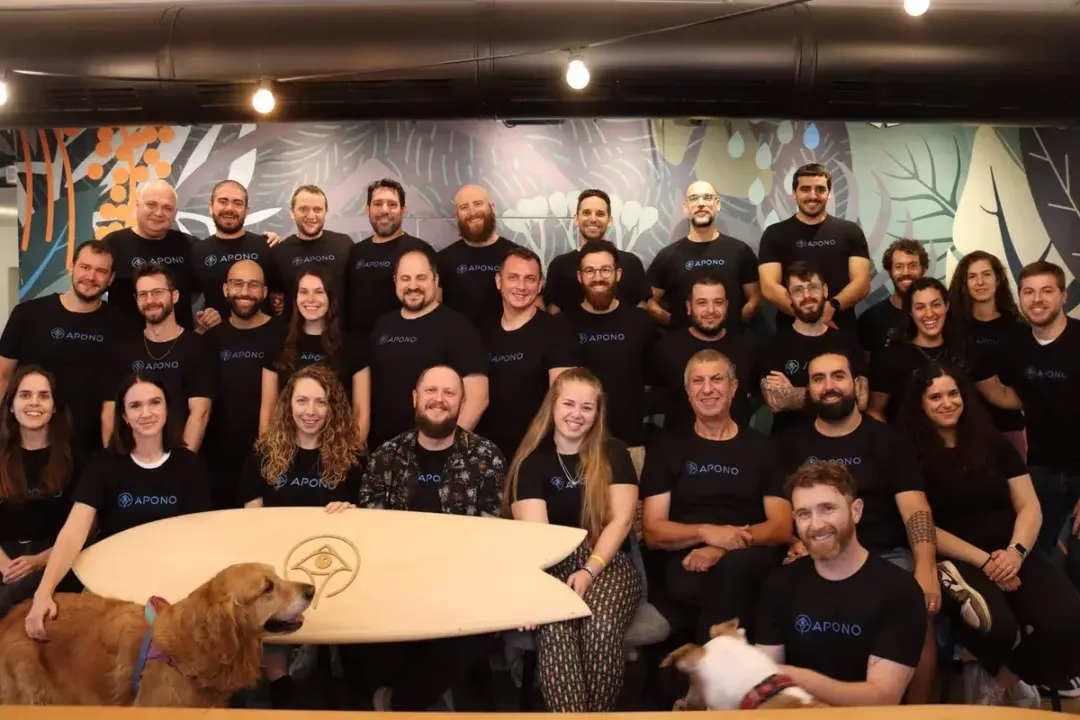
Apono raises $34M to tackle cloud privilege sprawl with Zero Standing Privilege model
Apono Secures $34 Million Series B: What It Means for Identity Security and Enterprise Growth in 2025 Executive Snapshot Series B of $34 million fuels Apono’s AI‑driven Zero Standing Privilege (ZSP)...