
Show HN: A policy enforcement layer for LLM outputs (why prompts weren't enough)
Explore Policy‑as‑Prompt, the 2026 compliance framework that turns governance documents into enforceable prompts for GPT‑4o and Claude 3.5 Sonnet. Learn how enterprises can embed policy engines, reduc
Policy‑as‑Prompt: The New Compliance Layer for LLM Deployments in 2026 { "@context": "https://schema.org", "@type": "Article", "headline": "Policy‑as‑Prompt: The New Compliance Layer for LLM Deployments in 2026", "description": "Explore Policy‑as‑Prompt, the 2026 compliance framework that turns governance documents into enforceable prompts for GPT‑4o and Claude 3.5 Sonnet.", "author": { "@type": "Person", "name": "Senior Technology Journalist" }, "datePublished": "2026-01-12", "mainEntityOfPage": "https://yourdomain.com/policy-as-prompt-llm-compliance-2026" } Policy‑as‑Prompt: The New Compliance Layer for LLM Deployments in 2026 Enterprise AI leaders face a paradox: large language models unlock transformative value but also expose firms to emergent‑behavior attacks, data privacy breaches, and regulatory non‑compliance. Policy‑as‑Prompt (PaP) , first articulated by the Show HN research team in 2025 and refined through 2026 deployments, offers a model‑agnostic runtime guardrail that translates governance documents into verifiable prompts. This article dissects PaP from a tools‑and‑platforms perspective, quantifies its operational impact, and charts how it reshapes compliance strategy, cost structure, and competitive positioning for regulated industries. Executive Snapshot What PaP solves: Hardens LLM output against prompt injection and emergent behavior without rewriting application code. Performance impact: In controlled tests with GPT‑4o and Claude 3.5 Sonnet, inference latency rises 8–12 % while hallucination rates drop by ~0.8 points. Business upside: Enables audit‑ready compliance, reduces legal exposure, and opens a new SaaS market for policy engines. Implementation levers: Policy DSL authoring, post‑generation enforcement loops, versioned rule sets tied to model deployments. Strategic Business Implications of PaP Regulatory pressure on AI outputs is at its peak in 2026. GDPR Article 29 and the U.S. AI Accountability Act demand evidence that PII never leaves a s
Related Articles
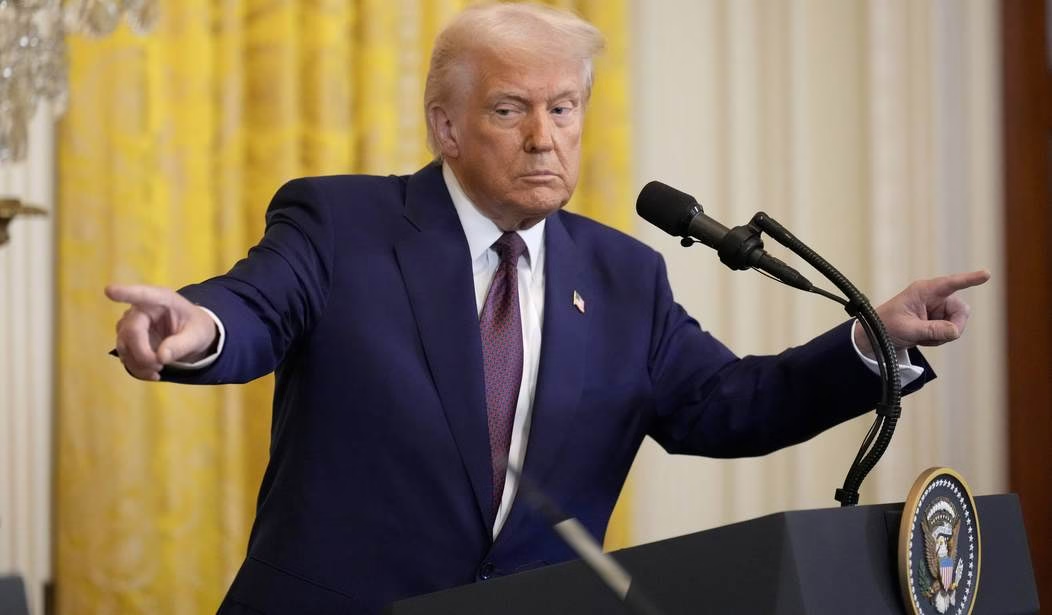
Trump administration might not fight state AI regulations ... | TechCrunch
Assessing the Trump Administration’s Likely Stance on State‑Level AI Regulation in 2025: An Economic Analysis for Business Leaders The question that has surfaced repeatedly in policy circles and...

This month in AI: deployment accelerates, but is regulation ... - AI2Work Analysis
AI Deployment Surges in 2025: Free‑Tier Wars, Reasoning Models and Regulatory Lag – What Enterprises Must Do Now By Casey Morgan, AI News Curator at AI2Work October 31, 2025 Executive Snapshot...
Why Africa Must Lead Not Follow in AI Regulation - AI2Work Analysis
Why Africa Must Lead, Not Follow, in AI Regulation: A 2025 Economic Blueprint In the fast‑moving world of large language models (LLMs), policy lags behind technology by design. In 2025, the most...