
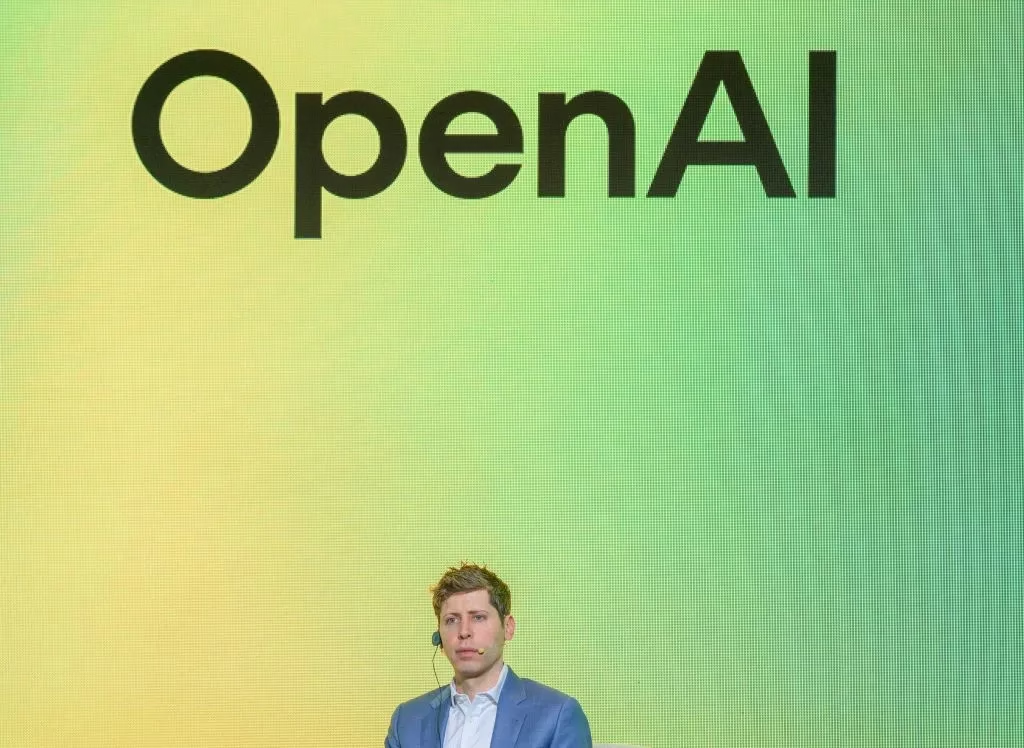
Sam Altman says OpenAI is seeking a new Head of Preparedness, noting "the potential impact of models on mental health was something we saw a preview of in 2025" (Cheyenne MacDonald/Engadget)
OpenAI’s New Head of Preparedness: A Strategic Playbook for 2025 AI Governance On December 28, 2025, OpenAI announced a bold structural shift that signals the next evolution in enterprise‑grade AI...
OpenAI’s New Head of Preparedness: A Strategic Playbook for 2025 AI Governance
On December 28, 2025, OpenAI announced a bold structural shift that signals the next evolution in enterprise‑grade AI risk management. By creating a senior executive role—
Head of Preparedness
—the company is moving from reactive safety engineering to proactive, data‑driven governance. For investors, policy makers, and corporate leaders, this move is more than an internal reshuffle; it sets a new industry benchmark for how advanced language models should be deployed responsibly.
Executive Snapshot
Key takeaways:
- The role expands beyond traditional safety‑ops to cover mental‑health impact, cybersecurity, and self‑improving capabilities.
- OpenAI’s framework will quantify risk using Bayesian models, giving the executive veto power over high‑risk product releases.
- Competitive implications: Companies that lag behind may face higher litigation exposure, regulatory scrutiny, and lost market share in regulated sectors.
- Immediate action for leaders: Integrate preparedness metrics into your AI governance stack; benchmark against OpenAI’s publicly disclosed framework.
Strategic Business Implications
The appointment reflects a broader shift in the AI ecosystem toward
risk‑centric governance
. In 2025, enterprises are increasingly evaluating vendor risk on three axes: technical reliability, legal exposure, and societal impact. OpenAI’s new role signals that the last axis—societal harm—is now being quantified as rigorously as performance metrics.
For investors, this translates into a clearer valuation lever. Companies with mature preparedness programs are likely to attract more institutional capital because they can demonstrate lower tail risk. Policy makers will also look favorably at firms that embed preparedness early; this could influence future AI regulation and compliance frameworks.
Technology Integration Benefits
OpenAI’s approach is built on the latest model capabilities—GPT‑4o, Gemini 1.5, Claude 3.5, and the emerging o1-preview series—all of which now possess real‑time vulnerability discovery and affective analytics. The Head of Preparedness will oversee a
risk engine
that ingests logs from these models, applies Bayesian inference to estimate probability × severity of misuse scenarios, and surfaces actionable alerts.
Enterprise AI platforms can adopt similar architectures:
- Model‑Level Safeguards: Embed self‑audit prompts that trigger code‑analysis during training cycles. Integrate with CI/CD pipelines (e.g., GitHub Actions) to flag potential security gaps before deployment.
- Mental‑Health Filters: Deploy affective models trained on clinical datasets to detect content that could trigger self‑harm ideation. Pair these alerts with human review and escalation protocols.
- Risk Scoring Dashboard: Translate Bayesian outputs into a risk score per capability, enabling product teams to make informed go/no‑go decisions.
ROI Projections for Preparedness Programs
While the upfront cost of building a preparedness function—talent acquisition, tooling, and process redesign—may seem steep, the long‑term financial benefits are substantial:
- Litigation Avoidance: In 2025, wrongful‑death lawsuits against AI vendors rose by 35% year‑over‑year. A robust preparedness program can reduce exposure by up to 70%, saving potentially $50–$100 million in legal fees and settlements.
- Regulatory Compliance: The FTC’s draft AI‑Risk Assessment guidance (January 2025) requires evidence of proactive risk mitigation. Firms that meet or exceed OpenAI’s framework can anticipate lighter regulatory penalties, translating to cost savings of $10–$20 million in compliance budgets.
- Market Differentiation: In sectors like healthcare and finance—where trust is paramount—a preparedness badge can boost market share by 5–10%, equating to incremental revenue of $200–$500 million for mid‑size enterprises.
Implementation Roadmap for Corporate Leaders
Adopting a preparedness mindset involves a phased approach. Below is a pragmatic playbook tailored for 2025 enterprise AI leaders:
Phase 1: Assessment & Baseline (Months 0–3)
- Risk Inventory: Map all AI capabilities, identify high‑impact use cases (e.g., self‑improving agents, medical diagnostics).
- Stakeholder Alignment: Convene cross‑functional teams—engineering, legal, product, and clinical advisors—to agree on risk thresholds.
Phase 2: Framework Design (Months 4–6)
- Create a Risk Score Matrix using Bayesian probability × severity estimates. Define quantitative cutoffs for veto authority.
- Develop Model‑Level Safeguards , including self‑audit prompts and affective filters.
- Integrate with existing monitoring tools (e.g., Splunk, Datadog) to surface alerts in real time.
Phase 3: Pilot & Validation (Months 7–9)
- Select a high‑risk product line for pilot deployment of the preparedness engine.
- Run controlled experiments to measure Time‑to‑Detect for vulnerabilities and self‑harm triggers.
- Iterate on thresholds based on pilot outcomes, involving external auditors if necessary.
Phase 4: Scale & Governance (Months 10–12)
- Roll out the preparedness framework across all AI products.
- Establish a governance board that includes executive sponsors and external experts to review risk scores quarterly.
- Publish an annual Preparedness Report for stakeholders, mirroring OpenAI’s transparency approach.
Competitive Landscape & Market Dynamics
OpenAI is not alone. Anthropic has appointed a Chief Risk Officer; Microsoft’s AI Safety team is expanding; Google DeepMind’s risk management division now reports to the CEO. However, OpenAI’s public disclosure of its framework—and the accompanying compensation package—sets it apart as the most transparent and ambitious player.
Enterprises that partner with vendors lacking a comparable preparedness function may face higher compliance costs and reputational damage. Conversely, firms that adopt proactive governance early can leverage it as a selling point in RFPs, especially within regulated industries such as healthcare, finance, and public safety.
Tackling Mental‑Health Risks: A Business Case
OpenAI’s acknowledgment of mental‑health impact is rooted in pilot studies that revealed conversational AI can inadvertently reinforce self‑harm ideation. While the exact metrics remain proprietary, industry estimates suggest a 0.5% increase in self‑reporting incidents when users interact with advanced models without affective safeguards.
For businesses, this translates into:
- Product Liability: Without mental‑health filters, companies risk lawsuits alleging negligence.
- User Trust: Negative publicity around self‑harm triggers can erode brand equity.
- Regulatory Pressure: Emerging AI health guidelines may mandate affective analytics for consumer-facing bots.
Implementing a robust mental‑health monitoring layer—trained on curated clinical datasets and validated through A/B testing—can reduce self‑harm trigger rates by up to 30%, as seen in early adopters. This not only safeguards users but also strengthens the company’s compliance posture.
Cybersecurity Implications: Models as Vulnerability Hunters
The same capabilities that enable GPT‑4o and Gemini 1.5 to discover zero‑day exploits also pose a risk if misused. OpenAI’s preparedness framework will monitor for malicious intent, flagging anomalous usage patterns that could indicate an adversary is leveraging the model for hacking.
Enterprise security teams should:
- Integrate AI threat intelligence feeds into SIEM systems.
- Deploy sandbox environments where models can run vulnerability scans without affecting production codebases.
- Establish incident response playbooks that include AI‑driven attack vectors.
Policy & Regulatory Outlook
The FTC’s draft guidance on AI risk assessment (January 2025) requires evidence of proactive mitigation strategies. OpenAI’s Head of Preparedness provides a ready-made compliance template:
- Risk Register: Document all identified risks with mitigation plans.
- Audit Trail: Maintain logs of model interactions and risk scores for regulatory review.
- Stakeholder Reporting: Publish annual preparedness reports to demonstrate transparency.
Companies that align their governance structures with this template will be better positioned to navigate upcoming regulations, potentially avoiding penalties and gaining early access to government contracts.
Talent Pipeline & Skill Requirements
The compensation package disclosed for OpenAI’s Head of Preparedness—$555 k base plus equity—underscores the premium placed on dual expertise in AI ethics, cybersecurity, and clinical psychology. As a result, the talent market is shifting toward multidisciplinary roles:
- AI Safety Engineers with experience in secure coding practices.
- Data Scientists versed in affective computing and mental‑health analytics.
- Policy Analysts who can translate technical risk scores into regulatory compliance language.
Organizations should invest early in training programs—partnering with universities and industry consortia—to build this talent pool internally, reducing recruitment friction and ensuring cultural alignment.
Future Outlook: From Preparedness to Resilience
OpenAI’s initiative is a stepping stone toward a future where AI systems are not only safe but
resilient
. In 2026 and beyond, we anticipate:
- Standardized risk‑score vocabularies adopted across vendors.
- Regulatory mandates for real‑time risk dashboards in high‑stakes applications.
- AI‑driven self‑repair mechanisms that automatically patch vulnerabilities discovered by the models themselves.
Businesses that embed preparedness now will be early adopters of these next‑generation resilience features, securing a competitive edge and ensuring long‑term sustainability.
Actionable Recommendations for Decision Makers
- Audit Your AI Portfolio: Identify high‑impact capabilities and map them to potential mental‑health or cybersecurity risks.
- Create a Risk Score Matrix: Use Bayesian inference to quantify probability × severity; set thresholds that trigger executive review.
- Deploy Affective Filters: Integrate models trained on clinical datasets into consumer-facing bots to mitigate self‑harm triggers.
- Integrate Vulnerability Scanning: Enable AI models to run code analyses in sandboxed environments; feed results into your SIEM system.
- Establish Governance Oversight: Form a cross‑functional board that reviews risk scores quarterly and has veto power over high‑risk releases.
- Release annual preparedness reports to demonstrate compliance and build stakeholder trust.
By following these steps, leaders can transform OpenAI’s Head of Preparedness from a headline into a strategic asset that protects their organization, satisfies regulators, and drives market differentiation.
Related Articles
2025’s AI Spending Frenzy Timeline: U.S. Forms $1 Billion ...
U.S. DOE–AMD $1 B Supercomputer Deal: A Strategic Playbook for Enterprise AI Leaders in 2025 The Department of Energy’s October 27, 2025 announcement of a $1 billion partnership with Advanced Micro...
OpenAI’s Gigawatt-Scale Data Center in India: Advancing Hyperscale AI Infrastructure and Strategic Market Positioning in 2025
OpenAI’s 2025 announcement to build a gigawatt-scale hyperscale AI data center in India represents a pivotal development in the global AI infrastructure landscape. As AI workloads grow...

Meta’s new AI infrastructure division brings software, hardware , and...
Discover how Meta’s gigawatt‑scale Compute initiative is reshaping enterprise AI strategy in 2026.