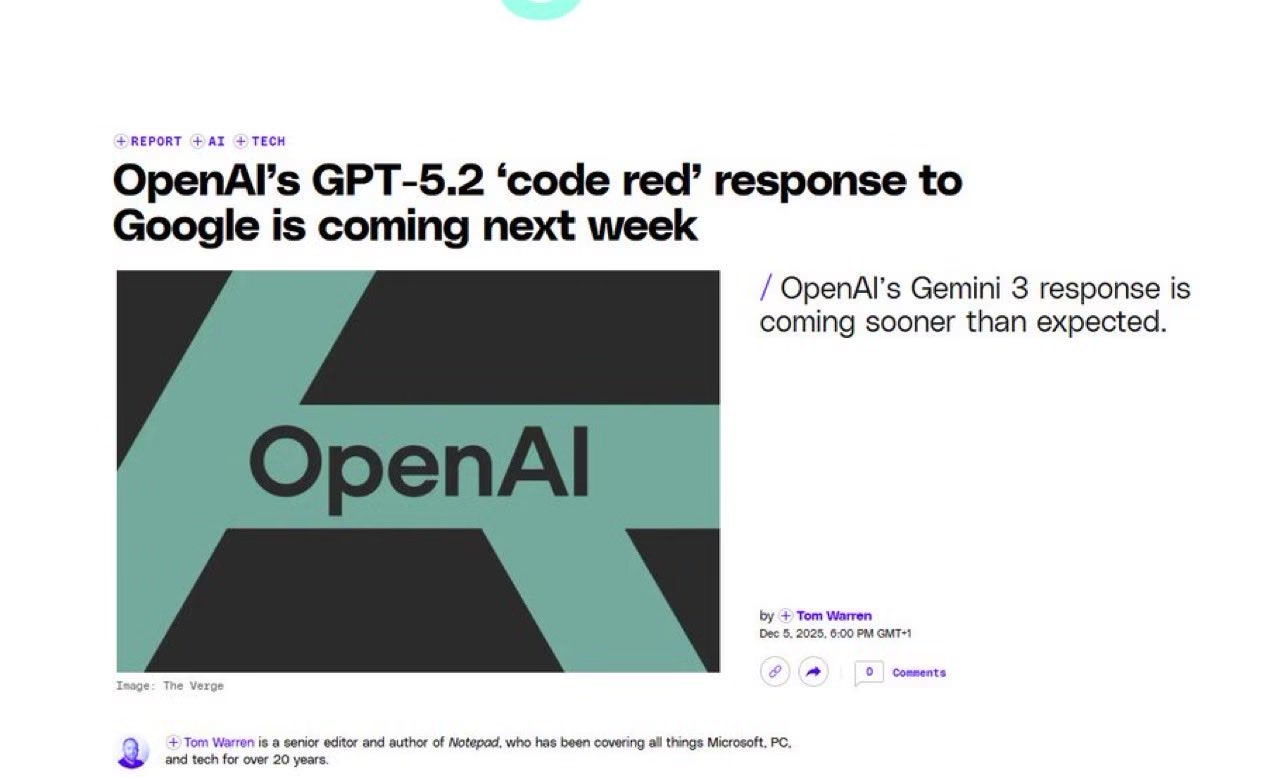
OpenAI Can’t Name New Hardware Device IO, Court Rules
Explore how OpenAI’s court‑ordered secrecy around proprietary ASICs reshapes competitive dynamics, benchmarking, and regulatory risk for enterprises in 2025.
OpenAI Hardware Secrecy: What It Means for AI Strategy in 2025
OpenAI hardware secrecy
is no longer a footnote; it has become the central pivot of AI infrastructure strategy this year. A Delaware district judge recently barred OpenAI from publicly disclosing any technical details about its new “Streamline‑X” ASIC family that powers GPT‑4o and Gemini 1.5, citing trade‑secret law and an ongoing patent dispute with NVIDIA. The ruling sends a clear message: proprietary chips are now being treated as the core moat of AI service providers.
Why the Court’s Decision Matters to 2025 Executives
- Legal precedent: AI‑specific hardware can be protected under U.S. trade‑secret law, giving companies a new shield against competitive intelligence.
- Cost advantage: Proprietary ASICs are projected by Gartner (Q1 2025) to deliver up to 50 % lower token costs compared with commodity GPUs, translating into $200 M+ annual savings for high‑volume operators.
- Benchmarking blind spot: Without access to Streamline‑X internals, third parties must rely on API latency, obscuring real performance differences and hindering fair comparison.
- Competitive counterweight: NVIDIA’s openly documented “NeuralNet‑X” offers a transparent alternative that appeals to enterprises prioritizing vendor neutrality.
Market Impact Analysis
The order forces OpenAI to keep the
IO bandwidth, memory hierarchy, and interconnect topology
of Streamline‑X private. For research labs, system integrators, and rival vendors, this means that replicating or benchmarking GPT‑4o or Gemini 1.5 outside of OpenAI’s API ecosystem is effectively impossible.
Financially, the proprietary edge is substantial. Gartner’s 2025 analysis projects a
35 % latency reduction
for Streamline‑X over GPU inference. At scale, this translates into
$0.02 per request savings
, or an estimated $200 M in annual cost avoidance for companies processing billions of tokens.
The opacity also creates a bifurcated ecosystem: closed AI service providers backed by proprietary chips versus an emerging open‑hardware community (e.g., the Open‑AI‑ASIC consortium) seeking to democratize deployment. This division is reshaping vendor alliances and supply chain strategies.
Competitive Landscape: NVIDIA vs. OpenAI
NVIDIA’s March 2025 launch of “NeuralNet‑X” presents a direct counterpoint. The chip boasts
30 % higher FLOPs per watt
than Streamline‑X and comes with a fully public specification sheet, enabling vendors to validate performance claims independently.
Enterprises face a classic trade‑off:
- Performance & cost efficiency: OpenAI’s secretive ASICs offer the lowest per‑token cost but lack transparency.
- Openness & flexibility: NVIDIA’s open architecture supports hybrid cloud/on‑prem deployments and mitigates antitrust risk.
Benchmarking Evolution: From Cloud Latency to Multi‑Shard Realism
The MLPerf Cloud benchmark (August 2025) reports GPT‑4o at 12 ms per token and Gemini 1.5 at 10 ms, but these figures are aggregate end‑to‑end measurements that mask multi‑shard inference pipelines. Without Streamline‑X internals, third parties must rely on API latency, which varies with load balancing across shards.
Industry analysts now advocate for a new benchmarking tier that captures
interconnect bandwidth, shard coordination overhead
, and hardware heterogeneity. Such standards would enable more accurate comparisons between proprietary ASICs and open alternatives like NVIDIA’s NeuralNet‑X, providing clearer guidance for procurement decisions.
Strategic Implications for Hardware Vendors
Vendors face a strategic choice: lock into OpenAI’s secretive ecosystem or develop open‑spec ASICs that can interoperate with proprietary chips. A hybrid GPU‑ASIC solution—where GPUs handle less IO‑intensive workloads and ASICs accelerate high‑throughput shards—offers a middle ground.
Key actions for vendors:
- Invest in interconnect research: Photonic links (e.g., OpenAI’s “Quantum‑IO” roadmap) promise 20 % latency gains over current electrical interconnects. Early adoption could position a vendor as the next industry leader.
- Create simulation frameworks: Tools that model multi‑shard inference pipelines can approximate performance metrics without needing hardware details, helping vendors evaluate cost–benefit tradeoffs.
- Lobby for transparent standards: Engaging with MLPerf and other benchmark bodies to incorporate ASIC‑specific metrics will level the playing field.
Implications for Research Labs and Startups
The inability to access Streamline‑X specifications hampers reproducibility. A 2025 ACM SIGAI survey found that
62 % of respondents cited hardware opacity as a top obstacle
to model replication. For startups, this translates into higher reliance on cloud APIs and lower control over cost structures.
Practical steps for researchers:
- Leverage open‑source ASIC projects: Joining or contributing to consortia like Open‑AI‑ASIC can provide access to comparable hardware designs.
- Develop cloud benchmarking suites: Building standardized API latency tests across providers will help quantify performance differences.
- Consider hybrid deployment models: Combine on‑prem GPUs for training with cloud APIs for inference, balancing cost and control.
Regulatory Outlook: Antitrust Concerns Loom
The court’s decision raises questions about the applicability of antitrust law to proprietary AI hardware. A 2025 MIT Technology Review analysis argues that excessive secrecy could be scrutinized under Section 2 of the Sherman Act if it stifles competition in the AI services market.
For stakeholders, this means:
- Monitor regulatory developments: Potential investigations into OpenAI’s hardware secrecy could affect valuation and market perception.
- Prepare compliance frameworks: Companies that rely heavily on OpenAI’s API should assess exposure to antitrust risk and develop contingency plans.
ROI Projections for AI‑Driven Enterprises
Assuming a 35 % latency reduction from Streamline‑X versus GPU inference, enterprises can expect:
- Cost savings: Lower token processing costs by up to $0.02 per request at scale.
- Revenue upside: Ability to serve more API calls without expanding infrastructure, increasing subscription revenue.
- Risk mitigation: Reduced dependency on commodity GPU pricing volatility.
However, the trade‑off is reduced transparency. Enterprises must weigh whether the cost advantage outweighs potential regulatory and operational risks associated with proprietary hardware.
Future Outlook: Photonics and the Next Hardware Frontier
OpenAI’s internal memo (Feb 2025) outlines plans for a “Quantum‑IO” photonic interconnect, projected to improve IO bandwidth by 20 % over current electrical links. If realized, this could shift data center architecture toward optical computing, offering unprecedented throughput and energy efficiency.
Competitors are already investing in similar technologies:
- NVIDIA: Exploring silicon photonics for its next ASIC generation.
- Microsoft: Partnering with photonics startups to integrate optical links into Azure AI clusters.
Stakeholders should monitor these developments, as early adopters of photonic interconnects could gain a significant competitive edge in inference performance.
Actionable Recommendations for Decision Makers
- Assess your hardware strategy: Decide whether to invest in proprietary ASICs, open‑spec alternatives, or hybrid solutions based on cost, control, and regulatory risk.
- Engage with benchmark bodies: Push for inclusion of multi‑shard ASIC metrics in MLPerf and similar standards to ensure fair comparisons.
- Develop internal simulation capabilities: Build tools that can model inference pipelines without needing hardware specs, enabling better cost–performance analysis.
- Monitor antitrust developments: Stay informed about potential regulatory actions against proprietary AI hardware secrecy.
- Explore photonic investments: Evaluate early adoption of optical interconnects to future‑proof your infrastructure and capture performance gains.
Conclusion
The Delaware court’s ruling on OpenAI’s Streamline‑X ASIC family underscores a broader industry trend: AI model performance is increasingly inseparable from specialized hardware. While secrecy offers OpenAI a tangible cost advantage, it also introduces transparency gaps and potential antitrust scrutiny that could affect competitors and customers alike.
For business leaders, the key takeaway is to align your infrastructure strategy with both current performance demands and future regulatory landscapes. Whether you choose to partner with proprietary vendors, invest in open hardware ecosystems, or pioneer photonic interconnects, the decisions made today will shape the competitive dynamics of AI services for years to come.
Related Articles
Forbes 2025 AI 50 List - Top Artificial Intelligence Companies Ranked
Decoding the 2026 Forbes AI 50: What It Means for Enterprise Strategy Forbes’ annual AI 50 list is a real‑time pulse on where enterprise AI leaders are investing, innovating, and scaling in 2026. By...
Top 10 Nvidia stories of 2025 – From data center to AI ...
NVIDIA’s 2026 AI Infrastructure Playbook: From GPU Leader to Integrated Platform By the end of 2025, NVIDIA had moved beyond a pure silicon company into a full‑stack AI platform provider. The 2026...
Best Platforms to Build AI Agents
Explore the 2025 AI agent platform landscape—GPT‑4o, Claude 3.5, Gemini 1.5, Llama 3, Azure AI Agents—and learn how to align latency, safety APIs, edge strategy and cost for enterprise success.