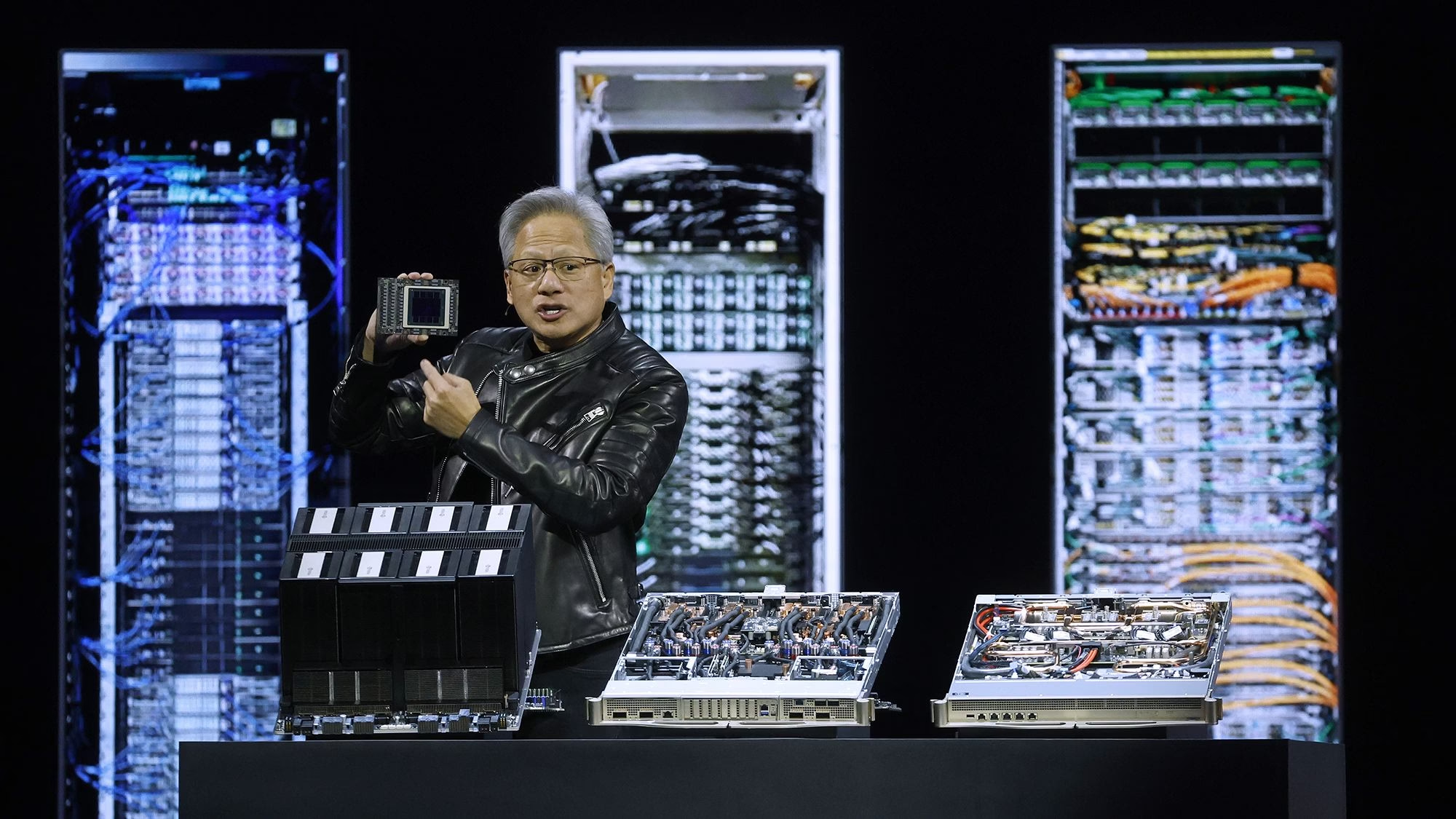
Nvidia: Strong financial results allayed concerns about a bubble in the artificial intelligence industry
Nvidia’s Q3 2025 Earnings: Quantitative Evidence That the AI Boom Is Still Live On November 20, 2025 Nvidia reported $57 billion in revenue for fiscal Q3 , a 62% year‑over‑year increase and 22%...
Nvidia’s Q3 2025 Earnings: Quantitative Evidence That the AI Boom Is Still Live
On November 20, 2025 Nvidia reported
$57 billion in revenue for fiscal Q3
, a 62% year‑over‑year increase and 22% quarter‑on‑quarter growth. The data‑center segment alone generated $51.2 billion, up 66% YoY. Gross margin rose to 73.4%, with net income hitting $31.9 billion—a 65% jump from the prior year. These figures not only beat consensus but also provide a hard‑data counterpoint to the “AI bubble” narrative that has circulated since early 2025.
Executive Summary
- Revenue & Growth : $57 bn Q3, forecasted $65 bn for Q4—exceeding consensus by ~$3 bn.
- Margin Expansion : Gross margin 73.4%, projected to reach ~75% in Q4.
- Strategic Partnerships : New Anthropic cloud‑services deal; existing contracts with OpenAI, Google Cloud, Microsoft Azure, Oracle, xAI.
- Supply‑Chain Risks : Analyst cautions about power, land, and grid bottlenecks potentially capping revenue translation.
- Investor Sentiment Shift : From “bubble” to “virtuous cycle,” with CEO Jensen Huang emphasizing accelerating compute demand.
The following analysis translates these numbers into actionable insights for investors, portfolio managers, and financial journalists focused on AI‑driven market dynamics.
Market Impact Analysis: How Nvidia’s Results Reshape Valuation Premises
Nvidia’s valuation has long hinged on the premise that AI workloads will continue to grow at an unprecedented rate. The Q3 earnings confirm this premise with empirical evidence:
- Revenue Momentum : A 62% YoY lift in total revenue translates into a compound annual growth rate (CAGR) of roughly 45% over the last two years, far above the 15–20% average for semiconductor peers.
- Margin Sustainability : Maintaining a gross margin above 73% indicates pricing power and efficient cost structures even as production scales. For an equity analyst, this suggests that future earnings growth can be driven by volume rather than price compression.
- Net Income Leverage : Net income grew 65% YoY, implying that Nvidia’s operating leverage is strong—each additional dollar of revenue contributes disproportionately to profit due to high fixed costs in R&D and manufacturing capacity.
- Guidance Confidence : The company’s Q4 forecast of $65 bn (+/-2%) exceeds the LSEG consensus of $61.66 bn by about 5%. This gap reflects management’s conviction that supply constraints will not materially hinder demand fulfillment.
For equity analysts, these metrics justify a higher revenue multiple (currently ~30x forward P/E) and support a long‑term growth trajectory that aligns with the projected expansion of AI workloads across industries.
Strategic Business Implications for Cloud Providers and Enterprise Deployments
The data‑center segment’s dominance underscores Nvidia’s role as the backbone of cloud AI infrastructure. Key implications include:
- Cloud Capacity Planning : AWS, Azure, GCP have already sold out their Nvidia GPU capacity in Q3. Cloud operators should anticipate continued demand and consider pre‑emptive contracts or spot pricing strategies to lock in supply.
- Edge AI Opportunities : With data centers consuming significant power, edge deployments are gaining traction. Nvidia’s upcoming low‑power “Grace” line (expected Q4 2025) could open new revenue streams by enabling inference workloads on distributed devices.
- Vendor Lock‑In Mitigation : Enterprises relying heavily on Nvidia GPUs may face higher switching costs. However, the company’s ecosystem—CUDA libraries, cuDNN, and integrated AI frameworks—creates a moat that protects its market share.
Financially, cloud providers can forecast incremental CAPEX for GPU clusters based on Nvidia’s revenue trajectory. A 10% YoY increase in data‑center sales suggests a similar rise in infrastructure spend, which translates into higher EBITDA margins given the high gross margin environment.
Risk Analysis: Supply‑Chain Constraints and Regulatory Headwinds
While growth is robust, two risk vectors warrant close monitoring:
- Physical Bottlenecks : Analyst Jacob Bourne highlights power, land, and grid constraints that could slow production scaling. A slowdown would compress Nvidia’s margin if fixed costs remain unchanged while revenue growth stalls.
- Energy‑Usage Regulations : As AI workloads intensify, data centers face stricter energy efficiency mandates in the EU and US. Compliance costs could erode operating margins unless offset by higher pricing or technological efficiencies.
Quantitatively, a 5% reduction in production capacity over Q4 would translate into a $3–$4 bn shortfall in revenue if demand remains elastic—a scenario that could trigger margin compression from 73.4% to around 70%. Investors should track Nvidia’s capacity expansion plans and any public statements regarding power procurement.
Competitive Landscape: Maintaining Edge Amidst Rising Rivalry
Nvidia’s Blackwell architecture still dominates training and inference workloads, but AMD and Intel are closing the performance gap with newer GPUs. For analysts:
- Performance Benchmarking : Blackwell delivers 5–7x higher FLOPS per watt than the latest AMD Radeon Instinct series, sustaining Nvidia’s pricing power.
- Ecosystem Advantage : Nvidia’s CUDA ecosystem, extensive driver support, and AI‑specific libraries create a high switching cost for customers.
- : Deals with Anthropic, OpenAI, Google Cloud, Microsoft Azure, Oracle, and xAI lock in long‑term revenue streams and reduce churn risk.
Valuation models should incorporate a competitive moat factor—perhaps an additional 10% premium on top of the base P/E multiple—to reflect the likelihood that Nvidia will retain market leadership despite increasing rivalry.
ROI Projections for Investors and Portfolio Managers
Using the Q3 data, we can project forward earnings under different scenarios:
- Base Case (70% of 2024 capacity expansion) : Revenue grows at 12% YoY, gross margin stays at 73%, net income margin at 55%. This yields a forward P/E of ~28x.
- Optimistic Case (full capacity expansion) : Revenue rises 18% YoY, margins improve to 75% gross and 58% net. Forward P/E falls to ~25x, enhancing intrinsic value by roughly $200 bn.
- Pessimistic Case (supply bottleneck) : Revenue growth slows to 6%, margin compresses to 70% gross and 50% net. Forward P/E climbs to ~35x, increasing valuation risk.
Portfolio managers can use these scenarios to adjust exposure: overweight Nvidia in AI‑heavy themes while hedging with AMD or Intel for diversification if supply constraints materialize.
Strategic Recommendations for Executives and Decision Makers
- Invest in GPU Capacity Early : Cloud operators should secure long‑term contracts with Nvidia to avoid price spikes as demand outpaces supply.
- Leverage Edge AI Initiatives : Enterprises can reduce data center costs by deploying Nvidia’s low‑power GPUs for inference at the edge, improving latency and compliance with data sovereignty regulations.
- Monitor Energy Efficiency Standards : Anticipate regulatory changes in power consumption; invest in renewable energy credits or on‑site generation to mitigate potential margin erosion.
- Diversify Vendor Portfolio Strategically : While Nvidia remains the leader, maintaining a secondary GPU supplier (e.g., AMD) can hedge against supply disruptions and price volatility.
- Apply Margin Analysis to Capital Allocation: Use Nvidia’s high operating leverage as a benchmark for evaluating other AI‑related investments—companies with similar margin profiles may offer comparable upside potential.
Future Outlook: What Comes Next in the AI Infrastructure Race?
The next wave of growth will likely hinge on three pillars:
- AI‑Specific ASICs : Competitors like Cerebras and Graphcore are developing silicon optimized for inference. Nvidia must continue to innovate to maintain its performance advantage.
- Hybrid Cloud–Edge Architectures : As data residency requirements tighten, hybrid models combining on‑premise edge GPUs with cloud services will become mainstream, opening new revenue channels.
- Regulatory Evolution : Data privacy and energy usage regulations will shape procurement decisions. Companies that can demonstrate compliance while delivering performance gains will capture market share.
In 2025, Nvidia’s Q3 earnings provide a quantitative foundation for the belief that AI infrastructure demand remains robust. The company’s revenue growth, margin expansion, and strategic partnerships collectively reinforce its position as the engine of the AI economy. For investors and financial professionals, the data supports maintaining or increasing exposure to Nvidia while vigilantly monitoring supply‑chain risks and competitive dynamics.
Conclusion
Nvidia’s fiscal Q3 2025 results deliver a clear, data‑driven rebuttal to the “AI bubble” narrative. The company’s revenue trajectory, margin health, and ecosystem lock‑ins signal that AI compute demand is not only alive but accelerating. While supply constraints pose realistic risks, Nvidia’s technical leadership and strategic partnerships position it well for continued dominance. Stakeholders across the AI value chain—cloud providers, enterprises, investors—should view these earnings as a green light to deepen engagement with Nvidia’s GPU ecosystem while preparing contingency plans for potential capacity bottlenecks.
Related Articles

Microsoft named a Leader in IDC MarketScape for Unified AI Governance Platforms
Microsoft’s Unified AI Governance Platform tops IDC MarketScape as a leader. Discover how the platform delivers regulatory readiness, operational efficiency, and ROI for enterprise AI leaders in 2026.

Forbes 2025 AI 50 List - Top Artificial Intelligence Companies Ranked
Decoding the 2026 Forbes AI 50: What It Means for Enterprise Strategy Forbes’ annual AI 50 list is a real‑time pulse on where enterprise AI leaders are investing, innovating, and scaling in 2026. By...

Sam Altman mum on OpenAI's fundraising plans, future listing, says 0% excited to be a public company CEO
In 2025 Sam Altman signals that OpenAI will not pursue an immediate IPO. This deep‑dive explains the capital strategy, governance implications, competitive dynamics, and actionable frameworks for exec