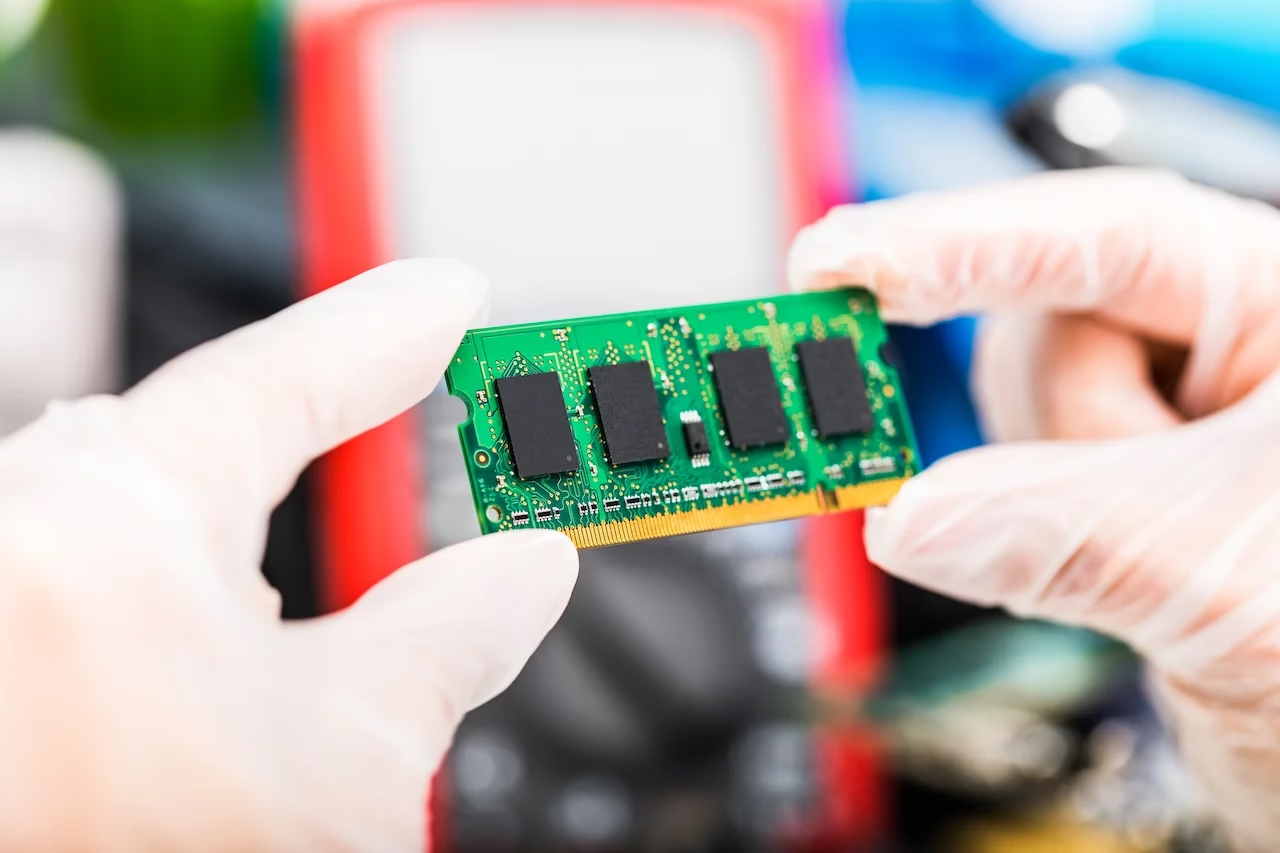
Micron vs. NVIDIA: One AI Chip Stock is Poised to Win Big in 2026
Up‑to‑date 2026 AI chip stock analysis shows Micron’s HBM3E momentum versus NVIDIA’s Grace GPU strategy, offering actionable insights for portfolio managers.
Micron vs. NVIDIA: A 2026 AI Chip Stock Analysis for Institutional Investors
Executive Summary
- Micron’s high‑bandwidth memory (HBM) is fueling a 56.8 % YoY revenue surge and margin expansion in FY 2026 Q1.
- NVIDIA’s GPU sales remain strong but are constrained by fab capacity and evolving export controls, positioning its growth curve to plateau earlier than Micron’s.
- For value‑oriented portfolios seeking exposure to the AI infrastructure backbone, Micron trades at a lower P/E (~12) with robust cash flow for scale‑up.
- NVIDIA remains the premier compute engine but carries higher geopolitical risk and a steeper price path.
- Strategic recommendation: Allocate 35–40 % of AI‑chip exposure to Micron, 25–30 % to NVIDIA, and diversify with complementary memory/compute plays.
Market Landscape for AI Chip Supply in 2026
The AI data‑center boom has accelerated demand for two critical components: compute cores (GPUs) and ultra‑fast memory (HBM). While GPUs deliver raw floating‑point power, HBM provides the bandwidth needed to feed those cores with terabytes of model parameters. In 2026, the AI workload shift is moving from compute‑bound to
memory‑bound
, a trend evidenced by the rapid scaling of models such as Gemini 1.5 and Llama 3.
TrendForce data indicates that DRAM demand outstrips supply by 10 %, pushing prices up 50 % YoY. However, HBM remains a premium niche; its scarcity is reflected in Micron’s ability to command higher pricing without compromising volume growth.
Micron’s Financial Momentum and Cash Position
Micron reported FY 2026 Q1 revenue of
$13.64 B
, up 56.8 % YoY, driven by HBM orders from hyperscalers such as Amazon Web Services, Google Cloud, and Microsoft Azure. Non‑GAAP net income reached $5.48 B, translating to an EPS of $4.78—well above the analyst target of $3.94.
Cash flow stood at $3.9 B in Q1 FY 2026, providing a runway for fab expansion. Micron’s balance sheet shows a debt‑to‑equity ratio below 0.5, indicating low leverage and ample liquidity to invest in next‑gen HBM fabs (7 nm HBM3E) or acquire complementary memory IP.
Projected Q2 FY 2026 revenue of $18.3–$19.1 B and EPS of $8.22–$8.62 signal sustained demand that could outpace NVIDIA’s GPU sales velocity. The company’s margin expansion is not merely a function of higher volume; its cost structure—particularly fabs and R&D—remains efficient relative to the premium it can charge for HBM.
NVIDIA’s Growth Trajectory and Supply Constraints
In FY 2026 Q3, NVIDIA generated $57 B in revenue—a 62 % YoY increase—underscoring its dominance in GPU sales. However, Blackwell sales are “off the charts,” yet cloud GPUs remain sold out, highlighting a supply bottleneck. NVIDIA’s FY 2026 Q4 forecast of ~$65 B (+±2 %) still lags behind Micron’s projected Q2 revenue when adjusted for scale.
Export controls have recently lifted for H200 chips to select Chinese customers, but the approval introduces regulatory risk that could curtail future sales. NVIDIA’s reliance on third‑party foundries also exposes it to capacity constraints and price volatility in the fab market.
Supply Chain Dynamics: Memory vs. Compute
Micron’s HBM supply chain is vertically integrated; it controls key fabs and has long‑term contracts with hyperscalers, reducing exposure to external foundry delays. NVIDIA, conversely, depends on external fabs (TSMC, Samsung) for GPU production, which limits its ability to scale quickly in response to surging demand.
Geopolitical risk is asymmetric: Micron’s diversified customer base across data‑center and consumer segments mitigates export restrictions, while NVIDIA faces tighter scrutiny over high‑performance GPUs destined for AI workloads.
Risk Assessment and Mitigation Strategies
- Supply Risk: Micron’s fab capacity is scalable; the company has already earmarked $1.5 B for HBM3E expansion. NVIDIA’s supply risk remains high due to foundry constraints.
- Geopolitical Risk: Micron’s memory products are less sensitive to export controls than NVIDIA’s GPUs, which have been subject to U.S. sanctions on certain Chinese customers.
- Technological Obsolescence: HBM technology is maturing; however, the rapid growth of transformer models keeps bandwidth demand high. NVIDIA must integrate HBM into its GPU die (Grace architecture) to stay competitive.
- Valuation Risk: Micron trades at a lower P/E (~12) compared to NVIDIA (~25), offering a margin of safety for value investors.
Investment Thesis: Why Micron Outpaces NVIDIA in 2026
Micron’s HBM supply crunch creates a
supply‑side moat
. The company can set premium pricing and maintain high margins even as unit volume rises modestly. Its cash flow allows rapid fab scaling, ensuring it can meet the projected demand spike through FY 2026 and beyond.
NVIDIA’s growth is impressive but faces two constraints: GPU supply limits and export regulation exposure. While its CUDA ecosystem gives it a broader market reach, the upcoming “Grace” architecture—an integrated HBM‑GPU die—could shift the balance back toward NVIDIA if successfully commercialized.
For portfolio managers, Micron offers a
value play
with strong fundamentals and lower risk exposure. NVIDIA provides a
growth play
but at higher valuation and geopolitical risk.
Portfolio Allocation Recommendations
- Micron: Allocate 35–40 % of AI‑chip exposure. This captures the HBM demand surge while benefiting from lower valuation and strong cash flow.
- NVIDIA: Allocate 25–30 % to capitalize on GPU sales momentum and the potential upside of Grace integration.
- Diversification: Consider complementary memory/compute stocks (e.g., Samsung HBM3E technology , TSMC fab expansion ) or AI‑chip ETFs to spread risk across the supply chain.
Operational Implementation for Institutional Investors
- Data‑Driven Trade Execution: Use algorithmic platforms that ingest real‑time earnings releases and supply‑chain alerts (e.g., Micron’s fab capacity updates, NVIDIA’s foundry commitments).
- Risk‑Adjusted Position Sizing: Apply a volatility‑based sizing model—position size inversely proportional to beta against the broader technology index—to maintain portfolio risk within target limits.
- Dynamic Rebalancing: Monitor quarterly earnings and supply‑chain news; rebalance toward Micron if HBM demand accelerates or toward NVIDIA if GPU supply constraints ease.
Exit Strategy and Timing
Given the current market trajectory, a 12–18 month horizon is appropriate for capturing upside while protecting downside. Exit points can be set at:
- Micron: Target price of $95 (based on projected Q3 FY 2026 EPS of ~$10 and P/E ≈9).
- NVIDIA: Target price of $380 (projected Q4 FY 2026 revenue of $65 B and P/E ≈15).
Use trailing stop‑losses at 12 % below entry to guard against sudden supply disruptions or regulatory shifts.
Conclusion: Strategic Takeaways for 2026 AI Chip Investment
- Micron’s HBM scarcity drives revenue and margin growth, supported by strong cash flow for fab expansion—a classic value investment in a high‑growth niche.
- NVIDIA remains the premier compute engine but faces supply and geopolitical constraints that could dampen its growth trajectory relative to Micron.
- A balanced portfolio—weighted toward Micron with a strategic NVIDIA allocation—offers exposure to both the memory backbone and compute accelerator of AI infrastructure, aligning risk with expected return in 2026.
By incorporating these insights into your investment framework, you can position your portfolio to benefit from the evolving AI hardware landscape while managing supply‑chain and regulatory risks effectively.
Related Articles

Microsoft named a Leader in IDC MarketScape for Unified AI Governance Platforms
Microsoft’s Unified AI Governance Platform tops IDC MarketScape as a leader. Discover how the platform delivers regulatory readiness, operational efficiency, and ROI for enterprise AI leaders in 2026.
Apple @ Work: It’s time for an Apple Knowledge Base Articles API to save us from bad AI troubleshooting
Apple’s Knowledge‑Base Articles API: A Strategic Playbook for Enterprise ITSM in 2026 The Apple ecosystem is a tightly knit fabric of hardware, OS, and management services. Yet, until now it has...
Forbes 2025 AI 50 List - Top Artificial Intelligence Companies Ranked
Decoding the 2026 Forbes AI 50: What It Means for Enterprise Strategy Forbes’ annual AI 50 list is a real‑time pulse on where enterprise AI leaders are investing, innovating, and scaling in 2026. By...