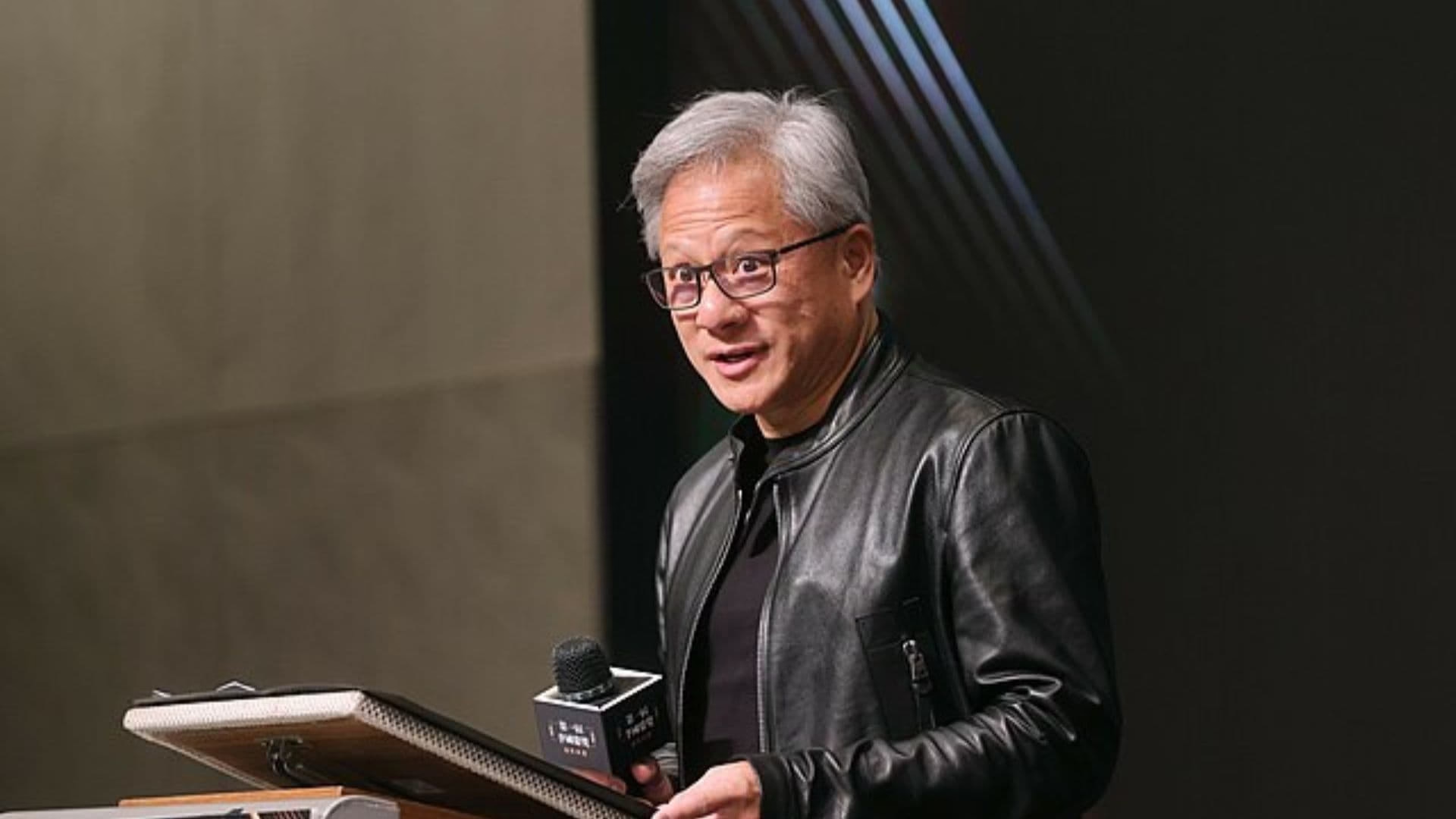
Exclusive: Nvidia buying AI chip startup Groq for about $20 billion in its largest acquisition on record
Nvidia’s $20 B Groq Deal: A Strategic Blueprint for Enterprise AI Inference in 2025 On December 24, 2025 Nvidia announced the largest acquisition in its history—a non‑exclusive licensing agreement...
Nvidia’s $20 B Groq Deal: A Strategic Blueprint for Enterprise AI Inference in 2025
On December 24, 2025 Nvidia announced the largest acquisition in its history—a non‑exclusive licensing agreement and acquihire of Groq’s Language Processing Unit (LPU) IP and key engineering talent. The deal, valued at roughly $20 billion in cash, marks a decisive pivot from GPU‑centric inference to specialized ASICs that deliver 3–5× higher throughput per watt for large language models (LLMs). For CIOs, CTOs, and investment analysts, the transaction is not just headline fodder; it signals a new equilibrium in AI hardware economics, supply chain strategy, and competitive dynamics.
Executive Summary: Why This Deal Matters
The Groq acquisition can be distilled into three strategic imperatives:
- Technology acceleration : Nvidia gains immediate access to an LPU architecture that outperforms current GPUs on inference‑heavy workloads, enabling lower latency and power consumption for LLMs, vision, and autonomous systems.
- Talent infusion : By bringing Jonathan Ross, Sunny Madra, and Groq’s design team into Nvidia, the company fast‑tracks its own ASIC roadmap while preserving GroqCloud’s SaaS operations.
- Market consolidation : The deal neutralizes a rising competitor, consolidates Nvidia’s dominance in inference hardware, and pressures AMD, Intel, and other players to rethink their R&D strategies.
For enterprise leaders, the implications translate into clearer decisions about data‑center architecture, vendor mix, and capital allocation for AI workloads.
Strategic Business Implications
Nvidia’s choice of a non‑exclusive licensing model coupled with an acquihire offers a pragmatic balance between speed and regulatory risk. Unlike a full takeover, the structure preserves GroqCloud as an independent SaaS platform, sidestepping antitrust scrutiny while granting Nvidia the freedom to integrate LPU IP across its product lines.
Key business takeaways:
- Capital efficiency : The $20 billion outlay is a premium (~3× last enterprise valuation) but remains within Nvidia’s healthy cash position ($60.6 B pre‑deal). For enterprises, this signals that large AI hardware investments can be justified by long‑term cost savings in inference power.
- Vendor lock‑in mitigation : By licensing rather than owning Groq outright, Nvidia keeps its supply chain flexible. Enterprises can negotiate multi‑vendor contracts for GPUs and LPUs without being forced into a single ecosystem.
- Competitive moat expansion : The deal effectively removes Groq from the direct competition field, tightening Nvidia’s monopoly on inference hardware. This has downstream effects on pricing power and service differentiation.
Technology Integration Benefits for Enterprise Inference
The LPU architecture is functionally sliced—combining memory, vector, and matrix units in a deterministic producer‑consumer model. Benchmarks released by TechRadar Pro (Feb 2024) demonstrate 3–5× higher inference throughput per watt compared to Nvidia’s current H100 GPUs on LLM workloads.
Implications for data‑center design:
- Power density : LPUs can deliver the same performance as a GPU cluster with only one-third of the power draw, reducing cooling costs and enabling higher server densities.
- Latency reduction : The deterministic flow eliminates queuing delays common in GPU kernels, making LPUs ideal for real‑time inference such as autonomous driving or edge analytics.
- Hybrid deployment : Nvidia plans to embed LPU cores into its DGX‑A and H100 chassis. Enterprises can mix GPU and LPU workloads on the same rack, optimizing for cost versus performance per use case.
Supply Chain & Manufacturing Considerations
Groq’s chips are fabricated on Samsung’s 4 nm node—currently the most advanced process in commercial production. By integrating this technology into its own ASIC roadmap, Nvidia can:
- Reduce fab lead times : Samsung’s Texas plant has already processed Groq orders; leveraging the same facility accelerates Nvidia’s time‑to‑market for inference ASICs.
- Diversify fab risk : Relying on a single foundry (TSMC) can expose companies to geopolitical or capacity constraints. The 4 nm partnership with Samsung offers an alternative channel.
- Scale production efficiently : With the GPU supply chain already strained by high demand, the LPU path provides a parallel scaling route for inference workloads.
Financial Impact & ROI Projections
The $20 billion outlay is substantial but strategically justified. Enterprises can anticipate:
- Inference cost reduction : Early estimates suggest a 25–35% decrease in per‑token inference cost when shifting from GPUs to LPUs for LLM workloads.
- Capital expenditure savings : Lower power and cooling requirements translate into $5–10 million annual savings for a mid‑size data center running 200 H100-equivalent nodes.
- Revenue opportunities : Nvidia’s hybrid GPU‑LPU offerings can command premium pricing for low‑latency inference services, creating new revenue streams for cloud providers and enterprise AI platforms.
Competitive Landscape Shifts in 2025
The Groq deal reshapes the competitive field:
- AMD & Intel : Both companies have accelerated ASIC R&D, but the LPU advantage forces them to either develop comparable architectures or form strategic alliances (e.g., AMD + Cerebras).
- Cerebras & Graphcore : These firms now face a consolidated Nvidia moat. Their focus may shift toward niche domains (e.g., high‑frequency trading) where GPU dominance is less entrenched.
- Cloud AI providers : Companies like AWS, Azure, and Google Cloud can leverage Nvidia’s LPU integration to offer differentiated inference services with lower TCO for customers.
Implementation Roadmap for Enterprise Leaders
Adopting Nvidia’s hybrid GPU‑LPU architecture requires a phased approach:
- Assessment : Benchmark current inference workloads against LPU specifications. Identify latency‑sensitive and power‑constrained use cases.
- Pilot deployment : Deploy a small cohort of DGX‑A nodes with embedded LPUs in a controlled environment (e.g., edge AI for autonomous vehicles).
- Integration : Update orchestration layers (Kubernetes, Ray) to schedule LPU workloads separately from GPU queues.
- Optimization : Fine‑tune model quantization and batching strategies to maximize LPU throughput per watt.
- Scale & monitor : Expand deployment across data centers while monitoring power usage effectiveness (PUE) and latency metrics.
Risk Management & Mitigation Strategies
While the benefits are compelling, enterprises should consider:
- Vendor dependency : Overreliance on Nvidia’s LPU could lock in pricing. Maintain a diversified hardware portfolio to hedge against supply disruptions.
- Software ecosystem maturity : Ensure that AI frameworks (PyTorch, TensorFlow) fully support LPU acceleration; monitor community contributions and vendor SDK updates.
- Capital allocation timing : Align the acquisition of new ASIC‑enabled hardware with forecasted workload growth to avoid underutilization.
Future Outlook: 2026 and Beyond
Nvidia’s strategic move sets a precedent for AI hardware consolidation. Anticipated trends include:
- Hybrid chip ecosystems : More vendors will integrate GPU and ASIC cores on single dies to offer best‑of‑both‑worlds performance.
- Edge‑centric inference : LPUs’ low power profile positions them for deployment in autonomous vehicles, drones, and IoT gateways.
- AI-as-a-Service evolution : Cloud providers will bundle LPU-accelerated inference into managed services, raising the entry barrier for small enterprises.
Actionable Recommendations for CIOs & CTOs
- Reevaluate data‑center power budgets : Conduct a cost–benefit analysis comparing current GPU clusters to prospective LPU deployments; target at least a 30% reduction in inference power draw.
- Engage with Nvidia early : Secure access to upcoming hybrid GPUs and LPUs through pilot programs; negotiate favorable terms for enterprise volume licensing.
- Invest in talent cross‑pollination : Encourage internal teams to collaborate with Nvidia’s LPU architects; develop in‑house expertise on ASIC design principles.
- Monitor supply chain developments : Track Samsung’s 4 nm capacity expansion and its impact on lead times for AI ASICs; diversify fab relationships accordingly.
- Leverage cloud partnerships : Work with major cloud providers to benchmark LPU‑accelerated inference services; integrate these into service-level agreements (SLAs) for customers.
In sum, Nvidia’s $20 billion Groq deal is more than a headline; it is a strategic realignment that redefines the economics of AI inference. By marrying high‑performance LPUs with its GPU ecosystem, Nvidia delivers a compelling value proposition to enterprises: lower power costs, reduced latency, and a clear path toward scalable, cost‑effective AI deployments in 2025 and beyond.
Related Articles

World models could unlock the next revolution in artificial intelligence
Discover how world models are reshaping enterprise AI in 2026—boosting efficiency, revenue, and compliance through proactive simulation and physics‑aware reasoning.

China just 'months' behind U.S. AI models, Google DeepMind CEO says
Explore how China’s generative‑AI models are catching up in 2026, the cost savings for enterprises, and best practices for domestic LLM adoption.

AI chip unicorns Etched.ai and Cerebras Systems get big funding boost to target Nvidia
Explore how AI inference silicon from Etched.ai and Cerebras is driving new capital flows, wafer‑scale performance, and strategic advantages for enterprises in 2026.