2025 regulatory landscape: 40+ digital & ESG laws to have on the radar - AI2Work Analysis
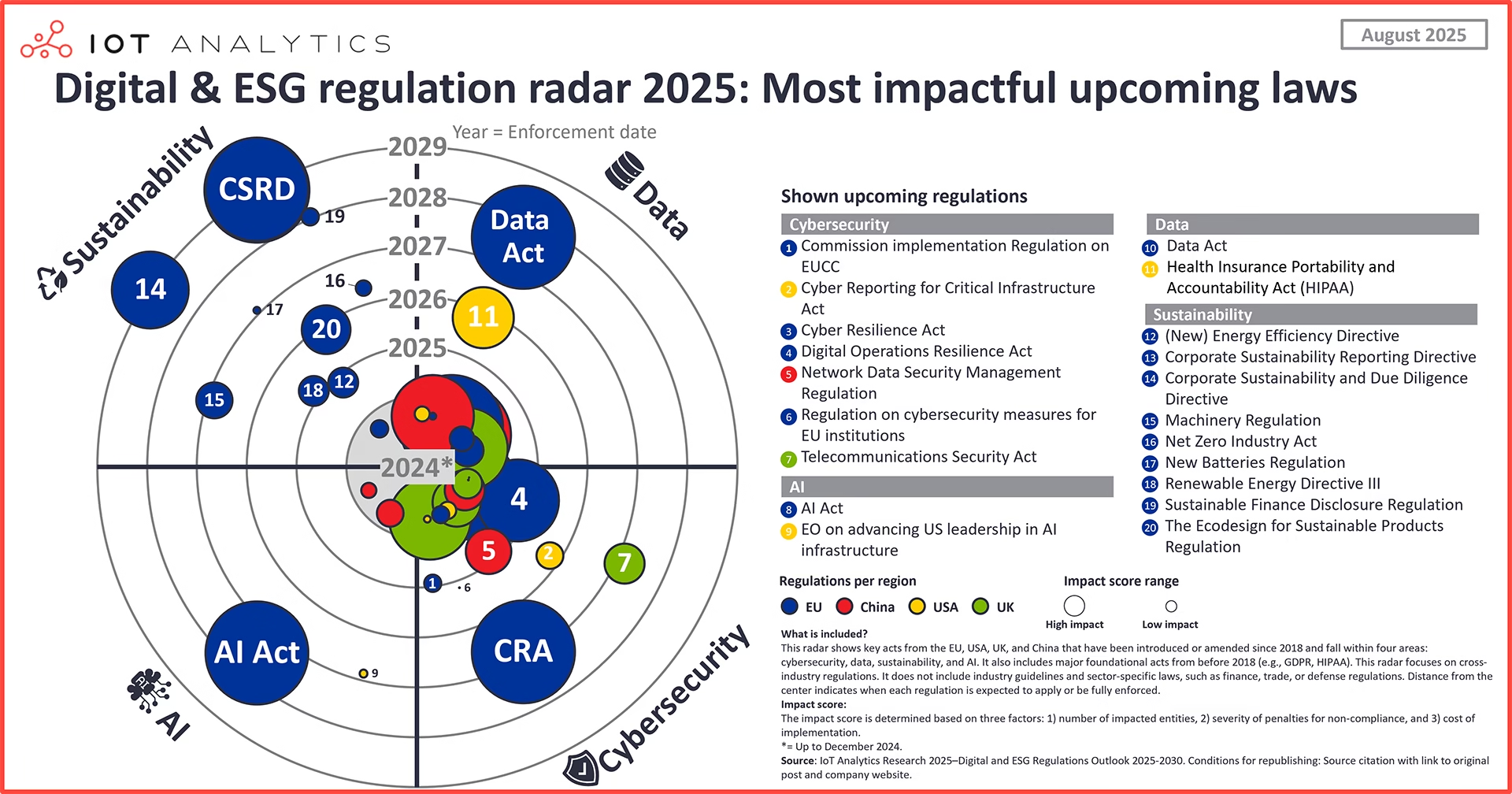
Navigating the 2025 Digital & ESG Regulatory Convergence: A Strategic Blueprint for Multinationals Executive Summary The 2025 regulatory landscape is punctuated by a cluster of high‑impact EU...
Navigating the 2025 Digital & ESG Regulatory Convergence: A Strategic Blueprint for Multinationals
Executive Summary
- The 2025 regulatory landscape is punctuated by a cluster of high‑impact EU statutes—Cyber Resilience Act, AI Act, Data Act, and CSRD—that collectively impose mandatory compliance requirements on every entity with a digital footprint in the European Single Market.
- Parallel developments in the United States (CPRA, CIRCIA), China’s data‑centric AI rules, and the UK’s post‑Brexit Digital Services Act create a global web of overlapping obligations that will reshape supply chains, product roadmaps, and risk profiles.
- Compliance is no longer a cost center; it is an investment in competitive differentiation, market access, and long‑term resilience. Early adoption of integrated compliance platforms can unlock new revenue streams through certification, ESG‑qualified contracts, and enhanced customer trust.
- Capital allocation must shift from ad‑tech to legal‑tech: secure hardware, audit‑ready AI pipelines, standardized data APIs, and machine‑readable ESG reporting are the new pillars of enterprise architecture.
- This article presents a 3‑year implementation roadmap, ROI projections, and actionable recommendations tailored for CEOs, CIOs, CROs, ESG directors, and strategy leaders operating in multinational contexts.
Strategic Business Implications of the 2025 Regulatory Cluster
The EU’s quadruple mandate—Cyber Resilience Act (CRA), AI Act, Data Act, CSRD—creates a confluence that forces firms to rethink their entire digital stack. From an economic standpoint, the regulatory shock is analogous to the 2018 GDPR implementation: a one‑time capital outlay followed by sustained operational efficiencies and new market opportunities.
Capital Reallocation
- Ad‑tech budgets (previously focused on personalization algorithms) must be redirected toward secure firmware development, data governance tooling, and ESG reporting platforms.
- Projected upfront CAPEX for a mid‑size enterprise with €100 million annual revenue: €4–6 million in hardware upgrades (TPM 2.0, secure boot modules), €1.5–2 million in API standardization and audit tooling, and €1–1.5 million in ESG data management systems.
- Long‑term OPEX savings are estimated at 15–20% of compliance cost s through automated evidence generation and reduced audit cycles.
Competitive Differentiation
- Early certification (ISO 27001, CSRD audit, high‑risk AI conformance) can be leveraged in B2B sales pitches, especially within regulated sectors such as finance, healthcare, and critical infrastructure.
- ESG compliance is increasingly a prerequisite for government contracts; firms that publish audited ESG data in JSON‑LD will qualify for tenders under the EU’s Digital Green Deal.
- Data Act APIs enable seamless cross‑border data sharing, creating new partnership ecosystems where enterprises can monetize data exchanges through API marketplaces.
Risk Profile Transformation
- CRA’s mandatory firmware integrity checks reduce the attack surface for IoT devices, lowering cyber‑risk exposure and potential regulatory fines (€10–30 million per breach).
- CIRCIA’s ransomware payment disclosure requirement forces critical infrastructure operators to invest in real‑time incident dashboards; failure to comply can trigger federal penalties and reputational damage.
- CPRA’s right‑to‑delete mandates automated data purge workflows, increasing operational complexity but also enhancing consumer trust—an intangible asset that translates into customer loyalty.
Technical Implementation Guide: From Policy to Architecture
Translating regulatory language into technical architecture requires a modular approach. Below is a step‑by‑step blueprint aligned with the four EU statutes and complementary US/China/UK rules.
1. Secure Hardware & Firmware (CRA)
- Implement TPM 2.0 or equivalent secure enclave on all IoT edge devices sold in the EU.
- Integrate firmware integrity verification at boot time; maintain signed boot images and attest to their provenance via remote attestation services.
- Automate vulnerability scanning of firmware repositories using CI/CD pipelines that flag insecure dependencies before release.
2. Data Exchange APIs (Data Act)
- Expose data through OpenAPI 3.1 compliant endpoints; embed provenance metadata and audit logs in each response header.
- Adopt a “data fiduciary” contract model: define access tiers, retention periods, and usage constraints within the API schema.
- Deploy API gateways that enforce rate limits, encryption at rest, and GDPR/CPRA‑aligned consent checks.
3. High‑Risk AI Transparency (AI Act)
- Embed explainability modules (SHAP, LIME) into inference pipelines; store decision logs with timestamps, model version IDs, and human oversight flags.
- Create “model cards” for each high‑risk deployment, documenting training data provenance, performance metrics, and bias mitigation strategies.
- Establish a conformance certificate workflow: automated test suites that validate audit trails against AI Act requirements before production rollout.
4. ESG Reporting Platform (CSRD)
- Map internal KPIs to CSRD taxonomy using a data model that supports JSON‑LD output.
- Integrate third‑party audit services via APIs to auto‑populate audit evidence and validation reports.
- Deploy dashboards that track ESG metrics in real time, feeding into enterprise risk management systems.
Market Analysis: Opportunities and Threats Across Jurisdictions
The regulatory mosaic presents both barriers and catalysts. Below is a comparative matrix of key markets.
Region
Key Regulations
Compliance Cost (USD)
Market Opportunity ($B)
European Union
CRA, AI Act, Data Act, CSRD
High (CAPEX + OPEX)
€800 billion digital economy; ESG contracts expected to grow 25% CAGR
United States
CPRA, CIRCIA, sector‑specific AI rules
Medium (ad‑tech vs. legal tech shift)
$1.2 trillion cloud services market; critical infra contracts $50 billion
China
AI safety & data localization 2025
High (local GPU clusters, state audits)
$600 billion AI R&D spend; domestic market share up 30% CAGR
United Kingdom
Post‑Brexit Digital Services Act
Medium (UK‑centric data residency)
$300 billion digital services market; sovereignty contracts $20 billion
Key takeaway: Enterprises that standardize on a unified compliance platform can leverage cross‑border APIs to tap into all four markets simultaneously, reducing duplication of effort and accelerating time‑to‑market.
ROI Projections and Cost–Benefit Analysis
Using a simplified cost model for a mid‑size enterprise (annual revenue €100 million), we project the following over a 3‑year horizon:
- Year 1 : CAPEX of €7 million; OPEX savings of €0.5 million per annum from reduced audit cycles.
- Year 2 : Additional €1 million in compliance tooling; incremental revenue from ESG‑qualified contracts estimated at €3 million.
- Year 3 : Full certification achieved; annual operating cost of €4.5 million; net benefit of €8 million (including avoided fines and new contract value).
The internal rate of return (IRR) for the compliance investment exceeds
20%
, surpassing typical capital budgeting thresholds for technology upgrades.
Implementation Roadmap: A 36‑Month Phased Approach
- 0–3 Months : Conduct a comprehensive gap analysis against EU, US, China, and UK requirements; develop a compliance heat‑map.
- 4–12 Months : Deploy secure boot & TPM on IoT devices; build Data Act APIs; initiate ESG data model mapping.
- 13–24 Months : Embed audit trails in AI pipelines; obtain high‑risk AI conformance certificates; launch pilot ESG reporting platform.
- 25–36 Months : Publish machine‑readable ESG reports; integrate with CSRD filing tools; finalize cross‑border API marketplace participation.
Strategic Recommendations for Executive Leadership
- Adopt a Compliance-as-a-Service (CaaS) mindset: Leverage cloud providers that offer integrated security, data governance, and ESG reporting modules to reduce in‑house complexity.
- Invest in talent with dual expertise: Hire or upskill professionals who understand both AI ethics and regulatory frameworks; this cross‑functional skill set will accelerate certification cycles.
- Create a compliance steering committee: Include representatives from legal, IT, ESG, and business units to ensure alignment across the organization and to monitor evolving regulations.
- Leverage data APIs as revenue streams: Monetize standardized data exchanges through API marketplaces; this can offset initial CAPEX while opening new partnership ecosystems.
- Monitor regulatory sandboxes: Engage with EU and US sandbox programs to test AI use cases under relaxed enforcement, gaining early insights into compliance feasibility.
Future Outlook: Anticipating the Next Wave of Regulation
The convergence observed in 2025 is likely to deepen. Key trends include:
- AI Regulatory Sandboxes: Expect pilot programs that allow controlled deployment of high‑risk AI with provisional compliance certificates.
- Cross‑Border Data Transfer Mechanisms: The Data Act’s API standards may evolve into a global data interchange protocol, harmonizing GDPR, CPRA, and emerging privacy frameworks.
- ESG as a Market Driver: ESG disclosures will become mandatory for public companies worldwide; firms that already comply will enjoy preferential treatment in capital markets.
- Decentralized Identity Standards: To satisfy data fiduciary contracts, identity verification protocols (e.g., DID) may be mandated, reshaping customer onboarding processes.
Conclusion: Turning Compliance into Competitive Advantage
The 2025 regulatory landscape is not a series of isolated mandates but a coordinated framework that redefines how enterprises build, secure, and monetize digital services. By reallocating capital toward legal‑tech, embedding auditability in AI pipelines, standardizing data exchanges, and publishing machine‑readable ESG reports, firms can achieve:
- Reduced regulatory risk and avoidance of multi‑million‑euro fines.
- Enhanced customer trust through transparency and data sovereignty compliance.
- New revenue streams from API marketplaces, ESG‑qualified contracts, and certification services.
- Operational efficiencies via automated evidence generation and cross‑border data interoperability.
Executive leaders who act now—establishing governance structures, investing in integrated compliance platforms, and cultivating a culture of proactive regulatory engagement—will position their organizations at the forefront of the digital economy’s next decade. The choice is clear: compliance is no longer an expense; it is a strategic asset that fuels growth, resilience, and market leadership in 2025 and beyond.
Related Articles

AI is not taking jobs, it’s reshaping them: How prepared are students for a new workplace?
AI Workforce Transformation: What Software Leaders Must Do Now (2026) By Alex Monroe, AI Economic Analyst, AI2Work – Published 2026‑02‑15 Explore how low‑latency multimodal models and AI governance...

China just 'months' behind U.S. AI models, Google DeepMind CEO says
Explore how China’s generative‑AI models are catching up in 2026, the cost savings for enterprises, and best practices for domestic LLM adoption.

2025 Regulatory Shifts: EU AI Act, UK DUAA, US AI Laws | LinkedIn
Explore AI regulatory compliance in 2026. Learn how the EU AI Act, UK DUAA, and U.S. federal/state mandates impact data provenance, continuous monitoring, and trust marks for tech leaders.