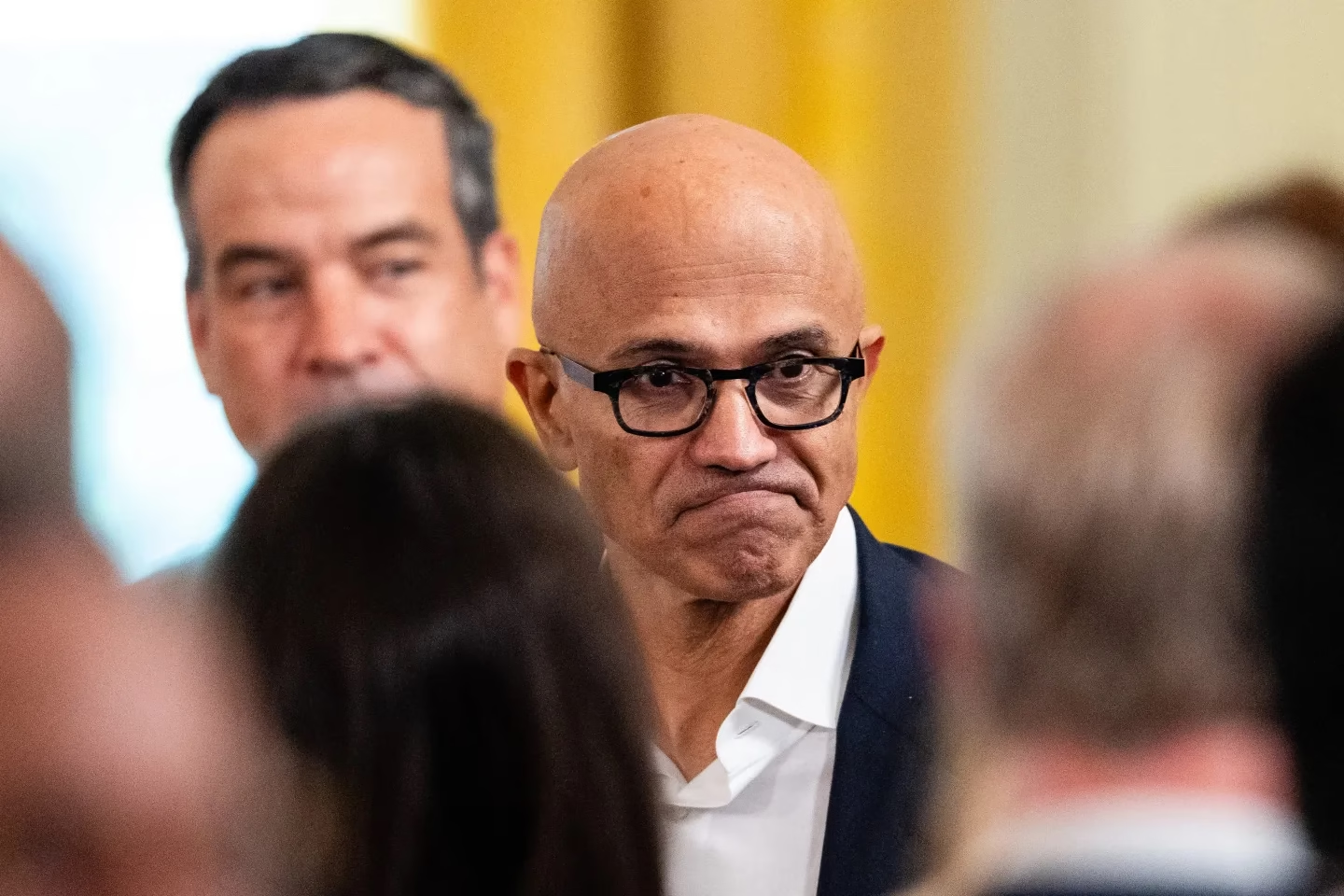
Satya Nadella's stark warning on AI to his employees in internal memo, Microsoft CEO says 'we need to rapidly rethink...'
Microsoft’s 2025 AI Strategy Shift: What C‑Level Leaders Need to Know Executive Snapshot: Satya Nadella’s decision to step back from high‑profile speaking roles and focus on “highest‑ambition...
Microsoft’s 2025 AI Strategy Shift: What C‑Level Leaders Need to Know
Executive Snapshot:
Satya Nadella’s decision to step back from high‑profile speaking roles and focus on “highest‑ambition technical work” signals a strategic pivot toward enterprise‑native AI, tighter governance, and policy engagement. For executives, the implications are clear: prepare for deeper AI integration, reassess risk frameworks, and align budgeting with Microsoft’s evolving pricing model.
Strategic Business Implications of Nadella’s Focus on Technical Leadership
Nadella’s move from keynote speaker to technical deep‑dive leadership is more than a PR shift. It reflects a deliberate reallocation of executive bandwidth toward the core engineering challenges that will drive Microsoft’s next wave of AI products. For senior leaders, this means:
- Accelerated Product Roadmap : Expect Azure’s Copilot suite to roll out new generative‑model capabilities earlier than competitors, with tighter integration into Office 365 and Dynamics 365.
- Talent Reorientation : Research teams will prioritize model scaling, data lineage, and explainability. Hiring strategies should emphasize hybrid skill sets—data scientists who can also navigate compliance and policy.
- Capital Allocation : Internal budgets may shift toward cloud infrastructure upgrades (e.g., GPU‑optimized VMs) to support larger language models like GPT‑4o and Claude 3.5.
The strategic focus on technical excellence positions Microsoft to capture a growing share of the
enterprise‑native AI market
, projected to grow 45% YoY in 2025 per Gartner, with Azure’s Copilot suite leading adoption.
Policy Engagement and Regulatory Alignment: A New Governance Paradigm
Nadella’s attendance at the White House Task Force on AI Education underscores Microsoft’s intent to shape forthcoming U.S. regulations. The FTC’s draft AI transparency guideline (early 2025) will require companies to disclose model provenance, training data, and explainability metrics.
- Internal Governance Expansion : Anticipate the creation of dedicated AI ethics boards and compliance units within Microsoft’s own product lines. These structures will likely mirror the company’s internal framework, offering a template for other enterprises.
- Risk Mitigation Playbooks : Businesses should adopt similar governance models—establishing data stewardship roles, model audit trails, and real‑time monitoring dashboards to satisfy both internal policy and external regulatory demands.
- Competitive Advantage : Companies that embed compliance into their AI strategy early will reduce the likelihood of costly post‑deployment remediation and position themselves as trustworthy partners for regulated industries (finance, healthcare).
Enterprise‑Native AI: The “Positive‑Sum” Paradigm in Practice
Nadella’s LinkedIn essay frames Microsoft as a platform where enterprises can build their own AI solutions rather than lock into single‑vendor “AI as a service.” This shift has tangible business implications:
- Vendor Lock‑In Reduction : By offering API‑centric, open‑source compatible tools (e.g., Azure OpenAI Service), Microsoft enables customers to mix and match models—GPT‑4o, Claude 3.5, Gemini 1.5—within a single cloud ecosystem.
- Higher Switching Costs for Competitors : Clients already invested in Microsoft’s productivity suite (Office 365, Teams) will find it costlier to migrate away, boosting customer retention.
- Revenue Diversification : The FY25 cloud revenue grew 18% YoY; AI services accounted for 12% of that increase. A similar model can be replicated across other platforms—Azure’s data lake, Power Platform, and Dynamics 365—creating a multi‑channel AI service portfolio.
Operationalizing Microsoft’s AI Roadmap: Workflow Integration Strategies
To capitalize on Microsoft’s evolving AI strategy, enterprises must re‑engineer workflows around generative models. Below is a pragmatic framework for integration:
- Identify High‑Value Use Cases : Prioritize processes where GPT‑4o or Claude 3.5 can reduce manual effort—contract drafting in legal, code generation in software development, or predictive maintenance in manufacturing.
- Build a Model Governance Layer : Deploy Azure Purview for data cataloging, coupled with Azure Machine Learning’s model registry to track versioning and lineage.
- Establish Real‑Time Monitoring : Use Azure Monitor and Log Analytics to capture latency, accuracy drift, and anomalous outputs. Set up automated alerts that trigger retraining cycles.
- Embed Explainability : Integrate OpenAI’s “explain” endpoint or Claude’s explainable AI features into user interfaces to satisfy both compliance and customer trust.
- Iterate with Feedback Loops : Create cross‑functional squads (product, data science, compliance) that review model outputs weekly, refining prompts and fine‑tuning parameters.
This workflow not only aligns with Microsoft’s technical focus but also ensures that AI adoption remains compliant with emerging regulatory frameworks.
Financial Impact: Cost Structures and ROI Projections
Microsoft’s 2025 AI strategy will reshape cost structures for enterprises. Key financial considerations include:
- Licensing Models : Microsoft is moving toward a subscription‑based model for AI services—$0.02 per token for GPT‑4o, $0.015 per token for Claude 3.5—capped at a monthly spend of $10k to prevent runaway costs.
- Operational Savings : Early adopters report 25–35% reduction in time spent on routine documentation tasks and 15% lower error rates in code reviews.
- ROI Timeline : For mid‑size enterprises (50–200 employees), the payback period for an AI‑enabled document automation solution is estimated at 8–12 months, assuming a $30k annual investment.
Business leaders should conduct a detailed cost‑benefit analysis that factors in compute costs, potential savings from process automation, and compliance risk mitigation expenses.
Risk Management: Navigating Ethical, Legal, and Operational Hazards
The memo’s lack of public detail suggests Microsoft is tightening internal controls. Executives must preemptively address the following risks:
- Bias & Fairness : Implement bias detection tools (e.g., AI Fairness 360) within Azure ML pipelines to audit outputs before deployment.
- Data Privacy : Leverage Azure Confidential Computing to protect sensitive data during model inference, aligning with FTC transparency guidelines.
- Model Drift : Set up scheduled retraining windows and monitor performance metrics (BLEU scores for language models) to catch degradation early.
- Regulatory Compliance : Adopt a “privacy by design” approach—encrypt data at rest, enforce role‑based access controls, and maintain audit logs that satisfy GDPR, CCPA, and emerging U.S. AI regulations.
Competitive Landscape: How Microsoft’s Shift Reshapes the AI Ecosystem
Microsoft’s enterprise‑native focus intensifies competition with Google Cloud, AWS, and independent AI vendors:
- Google Cloud : While expanding Gemini 1.5 offerings, Google is less aggressive in embedding AI into productivity suites. Microsoft’s Copilot integration gives it a distinct edge.
- AWS : Amazon Bedrock offers similar model APIs but lacks the tight coupling with its own SaaS products (e.g., WorkDocs). Microsoft’s ecosystem advantage remains strong.
- Independent Vendors : Smaller players may pivot to niche verticals, but they lack the scale of Azure’s compute infrastructure and integrated compliance tooling.
For enterprises, this means that choosing a vendor is no longer a binary decision; it requires evaluating how deeply AI can be woven into existing workflows while meeting regulatory obligations.
Future Outlook: Anticipating Microsoft’s Next Moves in 2026 and Beyond
Based on current trajectories, expect the following developments:
- AI‑Integrated Office Experience : Co-pilot features will extend to PowerPoint and Visio, enabling AI‑generated visual storytelling.
- Hybrid Model Deployment : Microsoft may introduce a “model marketplace” where customers can deploy third‑party models (e.g., Gemini 1.5) alongside native offerings.
- Regulatory Collaboration : Microsoft could spearhead industry consortia to develop AI certification standards, positioning itself as the de facto compliance benchmark.
- Enterprise AI Platforms : A unified “Microsoft AI Platform” may emerge, bundling data lake, ML pipeline, and governance tools into a single subscription.
Executives should monitor these signals to adjust long‑term technology roadmaps and investment strategies accordingly.
Actionable Recommendations for C‑Level Leaders
- Invest in Governance Infrastructure : Deploy Azure Purview and Azure Machine Learning’s model registry as foundational layers for auditability and explainability.
- Align Budget with AI Roadmap : Allocate 10–15% of IT spend to GPU‑optimized VMs, data lake storage, and compliance tooling; justify through projected ROI from process automation.
- Develop Cross‑Functional AI Squads : Combine product managers, data scientists, and legal/compliance officers to oversee model lifecycle and risk mitigation.
- Engage with Policy Bodies : Participate in industry working groups (e.g., AI Transparency Alliance) to stay ahead of regulatory changes and influence standards.
- Pilot High‑Impact Use Cases : Start with contract automation or code generation pilots; measure time savings, error rates, and compliance adherence before scaling.
By acting on these recommendations now, leaders can position their organizations to reap the full benefits of Microsoft’s 2025 AI strategy while safeguarding against emerging risks.
Conclusion: Navigating a New Era of Enterprise AI
Nadella’s strategic shift toward technical leadership and enterprise‑native AI is not merely an internal realignment; it signals a broader industry transformation. Companies that proactively embed robust governance, align budgets with new compute models, and integrate AI into core workflows will unlock significant operational efficiencies and competitive differentiation.
Executives must view Microsoft’s trajectory as both a benchmark and a catalyst—an invitation to reimagine how AI can be responsibly scaled across the enterprise. The next 12–18 months will determine whether organizations can translate these insights into tangible value, or risk being left behind in an increasingly AI‑centric business landscape.
Related Articles
Microsoft named a Leader in IDC MarketScape for Unified AI Governance Platforms
Microsoft’s Unified AI Governance Platform tops IDC MarketScape as a leader. Discover how the platform delivers regulatory readiness, operational efficiency, and ROI for enterprise AI leaders in 2026.

claude-agent-framework 0.3.0
Claude‑Agent‑Framework 0.3.0: A 2025 Playbook for Enterprise AI Automation In the crowded landscape of AI agent platforms, Anthropic’s Claude‑Agent‑Framework (CAF) 0.3.0 is carving a niche by...
OpenAI’s Gigawatt-Scale Data Center in India: Advancing Hyperscale AI Infrastructure and Strategic Market Positioning in 2025
OpenAI’s 2025 announcement to build a gigawatt-scale hyperscale AI data center in India represents a pivotal development in the global AI infrastructure landscape. As AI workloads grow...