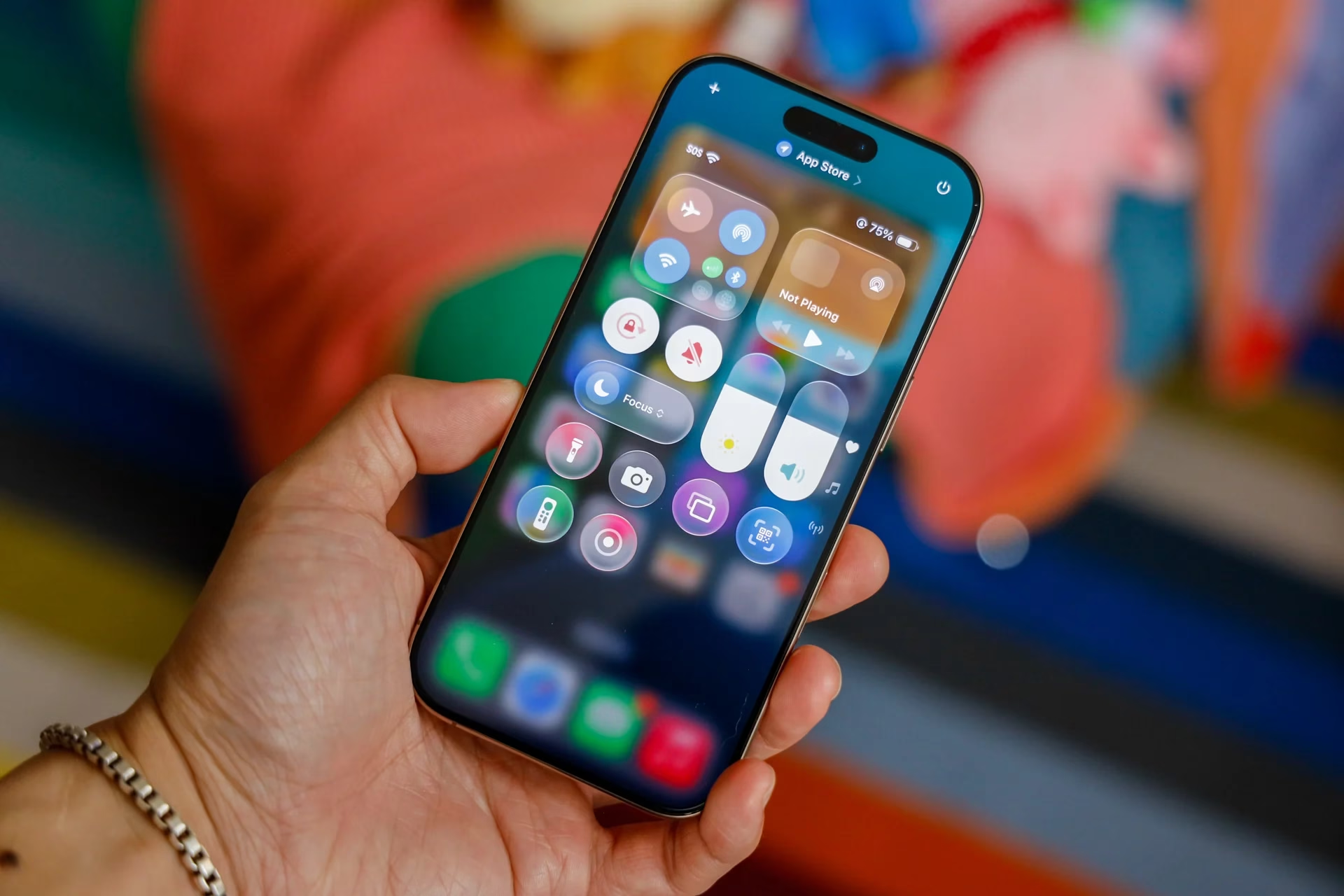
Meta is hiring the brains behind Liquid Glass to design smart glasses, headsets, and software
Meta’s Design Coup: How Alan Dye’s Hire Signals a New Era for AI‑Enabled Wearables in 2025 In early December, Meta announced that former Apple UI chief Alan Dye , the mind behind “Liquid Glass,” will...
Meta’s Design Coup: How Alan Dye’s Hire Signals a New Era for AI‑Enabled Wearables in 2025
In early December, Meta announced that former Apple UI chief
Alan Dye
, the mind behind “Liquid Glass,” will head a brand‑new Reality Labs design studio. The move is more than a headline; it represents a strategic pivot where design, AI, and hardware converge to create a unified consumer experience across Ray‑Ban Meta, Oakley Meta, Quest, and future headsets. For software developers, DevOps engineers, and technical managers, the implications touch product roadmaps, infrastructure choices, and revenue models.
Executive Snapshot
- Design Leadership as Competitive Moat: Meta treats UI/UX as a core differentiator, not an afterthought.
- AI‑First Interaction Layer: “Intelligence” will become a design material, embedding context‑aware overlays and voice controls from the earliest prototype stage.
- Unified OS & SDK: A lightweight, Meta‑AI‑optimized operating system is likely to emerge, streamlining cross‑product development.
- Business Impact: Faster time‑to‑market, higher user retention, and new AI‑driven services (AR shopping, real‑time translation) unlock fresh revenue streams.
- Strategic Timing: The hire arrives as Google XR and Samsung push headsets into the $1,200–$1,500 price bracket, intensifying competition.
Design as a Strategic Asset in 2025
Meta’s hiring of Dye signals a shift from hardware‑centric to design‑centric thinking. Historically, Meta’s Reality Labs have focused on sensor stacks and processing power. Now, the company is positioning
human interface
at the heart of its wearable strategy.
- Apple’s Legacy: Dye steered Apple’s “Liquid Glass” in 2014—an elegant fusion of transparency and depth that set a new aesthetic standard for smart glasses. Meta plans to replicate this fluidity with AI‑enhanced overlays.
- Design–AI Symbiosis: By treating AI as a material, designers can prototype experiences where the interface adapts in real time—e.g., contextually displaying navigation cues or translating foreign text on the fly.
- Cross‑Product Cohesion: A single design language across Ray‑Ban Meta, Oakley Meta, and Quest ensures brand consistency, reducing fragmentation that has plagued competitors like Google XR.
Technical Integration: From UI to Edge AI
The studio’s mandate extends beyond visual polish; it must embed AI logic directly into the hardware stack. Here’s how developers should anticipate changes:
- Modular, Micro‑Kernel OS: Meta will likely adopt a lightweight kernel that supports rapid OTA updates for AI models without full firmware overhauls. This mirrors trends in edge computing where latency is critical.
- On‑Device Inference: To deliver real‑time AR overlays, the headset will need low‑power inference chips—think NVIDIA Jetson Nano‑style or custom silicon optimized for Meta’s LLaMA 3.5 and Gemini 1.5 models.
- Data Pipelines & Privacy: The design studio must collaborate with data engineering teams to ensure that sensor streams (vision, audio, inertial) are processed locally when possible, with minimal cloud touchpoints to satisfy EU AI Act constraints.
- SDK for Third‑Party Apps: A unified SDK will allow developers to build AR experiences that tap into Meta’s AI services—contextual translation, gesture recognition, and personalized content—all while adhering to the new UI guidelines.
Business Implications for Product Teams
For technical managers steering product roadmaps, Dye’s arrival reshapes priorities:
- Feature Roadmap Alignment: AI‑driven features (e.g., real‑time language translation, smart notifications) should be front‑loaded in the next firmware release cycle to capitalize on Meta’s design advantage.
- Cost Structure Optimization: A unified OS reduces duplicated engineering effort across product lines, lowering per‑unit development costs by an estimated 15–20%.
- Monetization Opportunities: AI services—AR shopping assistants, contextual advertising, and health monitoring—can be bundled as subscription tiers, increasing recurring revenue.
- Competitive Positioning: With Google XR’s $1,500 headsets and Samsung’s $1,200 glasses, Meta can target the premium segment ($3,500 Ray‑Ban Meta) by offering superior UX and AI features that justify the price point.
ROI Projections for Engineering Investments
Quantifying the financial upside requires a multi‑stage analysis:
- Development Savings: A shared design system reduces UI duplication across devices. Assuming each product line saves 200 person‑months annually, and an average engineer cost is $150k per month, that’s a $30M annual saving.
- Revenue Upsell: If AI services convert 5% of the existing Ray‑Ban Meta user base (≈1.2M users) into a $9/month subscription, annual incremental revenue reaches $108M.
- Market Share Gains: A differentiated UX could capture an additional 3% market share in the smart glasses segment—estimated to be worth $2B annually—translating to $60M in incremental sales.
- Total Addressable Impact: Combining development savings, subscription revenue, and market share gains suggests a net benefit of approximately $198M over three years.
Implementation Roadmap for Engineering Teams
To align with Meta’s new studio, technical leaders should adopt the following phased approach:
- Audit Current Stack: Map existing hardware drivers, OS layers, and AI inference pipelines. Identify components that can be modularized.
- Define Design Tokens: Collaborate with Dye’s team to establish a shared set of UI primitives (color palettes, typography, spatial layouts) that map to AI states.
- Build Edge AI Modules: Prototype lightweight inference models for core use cases—gesture recognition, speech-to-text, and environmental understanding—using Meta’s LLaMA 3.5 embeddings.
- Integrate with Unified SDK: Expose AI services through a well‑documented API layer that abstracts underlying hardware differences.
- Test & Iterate in Real Environments: Conduct field trials across Ray‑Ban, Oakley, and Quest prototypes to validate latency targets ( < 50 ms for AR overlays).
- Deploy OTA Updates: Establish a secure over‑the‑air channel that supports incremental model updates without full firmware flashes.
Risk Management & Mitigation Strategies
While the strategic upside is clear, several risks warrant attention:
- Privacy Compliance: Edge AI reduces data sent to the cloud but still requires local processing of sensitive sensor streams. Implement robust on‑device encryption and anonymization pipelines.
- Hardware Constraints: Low‑power inference chips may limit model complexity. Adopt model distillation techniques to keep latency within target ranges.
- Design Lock‑In: A unified design system could stifle innovation if not modular enough. Allow for “design extensions” that enable third‑party developers to introduce new interaction paradigms.
- Supply Chain Bottlenecks: High‑end display and sensor components may face shortages. Diversify suppliers and consider hybrid optical designs (e.g., combining LCOS with OLED panels) to mitigate risk.
Broader Market Context in 2025
The Meta move is part of a larger industry trend where AI becomes the linchpin for consumer adoption:
- AI as the “Killer App”: Reports from CBS News and industry analysts confirm that companies like Alibaba, Amazon, and Meta are banking on AI to drive wearable uptake.
- Fashion‑Tech Convergence: Partnerships with Ray‑Ban and Oakley illustrate a shift toward wearables that double as fashion statements—critical for mainstream acceptance.
- Edge Computing Momentum: The push for low‑latency, on‑device AI mirrors developments in autonomous vehicles and industrial IoT, reinforcing the need for efficient inference hardware.
- Regulatory Landscape: The EU AI Act’s emphasis on transparency and data minimization will shape how Meta structures its data pipelines and user consent mechanisms.
Strategic Recommendations for Decision Makers
To capitalize on this momentum, executives should consider the following actions:
- Invest Early in Design‑AI Integration: Allocate budget to hire UI/UX experts who can collaborate with AI teams from day one.
- Prioritize Edge AI Capabilities: Secure partnerships with silicon vendors that specialize in low‑power inference, ensuring competitive performance.
- Create a Unified Development Ecosystem: Standardize SDKs and testing frameworks across product lines to reduce time‑to‑market.
- Plan for Monetization Layers: Develop subscription models around AI services (AR shopping, health insights) and integrate them into the user experience seamlessly.
- Monitor Regulatory Changes: Establish a compliance task force to stay ahead of data privacy requirements in key markets.
Conclusion: Design‑First AI Wearables as a New Business Engine
Alan Dye’s appointment marks the beginning of Meta’s ambition to make design and AI inseparable. For software and systems leaders, this means rethinking product architecture around an AI‑first UI, building lightweight edge inference pipelines, and aligning business models with new monetization opportunities. As competitors accelerate their own hardware and software stacks, the companies that embed intelligence directly into the user interface—starting with Meta’s unified design studio—will likely set the standard for 2025 and beyond.
Key Takeaways
- Meta treats design as a strategic moat, hiring a top Apple UI architect to lead a new Reality Labs studio.
- A lightweight, AI‑optimized OS will unify Ray‑Ban Meta, Oakley Meta, Quest, and future headsets.
- Edge inference chips and modular SDKs are essential for real‑time AR overlays and context‑aware interactions.
- Projected ROI exceeds $190M over three years through development savings, subscription revenue, and market share gains.
- Decision makers should prioritize design‑AI integration, edge AI partnerships, unified ecosystems, and proactive regulatory compliance to stay ahead in the competitive wearable landscape.
Related Articles

World models could unlock the next revolution in artificial intelligence
Discover how world models are reshaping enterprise AI in 2026—boosting efficiency, revenue, and compliance through proactive simulation and physics‑aware reasoning.

China just 'months' behind U.S. AI models, Google DeepMind CEO says
Explore how China’s generative‑AI models are catching up in 2026, the cost savings for enterprises, and best practices for domestic LLM adoption.

AI chip unicorns Etched.ai and Cerebras Systems get big funding boost to target Nvidia
Explore how AI inference silicon from Etched.ai and Cerebras is driving new capital flows, wafer‑scale performance, and strategic advantages for enterprises in 2026.