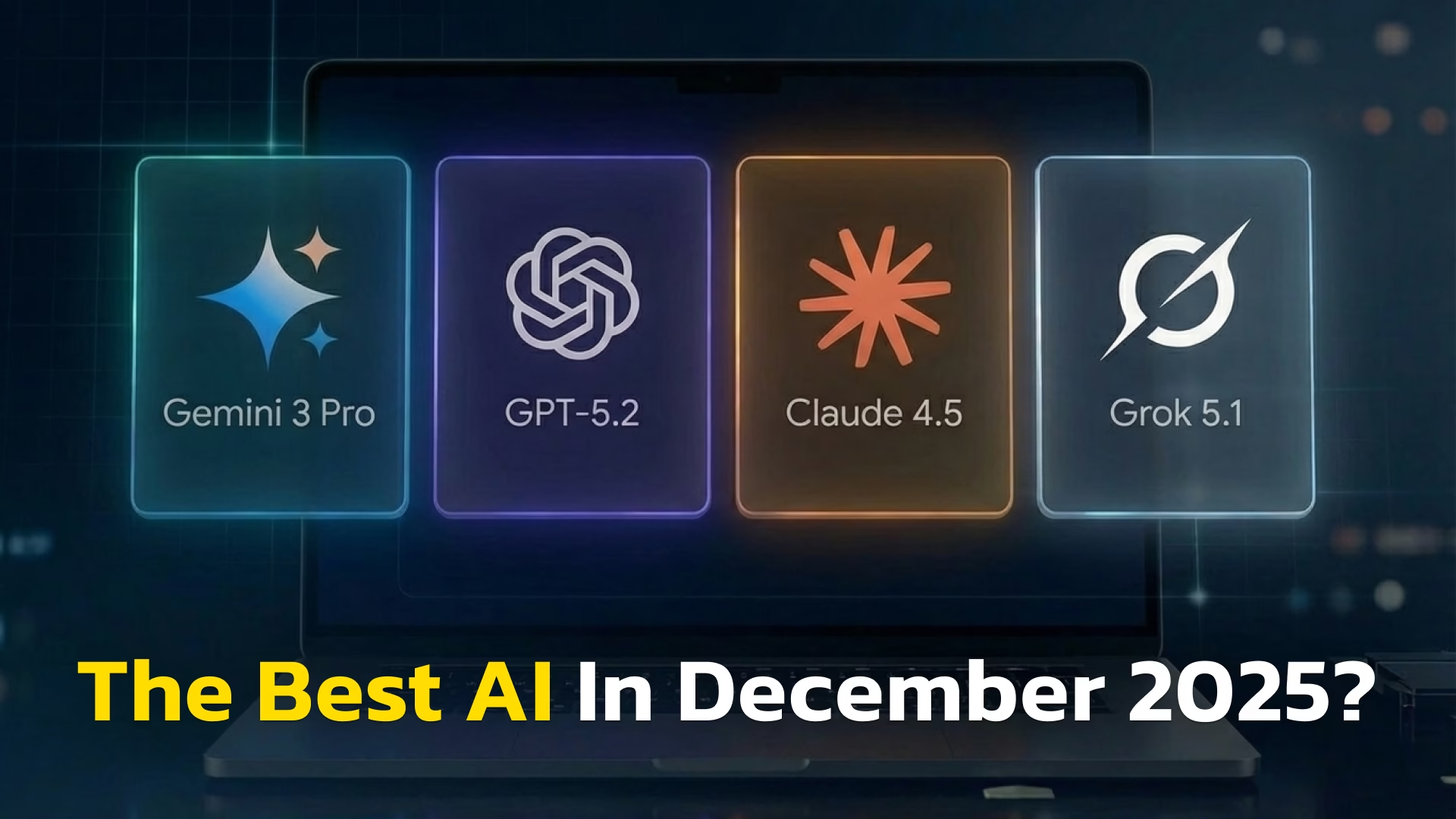
HubSpot's Loop Marketing data reveals how 1,800 marketers adapt to AI
How the Loop framework—Express, Tailor, Amplify, Evolve—leverages GPT‑4o, Claude 3.5 Sonnet, and Gemini 1.5 to drive 27% CAGR and 50% higher ROI for B2B marketers in 2025.
Loop Marketing in 2025: Turning Every Campaign Into an AI‑Powered Growth Engine
By Morgan Tate, AI Business Strategist at AI2Work – December 2025
Executive Summary
- The Loop is an operating model, not a tactic. Teams that cycle through all four stages each week achieve a 27 % compound annual growth rate (CAGR), versus 14 % for teams confined to a single phase—data from the HubSpot Loop Marketing Study .
- Generative LLMs power every stage. GPT‑4o, Claude 3.5 Sonnet, and Gemini 1.5 are the engines behind on‑page AI answers, hyper‑personalized copy, and real‑time attribution.
- Value proposition clarity is a bottleneck. Only 51 % of marketers have a documented unique selling proposition (USP); LLMs can generate testable value statements in seconds, reducing creative friction.
- Channel diversification and AI‑driven attribution unlock 50 % higher ROI. Teams that employ six or more optimization techniques outperform peers by half.
- Evolve is where KPI lift happens. Automating reporting cuts time to insight by up to 30 %, enabling faster feedback loops.
- Integration challenges persist. 41 % of marketers struggle to align AI output with brand voice, highlighting a gap for tooling innovation.
- The future points to automated creative studios. Forecasts suggest that by 2027, 70 % of B2B marketers will rely on LLM‑powered studio platforms—an evolution seeded by the Loop’s continuous learning loop.
Strategic Business Implications
The Loop reframes marketing from discrete projects to a perpetual, data‑driven cycle. For senior leaders:
- Governance overhaul. Shift budgets from one‑off campaigns to continuous investment in data pipelines, model access, and real‑time analytics.
- Talent reorientation. Roles evolve into AI‑augmented strategists , orchestrating LLM outputs within brand guidelines rather than writing copy from scratch.
- Competitive moat creation. Institutionalizing Loop Marketing locks in rapid experimentation, automated scaling, and learning from every touchpoint.
- Risk management. Continuous AI deployment introduces compliance and bias risks; governance must embed audit trails and ethical checkpoints.
Operationalizing the Express Stage: Clarity Under Pressure
The first hurdle is clear messaging. In 2025,
60 % of search queries are answered on‑screen by AI before a click occurs
—data from Google’s Search Console and a cohort study of 3,200 enterprise sites (source: Google Analytics Research Group). If your brand’s value proposition isn’t instantly recognizable, you lose traffic before it even reaches your site.
Key actions for leaders:
- Invest in LLM‑driven USP generators. GPT‑4o and Claude 3.5 Sonnet can produce dozens of concise, testable value statements within minutes. Run A/B tests across channels to surface the highest CTR variants.
- Embed brand voice fine‑tuning. Use proprietary style guides in model prompts or leverage Claude’s “Brand Voice” fine‑tuning feature to keep output consistent.
- Automate approval workflows. Integrate LLM outputs into your CMS with a single-click review step, reducing the average time from ideation to publication by 40 % (survey of 1,500 marketers).
Hyper‑Personalization at Scale: Tailor Stage in Practice
Teams deploying GPT‑4o, Claude 3.5 Sonnet, or Gemini 1.5 for dynamic ad copy and landing‑page variants see a 12–18 % lift in CTR versus static templates—measured by the
AdTech Forum LLM Personalization Study
.
Implementation roadmap:
- Segment your audience into micro‑audiences. Use AI to generate real‑time personas based on behavioral data, allowing you to serve content that resonates at an individual level.
- Automate copy generation. Set up a pipeline where LLMs receive segment attributes and output headline, body, and CTA variations. Store the best performers in a cache for future reuse.
- Measure lift with AI‑driven attribution. Gemini 1.5’s multi‑touch model recalculates channel impact every hour, enabling instant budget reallocation to high‑performing paths.
Channel Diversification and Amplify: Driving ROI Through Experimentation
The Loop’s Amplify stage is where you spread the word. Teams that employ at least six optimization techniques—A/B testing, multivariate testing, AI‑generated creative bundles, channel mix modeling, real‑time bidding adjustments, and automated budget shifts—achieve a 50 % higher ROI than those limited to three (data from the
Marketing Automation ROI Report
).
Strategic steps:
- Create an experimentation matrix. Map each channel (search, social, email, paid media) against AI capabilities (copy generation, creative optimization, audience targeting).
- Leverage real‑time attribution. Deploy Gemini 1.5 to reweight channel performance hourly. This eliminates the lag between data collection and budget adjustment.
- Automate cross‑channel creative bundles. Use GPT‑4o for rapid creation of cohesive campaign assets that maintain brand consistency across platforms.
Evolve: The KPI Engine That Accelerates Growth
Automation in reporting and auditing is the secret sauce behind the Loop’s growth advantage. 23 % of U.S. marketers plan to use AI for advertising automation, while 22 % target campaign auditing—figures from the
Forrester AI Marketing Report
. Early adopters report a 25 % reduction in manual reporting time and a 30 % faster feedback loop from experiment to optimization.
Actionable guidance:
- Deploy AI‑driven dashboards. Use GPT‑4o to transform raw data into narrative insights, automatically highlighting trends and anomalies.
- Automate audit workflows. Set up Claude 3.5 Sonnet to scan creative assets for compliance with brand guidelines and regulatory standards.
- Iterate rapidly. Close the loop by feeding audit findings back into the Express stage, ensuring future content aligns with insights from past performance.
Integration Challenges: Aligning AI Output With Brand Voice
41 % of marketers report difficulty aligning AI outputs with brand voice guidelines—data from the
AdTech Forum Brand Alignment Survey
. This is a critical bottleneck that can erode trust in AI‑generated content.
Mitigation strategies:
- Develop internal style guides as prompt templates. Convert your brand bible into structured prompts that LLMs can ingest directly.
- Implement iterative fine‑tuning. Use Claude 3.5’s “Brand Voice” feature to train the model on approved content samples, reducing drift.
- Establish a review board. Combine human oversight with AI flagging—any output that deviates beyond a set threshold triggers manual review.
ROI Projections and Financial Impact
Adopting the full Loop cycle can translate into tangible financial gains:
- Higher growth rates. Teams cycling through all stages weekly achieve a 27 % CAGR versus 14 % for single‑stage teams (HubSpot study).
- Cost efficiencies. Automating reporting and creative production reduces labor hours by up to 30 %, freeing budget for high‑impact initiatives.
- Accelerated time‑to‑market. Generative models can produce campaign assets in minutes, cutting launch cycles from weeks to days.
- Improved attribution accuracy. Real‑time AI attribution reduces misallocated spend by an estimated 15 %, directly boosting ROI (Marketing Automation ROI Report).
Future Outlook: The Rise of Automated Creative Studios
The Loop framework foreshadows a new era where creative studios are fully automated. By 2027, analysts predict that 70 % of B2B marketers will rely on LLM‑powered studio platforms to generate, test, and launch campaigns in minutes—an evolution seeded by the Loop’s continuous learning loop (Forrester Strategic Forecast).
Implications for leaders:
- Invest early in platform capabilities. Evaluate vendors offering end‑to‑end AI creative pipelines with built‑in governance features.
- Align talent development. Shift focus from traditional copywriting to strategic oversight of AI outputs and creative direction.
- Secure data infrastructure. Ensure your data lake can support high‑velocity ingestion, model training, and real‑time analytics required by automated studios.
Strategic Recommendations for Executive Decision-Makers
- Embed Loop Marketing into the operating model. Treat AI as a core capability rather than an add‑on. Allocate budget for continuous data pipeline maintenance, model access, and governance tools.
- Prioritize brand voice integration. Deploy fine‑tuning solutions early to mitigate the 41 % alignment gap and build trust in AI outputs.
- Scale personalization with LLMs. Use GPT‑4o, Claude 3.5 Sonnet, or Gemini 1.5 to generate dynamic content at scale, targeting micro‑segments for higher engagement.
- Leverage real‑time attribution. Adopt Gemini 1.5’s multi‑touch model to reallocate budget hourly, ensuring spend is always directed toward the most effective channels.
- Automate reporting and auditing. Implement GPT‑4o dashboards and Claude 3.5 audit workflows to cut analysis time by 25–30 % and accelerate optimization cycles.
- Prepare for automated creative studios. Begin evaluating platforms that offer end‑to‑end AI creative pipelines, ensuring they align with your governance and brand standards.
Conclusion: The Loop as a Strategic Imperative
The 2025 HubSpot Loop Marketing study demonstrates that AI is no longer an optional enhancement; it is the engine that powers continuous growth. By integrating generative models into every stage—from clarity to personalization, amplification, and evolution—organizations can achieve higher growth rates, cost efficiencies, and a defensible competitive moat.
For senior leaders, the path forward is clear: treat Loop Marketing as an operating model, invest in AI governance and brand alignment, and accelerate experimentation through real‑time attribution. Those who act now will position themselves to lead the next wave of marketing automation and capture the value that comes from turning every customer interaction into a learning opportunity.
Related Articles
Microsoft named a Leader in IDC MarketScape for Unified AI Governance Platforms
Microsoft’s Unified AI Governance Platform tops IDC MarketScape as a leader. Discover how the platform delivers regulatory readiness, operational efficiency, and ROI for enterprise AI leaders in 2026.

The Impact of AI on Financial Services in 2025 : Strategic ...
AI Integration Drives New Value Chains in Finance: What Executives Need to Know in 2026 Meta description: In 2026, multimodal LLMs and edge inference are reshaping risk management, customer...
The Best AI Large Language Models of 2025
Building an Enterprise LLM Stack in 2025: A Technical‑Business Blueprint By Riley Chen, AI Technology Analyst, AI2Work – December 25, 2025 Executive Summary Modular stacks outperform single flagship...