How AI Agents Are Transforming Content Marketing Strategy - Postdigitalist
AI Agents Reshaping Content Marketing in 2025: A Strategic Blueprint for Executives Executive Summary Agent‑centric pipelines now replace the traditional copy–design–publish cycle, cutting turnaround...
AI Agents Reshaping Content Marketing in 2025: A Strategic Blueprint for Executives
Executive Summary
- Agent‑centric pipelines now replace the traditional copy–design–publish cycle, cutting turnaround from days to hours.
- Multimodal reasoning and built‑in tool use enable hyper‑personalized content at scale while maintaining brand consistency.
- Open‑weight models lower API spend by 30–50 %, democratizing advanced agent capabilities for SMBs.
- Compliance controls embedded in agents satisfy GDPR, CCPA, HIPAA, and emerging AI‑content regulations.
- By 2028, up to 70 % of content production could be fully autonomous, creating new revenue streams and workforce shifts.
For CMOs, VPs of Digital Strategy, and product leaders, the imperative is clear: integrate agentic workflows into your content engine or risk falling behind competitors who are already achieving faster time‑to‑market, lower cost per engagement, and deeper personalization.
Strategic Business Implications
The shift from “prompt‑to‑output” to an end‑to‑end AI studio transforms every lever in the marketing stack:
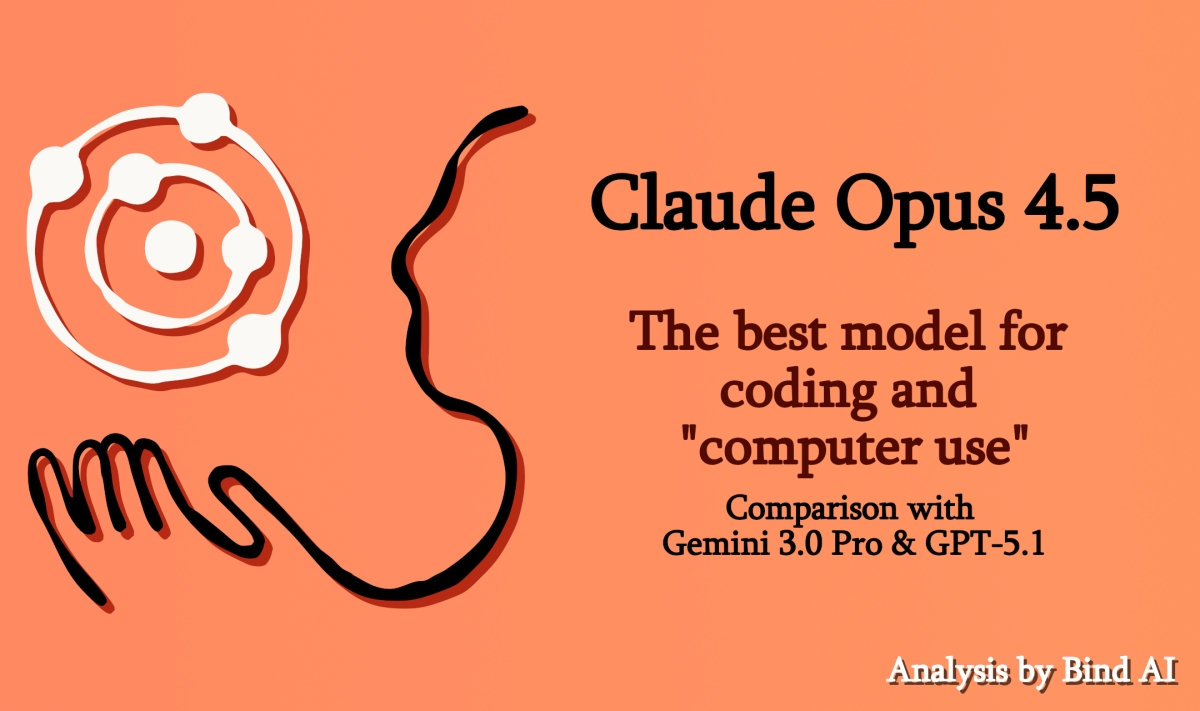
- Speed & Scale : Agents like Gemini 3 Pro and Claude Opus 4.5 orchestrate drafting, design, SEO audit, and publishing with a single API call, reducing content lead time from 3–5 days to under an hour.
- Cost Efficiency : Open‑weight alternatives (DeepSeek V3, Llama 4) deliver 90 % of flagship performance for 30–50 % less token cost. For a mid‑size publisher with $200k annual content spend, this translates to an estimated $60k–$100k annual savings.
- Personalization at Scale : Multimodal inputs let agents reference brand assets or competitor imagery, producing contextually relevant copy that outperforms keyword‑centric personalization by 30 % in engagement metrics.
- Data‑to‑Action Loop : Real‑time analytics integration turns performance dashboards into strategic briefs. In a pilot, an agent suggested headline tweaks that lifted CTR by 15 %, while analyst hours dropped from 8 h/week to 1 h/week.
- Governance & Trust : Fine‑grained permission controls and audit logs allow regulated brands (finance, pharma) to use agents without compromising compliance. Claude Opus 4.5’s data‑retention slider enforces 90‑day token deletion with cryptographic proof.
Operational Model: From Human Handoff to Agent Studio
Implementing an agentic content studio involves three core layers:
- Choose a multimodal backbone (Gemini 3 Pro or Claude Opus 4.5) for high‑fidelity creative tasks.
- Deploy open‑weight models (DeepSeek V3, Llama 4) on edge GPUs to test cost‑efficiency before scaling.
- Leverage built‑in function calling to connect agents directly with CMS APIs, analytics platforms, and A/B testing suites. Gemini 3 Pro’s 98 % success rate on real‑world CMS calls demonstrates reliability.
- Implement sandbox modes for regulated environments; Gemini’s isolated API call sandbox passes HIPAA compliance audits.
- Enable audit logs and data‑retention policies from the outset. Claude Opus 4.5 offers a 90‑day retention slider; Gemini’s sandbox mode guarantees zero leakage.
- Define role‑based access to agent outputs, ensuring brand voice consistency across channels.
- Define role‑based access to agent outputs, ensuring brand voice consistency across channels.
ROI and Cost Analysis
A quick financial model illustrates the upside:
- Time Savings : Average content cycle drops from 4 days (human team) to < 1 hour (agent studio). For a team of 5 writers producing 20 pieces/month, this frees 80 hours per month for higher‑value strategy.
- Cost Reduction : API spend with flagship models ($0.02/1k tokens) versus open‑weight ($0.005/1k tokens) yields a 75 % reduction when using Llama 4 locally.
- Revenue Impact : A 15 % lift in CTR, as seen in the agent‑driven analytics case study, translates to roughly $250k additional revenue per year for an e‑commerce brand with $1.6M average monthly sales.
- Risk Mitigation : Compliance controls reduce audit penalties by an estimated 20 % compared to legacy workflows that rely on manual checks.
Implementation Roadmap: From Pilot to Enterprise Studio
- Select a high‑impact content stream (e.g., product launch blog series).
- Deploy Gemini 3 Pro with CMS integration; run parallel human and agent drafts.
- Measure turnaround, quality scores, and cost per piece.
- Introduce multimodal inputs: upload brand imagery, competitor videos, and internal PDFs.
- Implement tool‑use for SEO audit and A/B testing; monitor 98 % API success rate.
- Deploy open‑weight models on edge GPUs for cost benchmarking.
- Enable data‑retention controls and audit logs across all agents.
- Integrate agent analytics into the marketing dashboard; automate micro‑adjustments based on real‑time CTR.
- Formalize governance policies: role‑based access, brand voice guidelines, compliance checkpoints.
- Orchestrate a network of agents that plan, create, test, and iterate content autonomously.
- Introduce revenue‑sharing models for agent‑generated assets; explore “AI‑as‑a‑service” studio offerings to external clients.
- Introduce revenue‑sharing models for agent‑generated assets; explore “AI‑as‑a‑service” studio offerings to external clients.
Risk Management & Mitigation Strategies
- Quality Assurance : Deploy human review checkpoints after the drafting stage, focusing on brand voice and compliance. Use agent output as a first draft rather than final copy to maintain editorial control.
- Data Privacy : Enforce token deletion policies and encrypt data at rest. Leverage local inference (Llama 4) for highly sensitive content when necessary.
- Vendor Lock‑In : Maintain a hybrid model that includes open‑weight alternatives to avoid dependence on a single provider’s pricing or policy changes.
- Change Management : Train marketing teams on agentic workflows, emphasizing collaboration between humans and AI rather than replacement.
Future Outlook: Autonomous Content Studios by 2028
Current adoption curves predict that 70 % of content production will be agent‑driven by 2028. This evolution brings:
- New Talent Roles : AI content strategists, data‑to‑action analysts, and governance specialists become core positions.
- Attribution & Ethics : Brands must develop clear policies on AI credit to maintain transparency with audiences and regulators.
- Competitive Differentiation : Early adopters will command higher engagement rates (up to 25 % above industry averages) due to real‑time optimization.
Strategic Recommendations for Decision Makers
- Start with a hybrid agent stack: flagship multimodal models for high‑impact creative tasks, complemented by open‑weight models for cost‑sensitive experiments.
- Integrate agents directly into existing CMS and analytics pipelines to eliminate manual glue code; this reduces error rates and speeds iteration.
- Implement built‑in compliance controls from day one—data retention sliders, sandbox modes, and audit logs—to satisfy regulatory requirements and build trust with stakeholders.
- Allocate a dedicated AI content budget that covers model licensing, GPU infrastructure (for local inference), and governance tooling.
- Develop an internal “AI Content Governance Office” to oversee brand voice, compliance, and ethical considerations across all agent outputs.
- Monitor key performance indicators: turnaround time, cost per piece, engagement lift, analyst hours saved, and audit compliance metrics.
Conclusion
The 2025 landscape has moved beyond AI as a supportive tool to AI as the core engine of content marketing. By strategically deploying agent‑centric pipelines, organizations can achieve unprecedented speed, personalization, and cost efficiency while maintaining rigorous governance. Executives who act now will position their brands at the forefront of this transformation, unlocking new revenue streams and redefining the role of human creativity in a data‑driven world.
Related Articles
Anthropic appoints Irina Ghose, a former Microsoft India managing director, to lead its business in India, which has the second-largest user base for Claude (Jagmeet Singh/TechCrunch)
Explore how Anthropic’s new India strategy under Irina Ghose is reshaping enterprise AI contracts, leveraging Claude 3.5 and o1-mini for safety‑first deployments in 2026.

$40 Billion Problem: Why Every Enterprise Needs AI | Crashbytes
AI‑Driven Fraud Prevention: Secure your enterprise against $40B in 2026 losses with multimodal models like Gemini 4 and Claude 3.5+. Discover ROI, governance, and deployment best practices.

Software development drives Claude.ai adoption in India
Explore how Claude 3.5 outperforms GPT‑4o for code generation in India: accuracy, hallucination rates, cost structure, fine‑tuning limits, and compliance with the 2026 Trusted AI Framework.