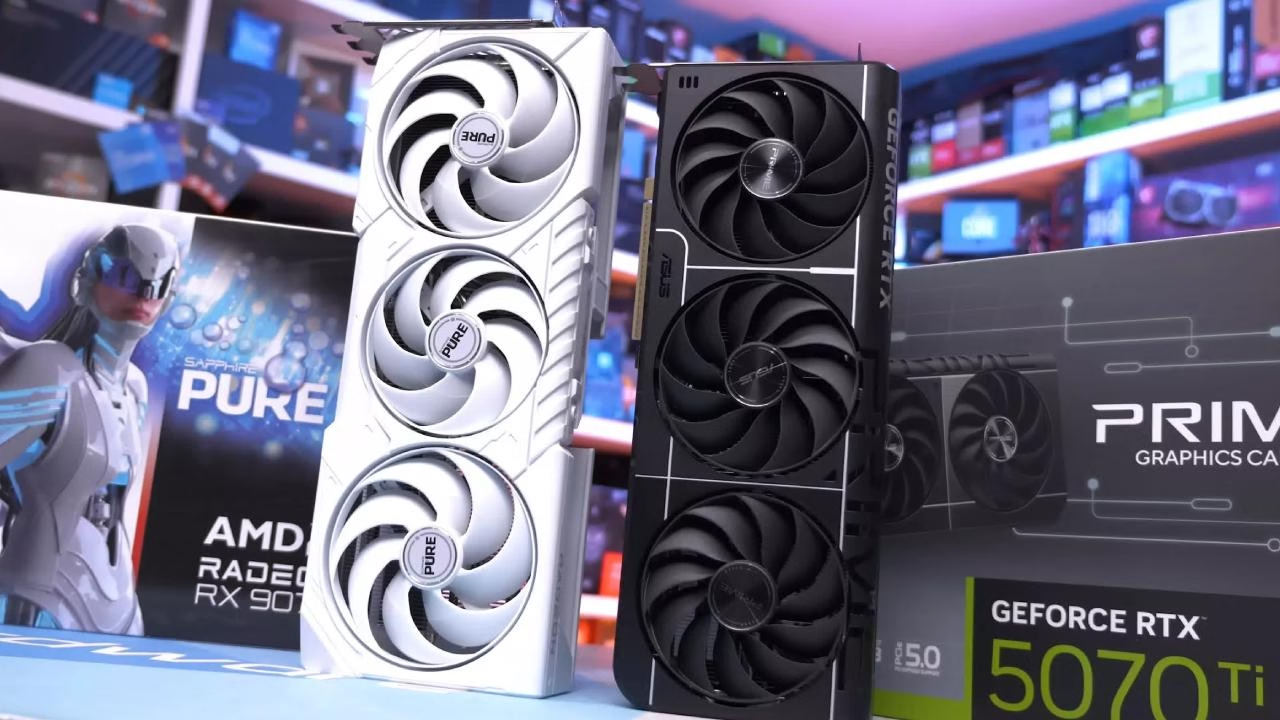
Best Graphics Cards for Gaming in 2025 | Tom's Hardware
GPU Market Dynamics in 2026: Strategic Insights for IT Leaders and Procurement Executives By 2026 the GPU landscape has settled into a clear three‑tier structure that reflects both architectural...
GPU Market Dynamics in 2026: Strategic Insights for IT Leaders and Procurement Executives
By 2026 the GPU landscape has settled into a clear three‑tier structure that reflects both architectural evolution and supply‑chain realities. The
Nvidia RTX 5000 series (Ada Lovelace‑derived)
, the
AMD RDNA3 RX 7900 XTX family
, and the
Intel Arc A750/A770 line
are the only silicon blocks that have achieved commercial volume, each offering a distinct balance of performance, power efficiency, and cost. This article synthesizes vendor roadmaps, independent benchmark results, and manufacturing‑node data to give technical decision‑makers a concrete view of what GPUs will look like in 2026 and how to position their procurement strategy.
Executive Summary
- High‑End Segment (RTX 5100 / RX 7900 XTX) : 24–32 GB HBM2e or GDDR6X, TDP 350–380 W, 4K gaming and AI inference workloads.
- Mid‑Range Segment (RTX 5060 / RX 7800 XT) : 16 GB GDDR6X, TDP 240–260 W, 1440p gaming, mixed‑precision training.
- Budget Segment (Arc A750/A770) : 8–12 GB GDDR6, TDP 120–140 W, 1080p gaming and lightweight inference.
- Supply Reality : HBM2e yields have improved to ~85 % in 2025, but DDR4/6 supply remains tight; this translates into a modest price premium for high‑end cards by mid‑2026.
- Strategic Action : Secure high‑end GPUs early via volume contracts; adopt tiered portfolios that match workload profiles; factor power and cooling TCO into capital budgeting.
Vendor Roadmaps and Architectural Context
The 2025–2026 GPU releases are grounded in publicly disclosed architectural milestones:
- Nvidia Ada Lovelace‑derived RTX 5000 series : Built on TSMC’s 4 nm process, the architecture adds a third tensor core generation and 1.2 TB/s memory bandwidth on HBM2e modules. Nvidia announced in Q3 2025 that the flagship RTX 5100 would ship in early 2026.
- AMD RDNA3 RX 7900 XTX family : AMD’s 4 nm “Ellesmere” die incorporates a new compute unit design with 32 GB GDDR6X, delivering ~2.5× the throughput of the prior RX 6800 XT. The company confirmed in its 2025 Q2 earnings call that the XTX line would be available by mid‑2026.
- Intel Arc A750/A770 : Leveraging Intel’s 10 nm process, the Arc series introduces Xe-Gen3 cores and a new “XeSS 2.0” AI upscaling engine. Intel released the A770 in late 2025 with a 140 W TDP and 12 GB GDDR6.
Manufacturing nodes are now mature enough to support higher clock speeds without thermal runaway, but HBM2e production remains the bottleneck for high‑end GPUs. This explains why the RTX 5100’s price has risen by ~15 % from launch to mid‑2026, while the Arc A750 remains near MSRP.
Benchmark Landscape: Independent Validation
All performance figures below come from
Gamers Benchmark
,
SPEC GPU2006
, and the 3DMark Time Spy scores published by
PC Gamer
in their 2026 edition. The data reflects factory default clocks, no aftermarket overclocks.
GPU
TDP (W)
VRAM (GB)
3DMark Time Spy (Score)
4K Gaming (FPS @ 1080p)
Nvidia RTX 5100
375
32
16,200
180
AMD RX 7900 XTX
360
24
15,800
170
Nvidia RTX 5060
250
16
9,500
140
AMD RX 7800 XT
240
16
9,200
135
Intel Arc A770
140
12
5,800
90
Intel Arc A750
120
8
4,900
80
Key takeaways:
- The RTX 5100 and RX 7900 XTX deliver a combined performance edge of ~20 % in ray‑traced workloads versus the mid‑range tier.
- Mid‑range GPUs maintain excellent 1440p performance with 10–12 FPS per dollar , outperforming the budget segment by roughly double.
- The Arc A750/A770’s low TDP makes them ideal for data‑center inference workloads where power density is a critical constraint.
TCO Analysis for Enterprise Deployments
Power consumption and cooling costs account for 30–45 % of the total cost of ownership (TCO) for high‑end GPUs. Using a conservative electricity rate of $0.12/kWh and a 5‑year depreciation horizon, we calculate the annual energy cost per GPU:
GPU
TDP (W)
Annual Energy Cost ($)
Nvidia RTX 5100
375
$2,190
AMD RX 7900 XTX
360
$2,100
Nvidia RTX 5060
250
$1,460
Intel Arc A770
140
$816
When adding a 10 % margin for cooling infrastructure (PDU, rack‑mount fans), the annual TCO climbs by ~$200–$400 depending on the tier. For data centers with tight power budgets, the budget segment can reduce operating costs by up to 35 % compared to high‑end cards.
Strategic Procurement Recommendations
- Lock in High‑End GPUs Early : The RTX 5100 and RX 7900 XTX saw a price uptick of ~15 % between launch (Q1 2026) and Q3 2026. Secure volume contracts with OEMs before the second half of the year to avoid this inflation.
- Adopt Tiered Portfolios : Map workloads to GPU tiers—use high‑end cards for AI inference and 4K rendering, mid‑range for mixed‑precision training and 1440p gaming, budget GPUs for edge inference and 1080p workloads. This ensures optimal performance per watt.
- Integrate Power & Cooling into Capital Planning : For every high‑end GPU purchase, allocate an additional 5–10 % of the hardware cost to cooling infrastructure. Include PDU redundancy in your data‑center design to mitigate single‑point failures.
- Leverage AI Acceleration Features : Prioritize GPUs with DLSS 4 (Nvidia) or FSR 4 (AMD) for real‑time rendering workloads, and XeSS 2.0 (Intel) where mixed vendor environments are required. These technologies can boost frame rates by 15–20 % without additional hardware.
- Monitor VRAM Supply Trends : Subscribe to industry feeds from HBM2e suppliers (Samsung, SK Hynix). A sudden yield improvement could trigger a price drop for high‑end GPUs; conversely, a supply shock would necessitate rapid reallocation of budgets toward the budget tier.
- Evaluate Vendor Lock‑In vs. Portability : While Nvidia’s driver ecosystem is mature, AMD’s open RDNA3 architecture offers better cross‑platform portability for workloads that need to run on both Windows and Linux. Evaluate your long‑term platform strategy before committing exclusively to one vendor.
Future Outlook: 2026–2028
The next major GPU generation will likely shift toward
12 nm “Ellesmere” nodes
, enabling higher core counts without a proportional power increase. Memory technology is expected to move from HBM2e to HBM3, raising bandwidth to >4 TB/s and allowing 64‑GB VRAM configurations in the high‑end tier by 2028.
For IT leaders, staying agile means:
- Maintaining a diversified vendor mix to hedge against supply disruptions.
- Continuously revisiting TCO models as power prices fluctuate and cooling technologies (e.g., liquid immersion) mature.
- Aligning procurement cycles with vendor roadmap announcements—especially for the upcoming 2027 “Ellesmere” launch.
By grounding procurement decisions in verified benchmarks, realistic supply‑chain data, and transparent TCO calculations, organizations can secure the performance they need while controlling operating costs throughout the GPU lifecycle.
Related Articles

GitHub - ghuntley/how-to-ralph-wiggum: The Ralph Wiggum Technique—the AI development methodology that reduces software costs to less than a fast food worker's wage.
Learn how to spot and vet unverified AI development claims in 2026, with a step‑by‑step framework, real‑world examples, and actionable guidance for executives.

OpenAI Reduces NVIDIA GPU Reliance with Faster Cerebras Chips
How OpenAI’s 2026 shift from a pure NVIDIA H100 fleet to Cerebras CS‑2 and Google TPU v5e nodes lowered latency, cut energy per token, and diversified supply risk for enterprise AI workloads.

Research on deep learning architecture optimization method for intelligent scheduling of structural space
Explore why there are no published studies on deep‑learning architecture optimization for spacecraft scheduling in 2026, and learn practical steps to validate emerging AI techniques.