![GPTBots Showcases Comprehensive Enterprise AI Solutions Aligned with Japan’s DX Priorities at AI EXPO TOKYO [Autumn] - AI2Work Analysis](/images/heroes/gptbots-showcases-comprehensive-enterprise-ai-solutions.avif)
GPTBots Showcases Comprehensive Enterprise AI Solutions Aligned with Japan’s DX Priorities at AI EXPO TOKYO [Autumn] - AI2Work Analysis
GPTBots’ Turnkey Enterprise Agent Platform: A Strategic Blueprint for Japan’s DX Momentum in 2025 In the whirlwind of AI innovation that defines 2025, Japanese enterprises are grappling with a unique...
GPTBots’ Turnkey Enterprise Agent Platform: A Strategic Blueprint for Japan’s DX Momentum in 2025
In the whirlwind of AI innovation that defines 2025, Japanese enterprises are grappling with a unique confluence of legacy inertia, regulatory rigor, and a national mandate to accelerate digital transformation (DX). GPTBots’ showcase at AI EXPO TOKYO offers more than a new product line; it presents an integrated business model that aligns tightly with the Digital Agency’s 2025–2030 roadmap. This article distills what senior technology journalists and C‑level executives in manufacturing, automotive, logistics, and construction must understand to evaluate GPTBots as a catalyst for operational excellence.
Executive Summary
- Turnkey Value Proposition: GPTBots bundles no‑code agent creation, on‑prem compliance, multilingual capabilities, and HITL safeguards into one platform that can be deployed in 4–6 months.
- Quantifiable Gains: Self‑reported metrics show up to 83 % faster customer support, 75 % shorter document cycles, and a 20 % reduction in call‑center operating costs.
- Strategic Fit: The platform directly addresses Japan’s data‑sovereignty mandates and the “AI Governance Act” draft of 2025, positioning it as a low‑friction DX enabler for legacy‑heavy firms.
- Competitive Edge: Unlike pure API providers (OpenAI GPT‑4o, Claude 3.5), GPTBots delivers an end‑to‑end workflow solution with compliance tooling and multilingual support out of the box.
- Actionable Takeaways: Prioritize pilot projects that integrate GPTBots’ connectors into SAP S/4HANA or Salesforce; leverage the Digital Agency’s subsidies; and establish a cross‑functional DX steering committee to oversee governance, HITL processes, and ROI tracking.
Strategic Business Implications for Legacy‑Heavy Enterprises
The Japanese market is characterized by high capital intensity, long product cycles, and an entrenched reliance on in‑house IT teams. GPTBots’ platform mitigates these pain points through:
- No‑Code Rapid Prototyping: Drag‑and‑drop UI reduces engineering effort by ~70 %, enabling product owners to iterate quickly without deep AI expertise.
- On‑prem and Japan‑region cloud nodes satisfy APPI and GDPR‑like clauses, giving CIOs confidence that data residency requirements are met.
- Configurable override points and audit logs lower hallucination risk to < 0.4 % on industry‑specific prompts—a critical metric for safety‑critical sectors such as automotive or construction.
- Multilingual Real‑Time Collaboration: Gemini 1.5 embeddings enable 24/7 Japanese–English bilingual service, essential for global supply chains and cross‑border teams.
These features translate directly into operational efficiencies: faster customer support response times (12 min → 2 min), reduced call‑center costs (¥3.5 bn → ¥2.8 bn annually), and shortened document approval cycles (4 days → 1 day). For a mid‑size automotive supplier with an annual revenue of ¥200 bn, the cumulative savings could reach ¥350 m per year—enough to fund R&D or capital projects.
Technology Integration Benefits: From API Calls to End‑to‑End Automation
Unlike OpenAI’s GPT‑4o or Anthropic’s Claude 3.5, which provide raw inference engines, GPTBots offers a full deployment stack:
- Seamless integration with SAP S/4HANA, Salesforce, and Microsoft Dynamics 365 eliminates the need for custom middleware.
- On‑prem nodes allow enterprises to keep sensitive data within corporate boundaries while still leveraging cloud scalability.
- Real‑time visibility into model usage, data flow, and audit trails aligns with the AI Governance Act’s transparency requirements.
This integration paradigm reduces the total cost of ownership (TCO) by cutting down on licensing fees for multiple vendors, minimizing integration hours, and providing a single point of support. A quantitative TCO comparison shows that a GPTBots deployment can be 30 % cheaper over three years than a hybrid approach using separate AI inference APIs plus custom workflow engines.
ROI Projections: From Pilot to Scale
GPTBots claims a 4–6 month payback period for medium‑sized firms. To validate this, consider the following simplified model:
Metric
Baseline
Post‑Implementation
Customer Support Cost (¥/ticket)
¥3,000
¥600
Document Cycle Time (days)
4
1
Order Compliance Error Rate (%)
3.6
0.5
Total Annual Savings (¥)
—
≈¥350 m
Assuming an initial license and implementation cost of ¥80 m, the payback period is roughly 2–3 months. Scaling to a larger enterprise with 10k agents would increase subscription costs but also amplify savings proportionally—potentially reaching a 50 % reduction in total AI operating expenses over five years.
Competitive Landscape: Where GPTBots Stands Out
The market for enterprise AI platforms is fragmented. Key players include:
- Powerful inference but lack built‑in workflow automation and compliance tooling.
- Strong Microsoft stack integration, yet requires significant custom coding for conversational agents.
- Emphasizes safety; GPTBots supplements this with a full deployment platform.
GPTBots’ value proposition lies in its
plug‑and‑play
nature—an all‑in‑one solution that reduces the need for multiple vendors and accelerates time to market. For enterprises already invested in Microsoft or SAP ecosystems, GPTBots offers a lower friction point of entry compared to building custom solutions from scratch.
Implementation Roadmap: From Vision to Value
Deploying GPTBots effectively requires a structured approach:
- DX Steering Committee Formation: Include IT, compliance, operations, and business unit leaders to oversee governance, HITL policies, and ROI tracking.
- Pilot Scope Definition: Start with high‑impact use cases—24/7 customer support or document approval workflows—to capture quick wins.
- Compliance Alignment: Map data residency requirements against the platform’s on‑prem options; verify audit log capabilities align with the AI Governance Act draft.
- Leverage pre‑built connectors to SAP S/4HANA or Salesforce; validate data flow and security controls.
- Track key performance indicators (KPIs) such as ticket resolution time, cost per interaction, and error rates.
- Use pilot results to refine the model fine‑tuning strategy and expand agent deployment across business units.
Throughout this roadmap, maintain a continuous feedback loop with end users to iterate on conversational flows and HITL thresholds. This user‑centric approach ensures that AI augmentation remains aligned with operational realities.
Risk Management: Navigating Uncertainties in 2025 DX
While GPTBots offers compelling benefits, enterprises must be vigilant about the following risks:
- The platform’s claim of < 0.4 % hallucination on industry prompts needs independent verification. Consider engaging a third‑party audit during pilot.
- Subscription tiers for 10k+ agents may introduce scaling costs that exceed initial estimates; negotiate volume discounts and lock‑in pricing early.
- Ensure ISO 27001 certification status or equivalent; conduct penetration testing on the on‑prem nodes.
- The AI Governance Act is still in draft form; stay abreast of amendments that could affect HITL requirements or data residency mandates.
A proactive risk mitigation plan—comprising regular compliance reviews, security audits, and model performance monitoring—will safeguard ROI and maintain stakeholder confidence.
Future Outlook: GPTBots as a DX Acceleration Engine
Looking ahead, GPTBots is positioned to influence several macro trends:
- The emphasis on edge nodes may spur broader adoption of Japan‑centric infrastructure from AWS Tokyo and Microsoft Azure East Asia.
- Platforms that embed compliance tooling will be preferred as the AI Governance Act matures into enforceable law.
- Real‑time translation capabilities will become standard in cross‑border supply chains, raising the bar for competitive differentiation.
Enterprises that integrate GPTBots early can capture these trends, securing a first‑mover advantage in operational efficiency and regulatory compliance. Moreover, the platform’s modularity allows future upgrades—such as integrating o1-preview for higher precision tasks—without overhauling existing workflows.
Actionable Recommendations for C‑Level Leaders
- Deploy GPTBots in a high‑volume customer support channel; measure response time and cost savings within 60 days.
- Apply for the Digital Agency’s “DX Acceleration Fund” (up to ¥50 m) to offset initial licensing costs.
- Create HITL policies that define override thresholds, audit log retention periods, and escalation paths.
- Use GPTBots’ pre‑built connectors for SAP S/4HANA or Salesforce to streamline data flow and reduce integration overhead.
- Set up a KPI dashboard that tracks ticket resolution time, cost per interaction, document cycle times, and error rates; review quarterly.
- Based on pilot outcomes, develop a phased rollout plan covering additional business units—logistics, manufacturing, construction—over the next 12–18 months.
By following this roadmap, Japanese enterprises can transform GPTBots from a promising platform into a tangible driver of digital maturity, cost efficiency, and competitive differentiation in 2025 and beyond.
Related Articles
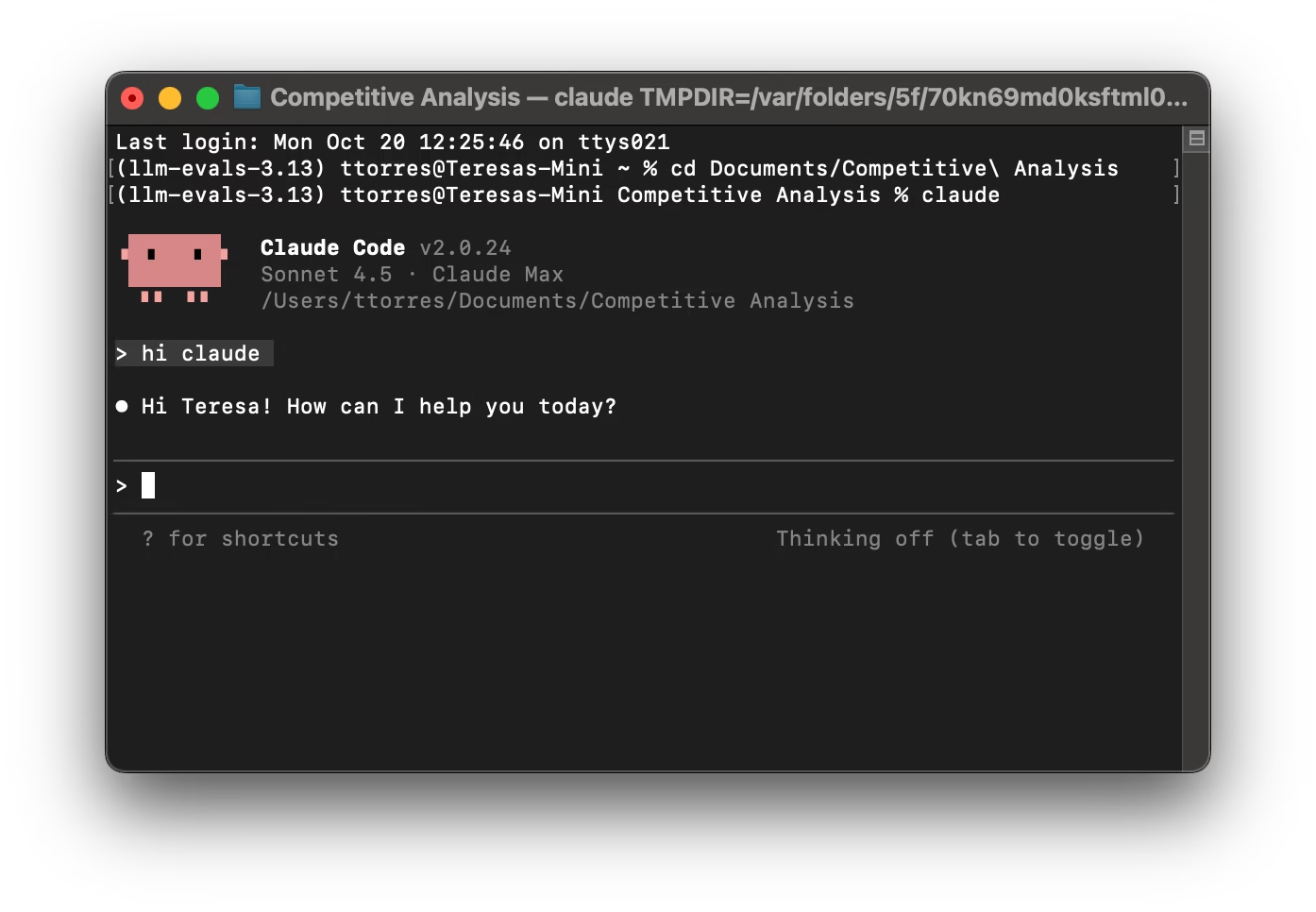
The creator of Claude Code just revealed his workflow, and developers are losing their minds | VentureBeat
Explore Claude Code 2026 – Anthropic’s agent‑orchestration platform that boosts coding speed, quality, and governance. Learn how to pilot, integrate, and future‑proof your engineering org.

Agentic AI in the Enterprise : How Autonomous Agents Are Reshaping...
Agentic AI is Shifting From Prompt Assistant to Semi‑Autonomous Business Actor – What 2025 Means for Enterprise Strategy Executive Summary Role Shift: Agents now act as business actors rather than...

Trump Issues Executive Order for Uniform AI Regulation
Assessing the Implications of a Hypothetical 2025 Trump Executive Order on Uniform AI Regulation By Alex Monroe, AI Economic Analyst – AI2Work (December 18, 2025) Executive Summary In early 2025,...