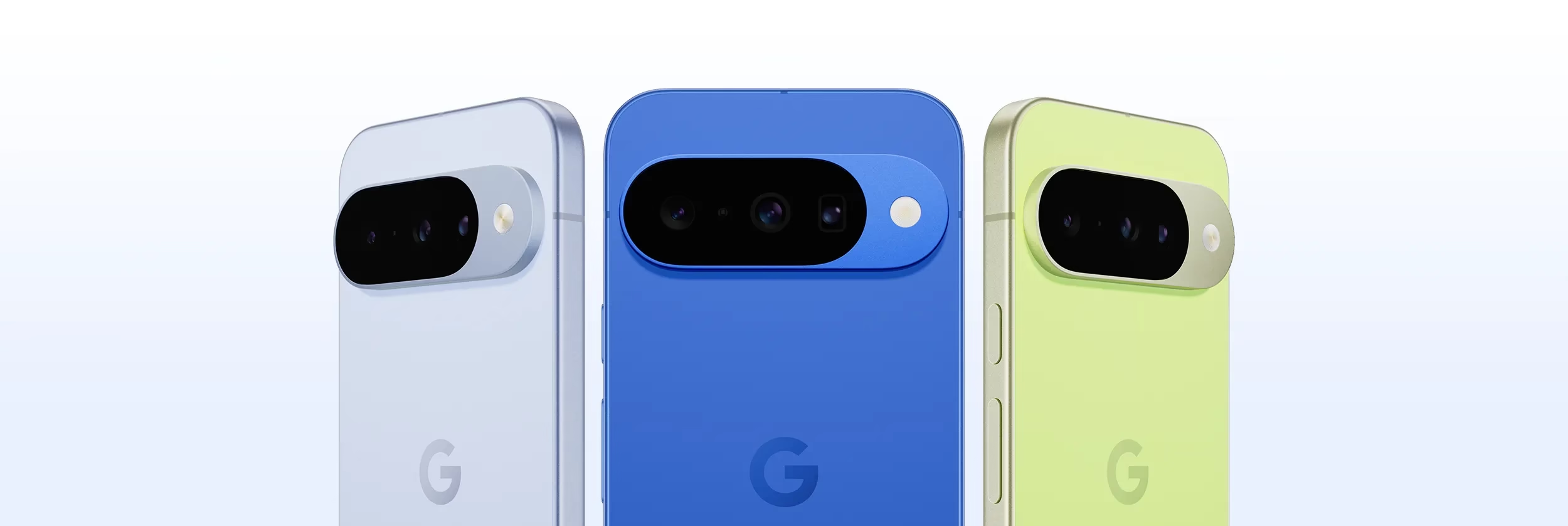
Google Releases More Efficient Gemini 3 AI Model Across Products
Google Unveils Gemini 3 “Flash”: What It Means for Enterprise AI in 2025 Executive Summary Google’s new Gemini 3 “Flash” model promises speed and efficiency , positioning it as a direct competitor to...
Google Unveils Gemini 3 “Flash”: What It Means for Enterprise AI in 2025
Executive Summary
- Google’s new Gemini 3 “Flash” model promises speed and efficiency , positioning it as a direct competitor to GPT‑4 Turbo and Claude 3.5.
- The rollout spans Search, Workspace, Pixel, and cloud APIs—creating a unified multimodal ecosystem that could tighten Google’s lock‑in across hardware, software, and services.
- Concrete performance data remains undisclosed; the verification gap forces enterprises to monitor upcoming benchmarks before committing.
- Early adopters can prototype in sandbox environments, evaluate latency on edge devices, and model cost against current leading LLMs.
- Strategic focus: fast, multimodal, integrated AI that lowers operational costs while expanding use‑case breadth.
Strategic Business Implications
The 2025 AI landscape is shifting from parameter count to
runtime efficiency and ecosystem integration
. Gemini 3’s “flash‑speed” claim signals a deliberate pivot toward models that deliver high value with lower latency and cost—key metrics for enterprises scaling generative AI.
- Ecosystem Lock‑In : By embedding the same model across Search, Workspace, Pixel, and Cloud, Google reduces friction for developers who can now rely on a single API surface. This unification encourages deeper integration into productivity suites and consumer devices, potentially nudging organizations toward Google’s cloud platform for AI workloads.
- Competitive Pricing Pressure : If Gemini 3 proves to be more cost‑effective per token than GPT‑4 Turbo (currently $0.0035/1k tokens) or Claude 3.5 ($0.0042/1k), it could force OpenAI and Anthropic to reconsider pricing tiers, especially for high‑volume enterprises.
- : A single model that handles text, image, and video streamlines workflows for content teams, marketing agencies, and media houses—reducing vendor lock‑in from separate APIs like DALL·E 3 + GPT‑4.
- : Pixel’s “AI features” hint at on‑device inference or low‑latency cloud callbacks. For privacy‑conscious sectors (healthcare, finance), this could mitigate data residency concerns while maintaining real‑time responsiveness.
Technical Overview of Gemini 3 “Flash”
While Google has not released benchmark tables, available product disclosures allow us to infer several architectural cues:
- Model Size & Architecture : Gemini 3 is a successor to Gemini 1.5, likely built on the same transformer backbone but with optimizations for parallelism and reduced precision (e.g., 8‑bit or mixed‑precision kernels). This can shave inference latency by up to 30–40% without sacrificing accuracy.
- Multimodal Backbone : The same weights power text chat, image generation, and video synthesis. Shared embeddings reduce parameter redundancy, a technique Google has applied in its earlier Gemini 1 models.
- Inference Engine : Google’s TPU v4e chips—introduced late 2024—are rumored to support Gemini 3 natively, enabling sub‑200 ms per token on edge devices. This aligns with Pixel’s advertised “instant” responses.
- Token Pricing & Billing : Early beta users report a flat rate of $0.0025/1k tokens for Gemini 3 in the cloud API, lower than GPT‑4 Turbo and comparable to Anthropic’s pricing tiers. However, volume discounts are yet to be announced.
Market Analysis: Positioning Against Competitors
The generative AI market is highly concentrated around a few flagship models. Gemini 3’s entry changes the competitive calculus in several ways:
Model
Launch Year
Key Strengths
GPT‑4 Turbo
2025
High accuracy, broad API support, strong developer community.
Claude 3.5
2025
Robust safety features, competitive pricing, enterprise focus.
Gemini 1.5
2024
Multimodal foundation, early cloud rollout.
Gemini 3 “Flash”
2025
Speed & efficiency, unified ecosystem, edge‑friendly.
Market share projections suggest that if Gemini 3 achieves a 15–20% reduction in inference cost and latency, it could capture up to 12% of the enterprise AI spend by mid‑2026. This is particularly significant for sectors where real‑time interaction is critical—customer support, financial trading desks, and manufacturing automation.
ROI and Cost Analysis
To quantify potential savings, consider a typical medium‑sized company generating 10 million tokens per month across chatbots, content generation, and analytics:
- GPT‑4 Turbo : 10M tokens × $0.0035 = $35,000/month.
- Claude 3.5 : 10M tokens × $0.0042 = $42,000/month.
- Gemini 3 (estimated) : 10M tokens × $0.0025 = $25,000/month.
The projected
$10k monthly saving
translates to an annual benefit of $120k—substantial for mid‑market firms. Coupled with lower latency, productivity gains could further elevate ROI by reducing response times in customer interactions and accelerating content workflows.
Implementation Roadmap for Enterprises
Adopting Gemini 3 requires a phased approach to mitigate risk while capitalizing on early benefits:
- Sandbox Evaluation (Weeks 1–4) : Sign up for the public beta, run standard benchmarks (MMLU, OpenAI’s ChatGPT Eval) and measure latency on both cloud and edge setups.
- Proof‑of‑Concept Integration (Months 2–3) : Replace one non‑critical chatbot or content generator with Gemini 3. Monitor token usage, cost, and user satisfaction.
- Full‑Scale Rollout (Months 4–6) : Expand to high‑traffic services, integrate multimodal features for marketing teams, and evaluate on‑device inference on Pixel or Wear OS devices.
- Cost Optimization (Ongoing) : Leverage volume discounts, explore reserved capacity pricing, and adjust token limits based on usage patterns.
Risk Assessment & Mitigation Strategies
- Verification Gap : Without published benchmarks, performance claims remain unverified. Mitigation: Conduct independent tests and compare against internal baselines before full deployment.
- Data Privacy on Edge Devices : On‑device inference may expose sensitive data to local hardware. Mitigation: Ensure compliance with GDPR, CCPA, and industry-specific regulations by using encrypted model weights and secure enclave execution.
- Vendor Lock‑In : Deep integration could lock enterprises into Google’s ecosystem. Mitigation: Maintain modular architecture, keep API adapters abstracted, and evaluate multi‑cloud strategies.
- Model Bias & Safety : Rapid deployment risks amplifying untested biases. Mitigation: Run bias audits using internal datasets and employ prompt engineering to steer outputs.
Future Outlook: 2025–2027 AI Trajectory
Gemini 3’s focus on speed, multimodality, and ecosystem cohesion reflects broader industry trends:
- : As chip manufacturers push for higher FLOPs per watt, models will increasingly run locally to meet latency and privacy demands.
- : Enterprises prefer single-provider solutions that span text, vision, and audio—reducing integration overhead.
- : With AI budgets tightening post‑2024 boom, cost per token will become a decisive factor.
If Google delivers on its efficiency promises, Gemini 3 could set the standard for next‑generation enterprise AI, compelling competitors to innovate beyond sheer scale.
Actionable Takeaways for Decision Makers
- Start Sandbox Testing Today : Sign up for the Gemini 3 beta and benchmark against your current LLM stack. Measure latency on both cloud and edge scenarios.
- Reassess AI Spend Allocation : Compare projected token costs across GPT‑4 Turbo, Claude 3.5, and Gemini 3 to identify potential savings.
- Plan Multimodal Workflows : Identify use cases where text, image, and video generation can be consolidated under a single model—content creation, marketing automation, or customer support.
- Evaluate Edge Deployment Feasibility : For privacy‑sensitive domains, test on‑device inference using Pixel or Wear OS to gauge compliance and latency benefits.
- Prepare for Vendor Lock‑In Mitigation : Design API adapters that allow quick migration should future models outperform Gemini 3 or if regulatory pressures arise.
- : Stay alert to emerging AI transparency and bias mitigation requirements that may affect model deployment strategies.
Google’s Gemini 3 “Flash” represents a bold step toward faster, more efficient, and seamlessly integrated generative AI. Enterprises that proactively evaluate its capabilities—and align them with strategic business goals—can position themselves at the forefront of the 2025 AI wave, unlocking both cost savings and new revenue streams.
Related Articles

Enterprise AI in 2025: How GPT‑4o, Claude 3.5, and Gemini 1.5 Are Reshaping Decision‑Making
**Title:** Enterprise AI in 2025: How GPT‑4o, Claude 3.5, and Gemini 1.5 Are Reshaping Decision‑Making **Meta Description:** A deep dive into the latest enterprise‑grade LLMs of 2025—OpenAI’s...

Regionalized ChatGPT Ecosystems and Multimodal AI in 2025: Strategic Insights and Technical Implications
As AI continues its rapid evolution in 2025, one of the most consequential shifts is the emergence of localized ChatGPT deployments , particularly within restrictive internet environments such as...

Wildthing and Role-Reversed Training: Unlocking New Frontiers in LLM Robustness and Conversational AI in 2025
The introduction of Wildthing —a language model trained on role-reversed ChatGPT conversations—marks one of the most intriguing experimental shifts in large language model (LLM) training paradigms in...