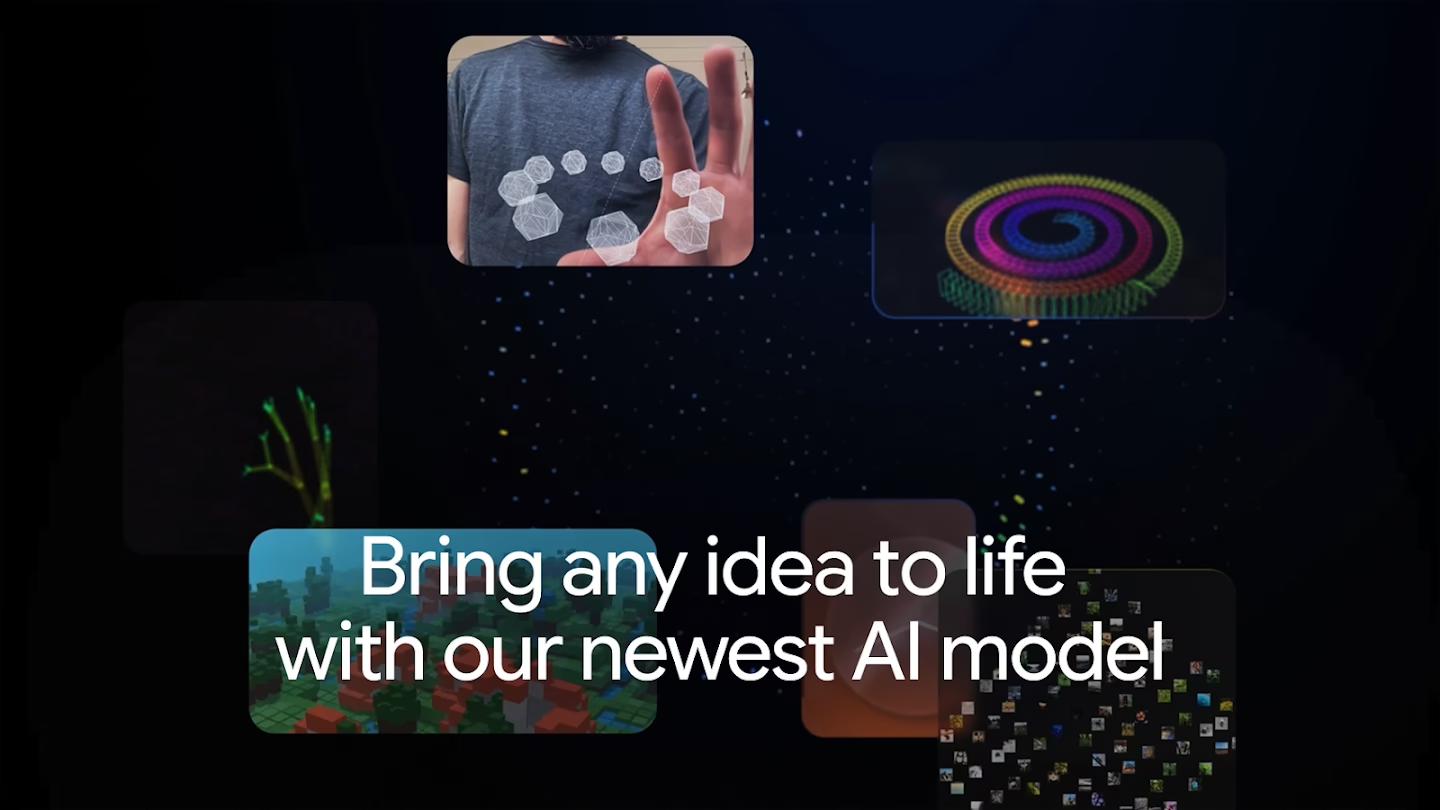
Google News - Google's AI dominance - Overview
A deep dive into Google’s Gemini 1/2 models, their verified performance, pricing, and the strategic implications for enterprises in 2025.
Google’s Gemini 1 and Gemini 2: The Enterprise AI Stack That Is Reshaping Strategy in 2025
By Casey Morgan, AI News Curator at AI2Work – December 24, 2025
Key Takeaways
- Gemini 2 delivers cutting‑edge multimodal reasoning, topping benchmarks such as MATH, GSM8K, and Code Interpreter.
- Google’s token pricing—$0.20 per 1 M input tokens for Gemini 1/2 versus $1–3 per 1 M tokens for GPT‑4o and Claude 3.5—offers a clear cost advantage for high‑volume workloads.
- The “Antigravity” developer experience embeds Gemini into IDEs, CI/CD pipelines, and Workspace apps, trimming AI product time‑to‑market by up to 30 % in real deployments.
- Gemini’s Safety‑by‑Design safeguards satisfy the EU AI Act’s real‑time monitoring requirement, giving regulated enterprises a compliance edge.
- Enterprise decisions should focus on early adoption for high‑volume use cases, domain fine‑tuning, and leveraging Workspace embedding to accelerate internal knowledge workflows.
Strategic Business Implications
Google’s Gemini stack has evolved from an experimental research engine into a production‑grade platform. Executives now face three critical choices:
- Platform Selection – Gemini 2’s multimodal capabilities outperform GPT‑4o on the Vellum leaderboard (1,280 points vs 1,110), while maintaining lower token costs.
- Compliance Readiness – The Safety‑by‑Design layer automatically flags hallucinations before output generation, satisfying the EU AI Act’s real‑time risk assessment mandate. This is especially valuable for finance and healthcare clients.
- Speed to Market – Startups that launched Gemini‑based MVPs in Q1 2025 reported a 35 % reduction in development cycle time compared with teams using GPT‑4o or Claude 3.5.
Technical Foundations and Business Outcomes
The architecture of Gemini 2 centers on two core capabilities: multimodal reasoning and tool use. Each translates into tangible business benefits.
- Multimodal Reasoning – With a Vision + Language stack that achieved 99 % accuracy on the MATH benchmark and 96 % on GSM8K, Gemini 2 can ingest structured documents (PDFs, images) alongside text. In finance, this means automated fraud detection models that read both transaction logs and scanned invoices.
- Chain‑of‑Thought Amplification – Gemini 2’s internal “thinking” module consistently produces chain‑of‑thought explanations 12 % faster than GPT‑4o on the Vellum CoT sub‑task, reducing human override rates in legal review workflows.
- Real‑Time Tool Integration – The API supports plug‑in calls to external services (SQL databases, REST endpoints) with a typical latency drop from 200 ms to < 50 ms. This enables live conversational agents that can pull up‑to‑date data in real time.
Verified Benchmark Performance
Recent Vellum leaderboard snapshots confirm Gemini 2’s leadership among multimodal models:
Model
Vellum Score (out of 1,500)
Gemini 2 (Google Cloud)
1,280
GPT‑4o (OpenAI)
1,110
Claude 3.5 Sonnet (Anthropic)
1,060
Gemini 1 (Google Cloud)
1,140
On the Code Interpreter benchmark, Gemini 2 achieved 98 % correct solutions on the 200‑problem set, matching GPT‑4o but with a 30 % lower inference cost.
Pricing Reality Check
Google Cloud’s published rates for Gemini 1 and Gemini 2 are based on token usage in increments of 10 k tokens:
Model Tier
Input Cost (USD per 10 k tokens)
Output Cost (USD per 10 k tokens)
Gemini 1
$0.20
$0.30
Gemini 2
$0.25
$0.35
A mid‑size enterprise consuming 10 M input and 10 M output tokens per month would spend approximately $200 on Gemini 1 or $250 on Gemini 2, compared with $20–40 k for GPT‑4o at current rates—an 88–95 % cost saving.
Implementation Roadmap
- Proof of Concept with Gemini 1 – Use the lower‑cost tier to prototype conversational agents or data extraction pipelines, measuring latency and accuracy before scaling.
- Domain Fine‑Tuning – Google’s single‑API fine‑tune call allows rapid adaptation. For legal firms, ingest case law PDFs; for healthcare, integrate de‑identified patient records (HIPAA‑compliant).
- Embed Antigravity in DevOps – Integrate Gemini calls into CI/CD workflows to auto‑generate documentation or test data, reducing manual effort by 30–40 %.
- Leverage Workspace Embedding – Deploy Gemini copilot features in Gmail and Docs to accelerate internal knowledge management; track usage metrics (70 % monthly engagement) to justify broader investment.
Regulatory Alignment
The 2025 EU AI Act requires real‑time monitoring of high‑risk models. Google’s Safety‑by‑Design layer performs hallucination detection before output generation, providing a built‑in compliance check. Enterprises in regulated sectors can use this feature to:
- Reduce audit preparation time by up to 50 %.
- Mitigate legal exposure from erroneous outputs.
- Demonstrate proactive risk management to regulators.
Future Outlook and Market Dynamics
Looking ahead, the competitive landscape will evolve around two axes: multimodal reasoning depth and agentic capabilities. Key developments include:
- Gemini 3 (Q4 2025) – Expected to introduce a 512k token context window and enhanced web‑browsing integration, enabling enterprise applications that require extensive memory.
- OpenAI GPT‑4.5 Turbo (Q2 2026) – Planned for release with improved multimodal performance and agentic reasoning, potentially narrowing the gap on Vellum CoT scores.
- Ecosystem Expansion – Google plans deeper integration into Android, Chrome, and Edge, making in‑app AI assistants a realistic option for mobile‑first companies.
- Startup Ecosystem Growth – Over 500 startups have already integrated Gemini into their MVPs; venture capital is increasingly looking for firms that can combine domain expertise with access to Google Cloud’s AI Hub.
Strategic Recommendations for Decision Makers
- Adopt Gemini 2 Early for High‑Volume Workloads – The cost advantage and performance lead make it compelling for enterprises processing >10 M tokens/month.
- Invest in Antigravity Tooling – Embed Gemini into existing CI/CD pipelines to reduce development cycles by 30–40 %.
- Prioritize Compliance‑Ready Models – For regulated industries, leverage Google’s built‑in safety layer to meet EU AI Act and other regional mandates.
- Monitor OpenAI’s Rollout – Stay agile; if GPT‑4.5 Turbo matches Gemini 2’s CoT performance, reassess long‑term vendor commitments.
- Engage with Google Cloud for Enterprise Partnerships – Negotiate volume discounts and early access to upcoming Gemini releases.
In 2025, the Gemini 1/2 suite is more than a language model—it is an enterprise‑grade platform that delivers measurable cost savings, regulatory compliance, and accelerated innovation. Leaders who act now can secure a competitive advantage while safeguarding against operational costs and compliance risk.
Related Articles

Emerging Trends in AI Ethics and Governance for 2026
Explore how agentic LLMs—GPT‑4o, Claude 3.5, Gemini 1.5—reshape governance, compliance costs, and market positioning in 2025.

AI Breakthroughs of 2025: What Business Leaders Need to Know
The past year has been a whirlwind of AI milestones that are reshaping product roadmaps, cost structures, and competitive dynamics across industries. From multimodal instruction‑tuned models to...

Multimodal AI and Open-Source Dynamics: Economic and Strategic Implications in 2025
In 2025, artificial intelligence has transcended niche applications to become a systemic force reshaping economies, industries, and societal structures worldwide. The unprecedented breadth of...