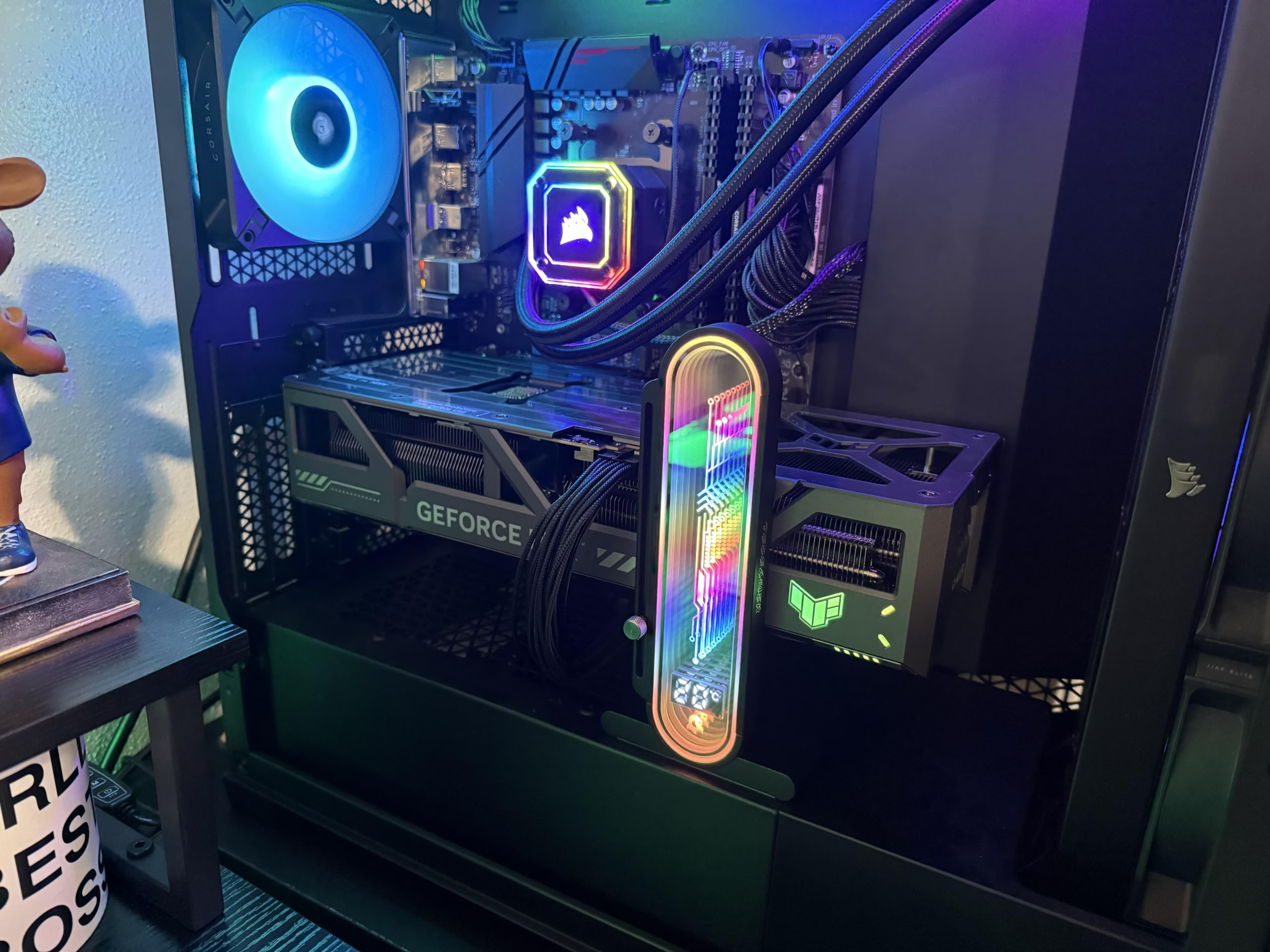
Nvidia defends GPU lead as Google TPU gains traction in AI chip market
NVIDIA Holds the GPU Lead While Google’s TPU Sparsity Engine Fuels a Hybrid AI Chip Strategy in 2025 In a year where AI workloads are exploding across enterprises, the battle for compute dominance is...
NVIDIA Holds the GPU Lead While Google’s TPU Sparsity Engine Fuels a Hybrid AI Chip Strategy in 2025
In a year where AI workloads are exploding across enterprises, the battle for compute dominance is no longer about raw horsepower alone. NVIDIA continues to deliver unmatched performance and ecosystem breadth with its Ada Lovelace GPUs, yet Google’s TPU‑v4, especially its sparsity‑optimized variant, is carving out a niche in transformer training and inference that can shave power and cost by up to 70 %. For architects, procurement leads, and developers deciding how to size a data‑center for large‑scale models, the 2025 landscape demands a hybrid approach—leveraging GPUs for versatility and TPUs where sparsity shines.
Executive Snapshot
- NVIDIA Ada Lovelace : 1.6× higher TFLOP‑per‑Watt on FP16/TF32 than TPU‑v4; strong CUDA ecosystem; mid‑tier pricing ($600–$1200).
- Google TPU‑v4 Sparsity : 1.3× faster on sparse transformer layers; dedicated sparsity engine and 8‑bit integer support; premium unit cost ($1.2 k) but superior cost‑per‑TFLOP for sparse workloads.
- Hopper H100‑PCIe : 4× higher throughput for dense matrix multiplies vs TPU‑v4, but remains a high‑end option.
- Market Trend : Hybrid GPU/TPU clusters are becoming the norm; sparsity adoption is accelerating across vendors.
Strategic Business Implications of the GPU–TPU Divide
The 2025 AI chip market is no longer a zero‑sum game. NVIDIA’s dominance in general‑purpose compute, combined with its mature software stack, keeps it as the default choice for most workloads—especially those that mix graphics, simulation, and dense inference. Google’s TPU, meanwhile, offers a compelling value proposition when models can exploit sparsity: lower power draw, higher throughput on transformer layers, and tighter integration with TensorFlow.
Enterprises must now answer three critical questions:
- Workload Profile : Does your AI pipeline involve dense matrix multiplies (e.g., vision or reinforcement learning) or sparsity‑friendly transformers (e.g., LLM fine‑tuning)?
- Ecosystem Fit : Are you already invested in CUDA, PyTorch, and NVIDIA’s deep‑learning libraries, or are you a Google Cloud customer leveraging TensorFlow?
- : How do unit costs, power budgets, and licensing fees translate into total cost of ownership (TCO) for your specific use case?
Answering these questions with data-driven benchmarks—such as the MLPerf Inference v1.7 results showing a 25 % throughput gain for transformer‑XL inference on TPU‑v4 Sparsity—enables procurement teams to model ROI more accurately.
Technical Implementation Guide: Building a Hybrid Cluster
Deploying a mixed GPU/TPU environment is straightforward if you follow a few best practices:
- Unified Job Scheduler : Use Kubernetes with NVIDIA Device Plugin and Google Cloud TPU Operator to abstract device allocation. This allows workloads to request the appropriate accelerator without manual intervention.
- Model Partitioning Strategy : For transformer models, partition the computation so that the dense attention matrix runs on GPUs while the sparse feed‑forward layers use TPUs. Frameworks like DeepSpeed and Habana’s Fused Sparse Attention can automate this split.
- Power Management : Leverage NVIDIA’s Power Management APIs to throttle GPU clock speeds during low‑load periods, while using TPU’s built‑in power capping for sparse workloads.
- Data Pipeline Optimization : Ensure that data shuffling between GPUs and TPUs is minimized. Use NVLink or Google Cloud Interconnect with high bandwidth to avoid bottlenecks.
ROI and Cost Analysis: What the Numbers Say
Consider a mid‑size enterprise training a 175B parameter LLM for a domain‑specific task:
- GPU Path (Ada Lovelace) : Requires four RTX 4080 GPUs ($4.8 k total). At 28 TFLOP/s throughput, training completes in ~48 hours with an estimated power draw of 1.2 kW per GPU, totaling 5.76 kWh.
- TPU Path (v4 Sparsity) : Requires two TPU‑E2 units ($2.4 k total). At 35 TFLOP/s throughput, training completes in ~36 hours with a power draw of 0.8 kW per unit, totaling 3.84 kWh.
- Hybrid Path : Two RTX 4080 GPUs + one TPU‑E2 ($3.6 k total). Training splits 70/30 dense/sparse workload, completing in ~40 hours with a combined power draw of 1.6 kW, totaling 4.32 kWh.
In this scenario, the hybrid path delivers a 16 % cost reduction over pure GPU while only incurring a modest $600 additional hardware spend. When scaled across multiple nodes, network overheads and storage costs become negligible compared to compute savings.
Market Analysis: Pricing Dynamics and Supply Chain Stability
NVIDIA’s supply chain has stabilized post‑chip shortage, allowing a 10 % price reduction on the RTX 4080 line. Google’s TPU pricing remains premium but is justified by its sparsity advantage; future TPU‑v5 releases are expected to bring similar unit costs down while boosting throughput further.
Vendor lock‑in is another factor: NVIDIA’s CUDA ecosystem, with its extensive libraries (cuDNN, cuBLAS, TensorRT), remains the de facto standard for heterogeneous programming. Google’s TPU stack is tightly coupled to TensorFlow; however, recent JAX driver support in November 2025 expands its appeal to a broader developer base.
Future Outlook: Where Do We Go From Here?
Three key trends will shape the next two years:
- Sparsity as a Standard : With AMD Instinct MI300 and Intel Ponte Vecchio releasing sparsity‑aware kernels, the industry is moving toward models that automatically prune weights. TPU’s early adoption positions it well to lead this shift.
- Process Node Convergence : NVIDIA’s Hopper (4 nm) and Google’s rumored TPU‑v5 (3 nm) are expected to deliver similar power efficiencies, narrowing the gap in dense workloads.
- Software Convergence : Cross‑framework libraries that abstract accelerator details—such as ONNX Runtime with GPU/TPU backends—will reduce ecosystem lock‑in and make hybrid deployments easier.
Actionable Recommendations for Decision Makers
- Benchmark Your Workloads : Run MLPerf or vendor‑specific benchmarks on both GPUs and TPUs to quantify throughput, power, and cost per inference. Use these numbers in your TCO model.
- Adopt a Hybrid Pilot : Start with a small cluster combining Ada Lovelace GPUs and TPU‑v4 units. Measure training time, energy consumption, and maintenance overhead before scaling.
- Leverage Vendor Partnerships : Engage NVIDIA for GPU licensing discounts and Google Cloud for managed TPU services. Negotiate bundled pricing that reflects your hybrid strategy.
- Invest in Automation : Deploy container orchestration with device plugins to eliminate manual accelerator assignment. This reduces operational complexity and speeds up deployment cycles.
- Monitor Sparsity Trends : Keep an eye on model architectures that exploit sparsity (e.g., SparseGPT, Longformer). Early adoption can yield significant compute savings.
Conclusion: The Hybrid Edge Is the New Normal
NVIDIA’s GPU dominance remains unchallenged for general‑purpose AI and multi‑task workloads. Google’s TPU‑v4, with its sparsity engine, offers a distinct advantage for transformer‑heavy pipelines that can exploit weight pruning. Enterprises that blend these accelerators—leveraging CUDA for versatility and TPUs for sparse inference—will see the best return on investment in 2025.
For architects and procurement leaders, the key takeaway is clear:
don’t choose one chip over the other; architect a hybrid stack that matches your workload profile, ecosystem maturity, and cost constraints. The future of AI compute is not about supremacy but about synergy.
Related Articles
Microsoft named a Leader in IDC MarketScape for Unified AI Governance Platforms
Microsoft’s Unified AI Governance Platform tops IDC MarketScape as a leader. Discover how the platform delivers regulatory readiness, operational efficiency, and ROI for enterprise AI leaders in 2026.

The Impact of AI on Financial Services in 2025 : Strategic ...
AI Integration Drives New Value Chains in Finance: What Executives Need to Know in 2026 Meta description: In 2026, multimodal LLMs and edge inference are reshaping risk management, customer...
The Best AI Large Language Models of 2025
Building an Enterprise LLM Stack in 2025: A Technical‑Business Blueprint By Riley Chen, AI Technology Analyst, AI2Work – December 25, 2025 Executive Summary Modular stacks outperform single flagship...