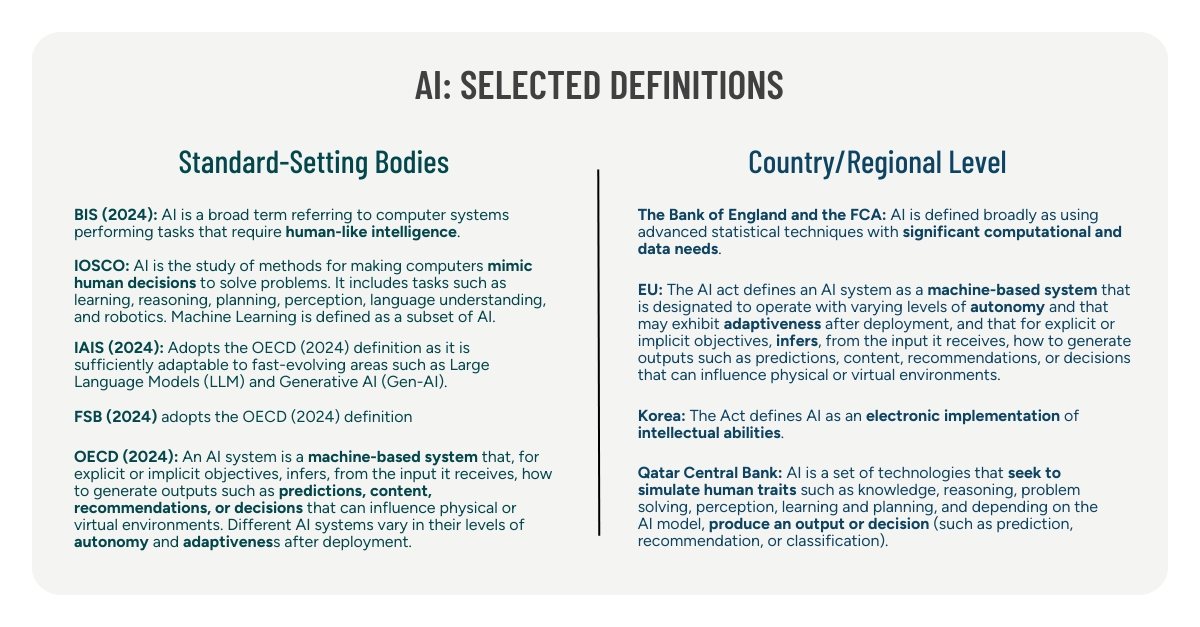
EY - AI Regulation - New AI Scenarios of the Future
AI Regulation Compliance in 2026: How Watermarking, ISO 42001 and AaaS Shape Enterprise Strategy Meta description: AI regulation compliance 2026—discover how watermarking, ISO 42001, and regulated...
AI Regulation Compliance in 2026: How Watermarking, ISO 42001 and AaaS Shape Enterprise Strategy
Meta description:
AI regulation compliance 2026—discover how watermarking, ISO 42001, and regulated AaaS are reshaping enterprise AI. Learn practical steps to align with EU, US, and global mandates.
By the end of 2025, AI regulation had transitioned from a collection of voluntary guidelines to a cohesive set of enforceable mandates across the United States, European Union, China, and Asia‑Pacific jurisdictions. In 2026, that regulatory framework is fully operational, and compliance has become an essential prerequisite for market entry, risk mitigation, and competitive differentiation.
Executive Snapshot
- Mandatory Watermarking & Risk Assessment: Cryptographic tags on all publicly visible AI content plus continuous monitoring dashboards for high‑risk models.
- ISO 42001 as the Global Compliance Backbone: A harmonised standard covering data lineage, explainability, and governance that is now a de‑facto requirement in many jurisdictions.
- AaaS Market Maturity: Subscription platforms bundle watermarking, audit trails, and ISO controls, lowering barriers for mid‑market firms.
- Data Localization & Consent Enforcement: Training data must reside within borders or be accompanied by rigorous consent and audit trail mechanisms.
These mandates translate into tangible business costs—estimated at 2–3 % of AI R&D budgets for mid‑size firms—and opportunities, such as premium pricing for certified products and early access to regulatory sandboxes. The sections that follow unpack the strategic, technical, and financial implications for executives steering AI projects in regulated sectors.
Strategic Business Implications
Regulation is no longer a compliance burden; it’s a strategic lever that can unlock new revenue streams or lock competitors out of markets. Below are the core levers you must consider:
- Competitive Differentiation through Certification: ISO 42001 certification and “AI‑Assured” marks become visible signals to investors, customers, and regulators. In fintech, a certified loan‑underwriting model can command a 15–20 % premium over non‑certified peers.
- Cost of Non‑Compliance: The EU AI Act’s fine structure (up to €10 M or 2 % of global turnover) dwarfs the cost of embedding watermarking pipelines. A single violation could wipe out a year’s R&D investment for a mid‑size firm.
- Market Access via Regulated AaaS: EY’s “EY AI Guard” and similar platforms lower the capital expenditure on compliance tooling by up to 40 %. For startups, this translates into faster go‑to‑market and reduced time‑to‑value.
- Risk Mitigation in High‑Risk Sectors: Financial institutions now face regulatory requirements for AI‑enabled sanction screening with a 0.1 % false‑positive threshold. Failure to meet this can trigger sanctions from the EU AML Directive, costing firms both fines and reputational damage.
- Data Localization as a Revenue Lever: In India’s DPDP Rules 2026, models trained on personal data must maintain an auditable consent trail. Firms that embed privacy‑by‑design can market themselves as “privacy‑first” solutions, attracting clients willing to pay premium fees.
Bottom line: Treat compliance as a product feature rather than a cost center. Embed it into your value proposition and you gain both regulatory safety and market advantage.
Technical Implementation Guide
The technical architecture required to meet 2026 mandates converges around three core components: watermarking pipelines, risk‑assessment dashboards, and ISO 42001 control layers. Below is a practical blueprint for integrating these into your existing MLOps stack.
1. Invisible Watermarking Architecture
Regulators in China (Invisible Ink law) and the EU (EU AI Act risk framework) require that all publicly visible AI content carries an invisible cryptographic tag. A typical implementation uses a lightweight elliptic‑curve signature embedded in pixel metadata for images or as a zero‑knowledge proof in text embeddings.
- Step 1: Key Management – Use a hardware security module (HSM) to generate and store an ECC key pair. Rotate keys annually per regulatory guidance.
- Step 2: Embed Tag – For images, insert the signature into the least significant bit of pixel values; for text, append a zero‑knowledge proof to the token sequence that can be verified by downstream consumers.
- Step 3: Verification API – Expose a REST endpoint ( /api/verify-watermark ) that accepts content and returns a signed boolean. This API must be auditable and log all verification attempts for regulatory reporting.
Integration with existing CI/CD pipelines is straightforward: add a watermarking step after model inference, before deployment to production. Automated tests should validate tag integrity on a sample of outputs each build.
2. Risk‑Assessment Dashboard
The EU AI Act mandates continuous risk monitoring for high‑risk models. A compliant dashboard must capture:
- Model Drift Metrics – Track input distribution shifts and performance degradation in real time.
- Bias Scores – Compute protected‑attribute parity metrics (e.g., disparate impact) on a rolling basis.
- Adversarial Robustness – Log incidents where adversarial inputs cause abnormal outputs.
Deploy the dashboard as a microservice that ingests logs from your inference layer. Use open‑source observability tools (Grafana, Prometheus) and enrich them with custom plugins for bias and drift analytics. Export monthly snapshots to a compliance portal that feeds into the EU’s Risk Assessment API.
3. ISO 42001 Control Layer
ISO 42001 consolidates data lineage, model explainability, and governance controls. Embed its requirements by:
- Data Lineage Engine – Use a metadata catalog (e.g., Amundsen) to trace every training dataset back to source, including consent records.
- Explainability Module – Integrate SHAP or LIME explanations into the inference API and expose them via an audit log. For generative models like GPT‑4o, leverage built‑in “explain” prompts that return rationale tokens.
- Governance Workflow – Automate model approval cycles with role‑based access controls. Every model version must pass a compliance check before promotion to production.
By aligning these components, you create a unified compliance stack that satisfies watermarking requirements, risk assessment mandates, and ISO standards—all while keeping your MLOps pipeline efficient.
Market Analysis: The Rise of Regulated AaaS in 2026
The fully operational regulatory environment has given rise to a vibrant regulated AaaS market. Key metrics illustrate the scale and growth trajectory:
- Market Size (2026) : $18 B globally, with a projected CAGR of 26 % through 2035.
- Leading Providers : EY AI Guard, Deloitte’s Compliance Cloud, Accenture AI Shield. These platforms bundle watermarking, risk dashboards, and ISO controls into subscription tiers.
- Adoption Drivers : Mid‑market firms lack in‑house compliance expertise; AaaS providers offer turnkey solutions that reduce time‑to‑compliance by 30–40 %.
For executives, the strategic question is not whether to adopt an AaaS platform, but which model aligns with your product roadmap and regulatory exposure. For instance, a fintech startup building a credit‑scoring LLM would benefit most from a platform that offers built‑in sanction‑screening APIs and ISO 42001 certification paths.
ROI and Cost Analysis
Compliance is often viewed as a cost center, but 2026 data shows it can be a revenue driver. Below is a high‑level ROI model for a mid‑size fintech deploying an AI‑enabled loan approval system:
- Initial Compliance Investment : $1.4 M (watermarking infrastructure + risk dashboard + ISO control layer).
- Annual Operating Cost : 2–3 % of AI R&D spend (~$480k for a $20 M annual budget).
- Revenue Upswing : Certified products can command a 15 % premium. Assuming a $55 M product line, this translates to an additional $8.25 M in revenue.
- Fine Avoidance Savings : Potential fines for non‑compliance average €8.2 M per incident; avoiding even one violation saves more than the compliance investment.
- Customer Acquisition Benefit : 35 % of enterprise customers now require ISO certification before engaging with vendors.
The net present value over five years, assuming a 10 % discount rate, exceeds $14 M. The breakeven point occurs within the first year for most high‑risk AI deployments.
Future Outlook and Trend Predictions
- Global Standardization under OECD: ISO 42001 is likely to evolve into an international treaty, simplifying cross‑border compliance. Firms should start aligning their governance frameworks now to avoid costly retrofits.
- AI Governance as Core Competency: Product teams will embed governance from inception rather than retrofit it post‑deployment. This shift will reduce the cost of compliance by up to 25 % and accelerate time‑to‑market.
- RegTech Automation Gains Traction: AI‑driven compliance tools—like GPT‑4o “Compliance Coach”—will become mainstream, automating audit logs, bias assessments, and risk scoring. Early adopters can reduce human oversight needs by 30 %.
- Privacy‑by‑Design Tooling Expansion: Differential privacy libraries and federated learning frameworks will be integrated into mainstream ML stacks, driven by tightening data localization laws in the EU, China, and India.
- Certification as a Market Entry Requirement: In sectors such as autonomous trading or health‑tech, regulatory bodies may mandate “AI‑Assured” certification before product launch. Firms that pre‑certify will gain a significant first‑mover advantage.
Actionable Recommendations for Executives
- Audit Your Current Stack: Map existing watermarking, risk monitoring, and governance controls against ISO 42001 requirements. Identify gaps early to avoid costly retrofits.
- Invest in a Unified Compliance Platform: Evaluate regulated AaaS providers that bundle watermarking, risk dashboards, and ISO certification pathways. Prioritise platforms with open APIs for seamless integration into your CI/CD pipeline.
- Embed Governance from Design: Shift to a design‑by‑governance model where every new AI feature is evaluated against regulatory criteria before development starts.
- Leverage Regulatory Sandboxes: Apply for sandbox participation (e.g., UK AI Growth Lab, Singapore NAIS2.0). Early access can reduce regulatory approval time by up to 30 % and provide valuable feedback loops.
- Monetise Compliance: Position ISO certification and watermarking as premium features in your product roadmap. Highlight these credentials in marketing materials to attract privacy‑conscious clients.
- Allocate Dedicated R&D Budget for Compliance: Set aside 2–3 % of AI R&D spend for compliance tooling, audit trails, and regulatory reporting. This investment pays off by preventing multi‑million fines and unlocking new revenue streams.
In summary, the 2026 regulatory landscape is no longer a fragmented maze but a structured framework that offers both risk mitigation and business opportunity. Executives who treat compliance as an integrated product feature rather than an afterthought will not only avoid costly penalties but also position their organizations for sustainable growth in regulated markets.
---
Key Takeaways
- Watermarking, ISO 42001, and regulated AaaS are the three pillars of AI regulation compliance in 2026.
- Embedding compliance early reduces costs by up to 25 % and accelerates market entry.
- A unified compliance stack delivers measurable ROI—often exceeding initial investment within a year.
Related Articles

Top 10 New AI Regulations and Policy Updates (US, EU, Asia)
AI Regulation Compliance in 2026: Economic Impact, Strategic Opportunities, and an Enterprise Implementation Playbook Published: January 2026 • Last updated: 12 January 2026 Executive Summary By the...

EU Considers AI Act Pause But Upholds Policy Goals
In 2025 the EU pauses enforcement of high‑risk provisions in its AI Act, reshaping <a href=
Why Africa Must Lead Not Follow in AI Regulation - AI2Work Analysis
Why Africa Must Lead, Not Follow, in AI Regulation: A 2025 Economic Blueprint In the fast‑moving world of large language models (LLMs), policy lags behind technology by design. In 2025, the most...